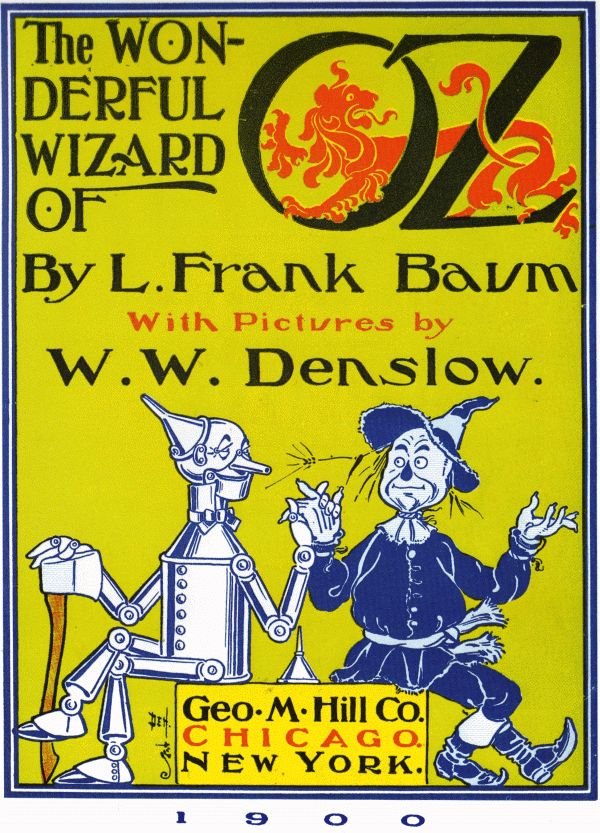
- Novel
The Wonderful Wizard of Oz
- Published: 1900
- Atlas edition: V1.3 ·
- Language: English
ABOUT THE AUTHOR
L. Frank Baum
1856–1919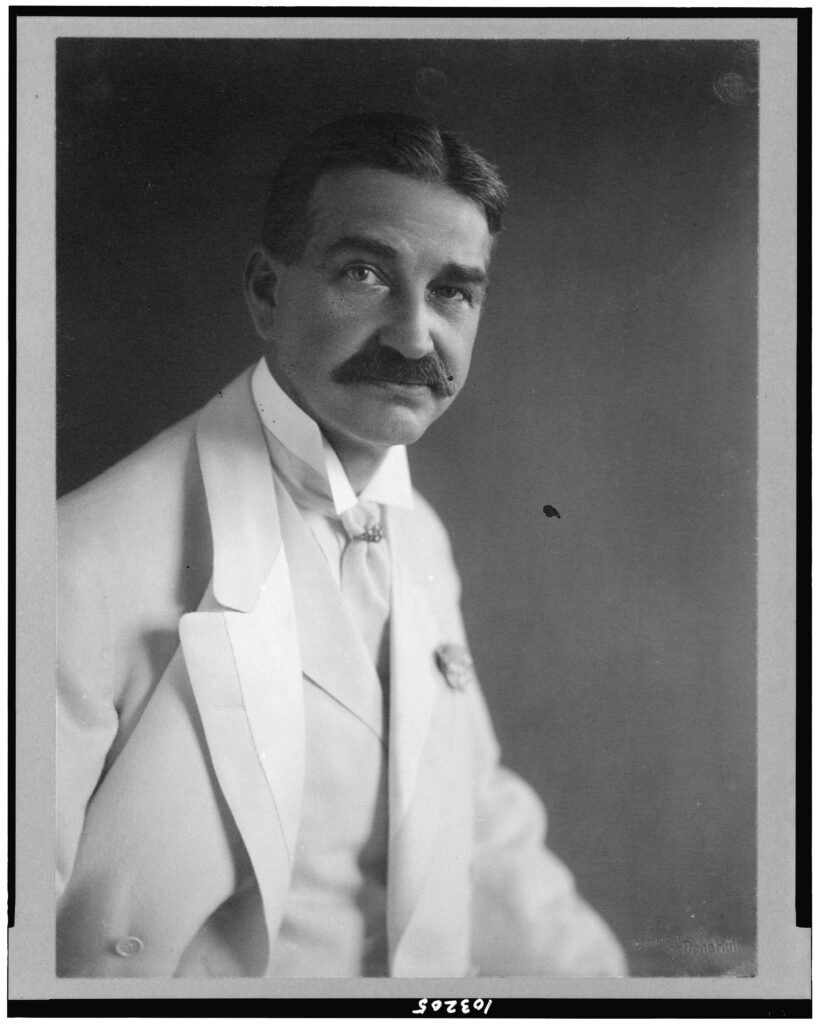
L. Frank Baum was an American author best known for creating the land of Oz. Before finding lasting success in children’s literature, he worked in theatre, journalism, retail and publishing, experiences that helped shape his interest in performance, popular entertainment and the possibilities of a distinctly American fairy tale.
The Wonderful Wizard of Oz appeared in 1900 with illustrations and colour design by W. W. Denslow. Baum returned to Oz across a long sequence of books, expanding its geography and characters while responding to generations of young readers. His work helped move children’s fantasy away from inherited European settings toward modern machinery, prairie landscapes and self-invented heroes. Baum’s legacy is also complicated by racist newspaper editorials attributed to him in the 1890s; those writings should be acknowledged rather than hidden when his life and cultural influence are discussed.
ABOUT THE WORK
The Wonderful Wizard of Oz
The Wonderful Wizard of Oz follows Dorothy, a girl from the Kansas prairie, after a cyclone carries her house, and her little dog Toto, into the strange and colourful land of Oz. Hoping that the great Wizard can send her home, she sets out along the road of yellow brick wearing the silver shoes of the Wicked Witch of the East.
On the way she is joined by the Scarecrow, who longs for brains; the Tin Woodman, who wants a heart; and the Cowardly Lion, who seeks courage. Their journey brings danger, companionship and a series of tests that reveal how often the qualities they desire are already present in their actions. L. Frank Baum’s story, first published in 1900 with W. W. Denslow’s illustrations, is a modern fairy tale shaped by friendship, resourcefulness and the wish to find one’s way home.
Before they reach the Emerald City they escape the Kalidahs and a deadly field of poppies. The Wizard then agrees to help only if they defeat the Wicked Witch of the West, who sends wolves, crows, bees and finally the Winged Monkeys against them in the Winkie country. Victory reveals the truth about the Wizard, and a last journey south to Glinda, the Good Witch, shows Dorothy how to use the silver shoes to return home.
WHY IT MATTERS
Why The Wonderful Wizard of Oz Matters
The Wonderful Wizard of Oz matters because it helped establish a form of children’s fantasy that felt recognisably American. Instead of beginning with castles, hereditary rulers and distant medieval landscapes, Baum opens on the Kansas prairie and carries ordinary characters into a world filled with machinery, spectacle, roads, cities and improvised solutions.
Oz is fantastical, but its travellers advance through cooperation and practical action rather than noble birth. In his introduction, Baum described the book as a “modernized fairy tale” that kept wonder and joy while leaving out the heartaches and nightmares of older tales. That intention shapes the tone of The Wonderful Wizard of Oz from its first chapter.
The Travellers of The Wonderful Wizard of Oz
The companions give the novel its clearest emotional structure. The Scarecrow, Tin Woodman and Cowardly Lion each believe that a missing quality prevents them from becoming complete. Yet the journey repeatedly shows the Scarecrow thinking, the Tin Woodman caring and the Lion acting bravely while afraid. Their supposed deficiencies are sustained less by evidence than by the stories they tell about themselves.
Dorothy’s own wish works in a similar way. The power that can return her home is close at hand, but she needs knowledge, experience and help before she can use it. That pattern keeps The Wonderful Wizard of Oz useful without reducing it to a slogan: it can introduce young readers to questions about confidence, authority and self-knowledge.
The Wonderful Wizard of Oz is also a carefully built book to read aloud. Its twenty-four short chapters each carry a complete episode, its sentences are plain and rhythmic, and its humour often comes from the characters’ own logic. These qualities help explain why the story moves easily between generations, and why many readers first meet The Wonderful Wizard of Oz in the voice of a parent, teacher or librarian.
Older readers may notice how readily the travellers accept the Wizard’s reputation. The great ruler at the centre of the Emerald City proves to be a gifted showman whose authority depends on distance, machinery, green spectacles and carefully managed appearances. His exposure does not make him entirely malicious or useless, but it does make the difference between performance and power impossible to ignore.
The original collaboration also matters. W. W. Denslow’s illustrations and colour design were not incidental decoration; they helped define the characters and the visual rhythm of the book. Preserving that contribution makes this edition of The Wonderful Wizard of Oz a record of a joint cultural object rather than text detached from its first artistic form.
The first edition of The Wonderful Wizard of Oz, published by the George M. Hill Company in 1900, was an unusually lavish children’s book. Denslow’s colour plates and the many smaller pictures set around the text change their colours as Dorothy travels, from the blue of the Munchkin country to the green of the Emerald City, so the design itself helps readers feel where they are.
The Wonderful Wizard of Oz Beyond the Page
The book’s afterlife is enormous. Baum went on to write thirteen further Oz books, the story was adapted for the stage within two years of publication, and the 1939 film made it familiar worldwide, replacing Dorothy’s silver shoes with ruby slippers. Later readers have also proposed allegorical readings, such as a parable of 1890s American politics, which Baum himself never confirmed.
At the same time, the book belongs to a wider historical context that includes difficult aspects of Baum’s public writing and adaptations that sometimes overshadow the novel itself. Reading the 1900 text of The Wonderful Wizard of Oz closely allows its invention, limitations and cultural reach to be considered together.
Edition Record
- First publication
- 1900 · W. W. Denslow
- Textual basis
- The illustrated Project Gutenberg ebook 43936 source family, preserving the original work by L. Frank Baum and the illustration and colour programme by W. W. Denslow
- Atlas edition
- V1.3 ·
- Language
- English
This edition preserves the illustrated Project Gutenberg ebook 43936 source family and identifies W. W. Denslow’s contribution alongside Baum’s text. Atlas preparation is limited to the institutional frame, validated reflowable structure and presentation; the historical artwork is not presented as an Atlas creation.
Accessibility: Reflowable EPUB with semantic navigation, reader-controlled typography and descriptive image treatment where supported. The many original illustrations remain part of the reading sequence. A visually checked A5 PDF is also provided for print and fixed-layout reading.
Source & Rights
- Text source
- Project Gutenberg
The Wonderful Wizard of Oz by L. Frank Baum, with the original illustrations and colour design of W. W. Denslow. Prepared from the illustrated Project Gutenberg ebook 43936 source family.