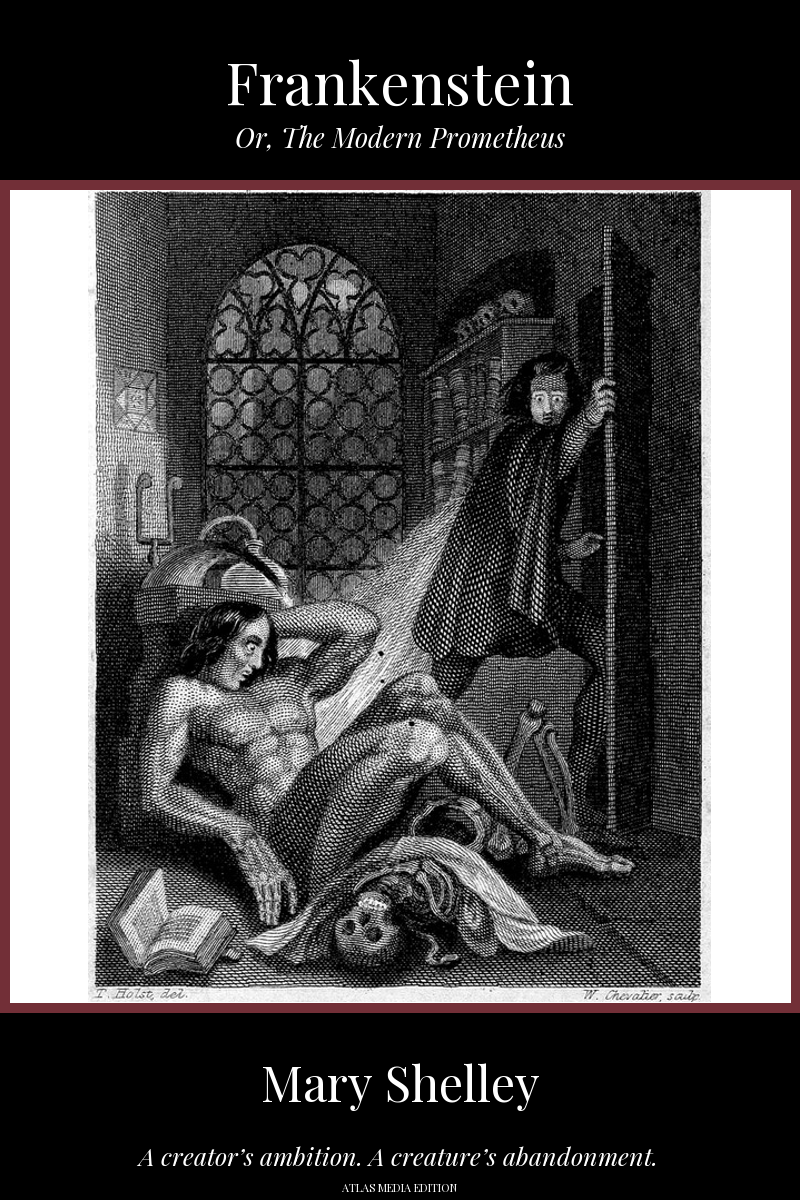
- Novel
- Gothic Fiction
- Horror
- Science Fiction
Frankenstein
- Published: 1818
- Atlas edition: V1.4 · 2026
- Language: English
ABOUT THE AUTHOR
Mary Wollstonecraft Shelley
1797–1851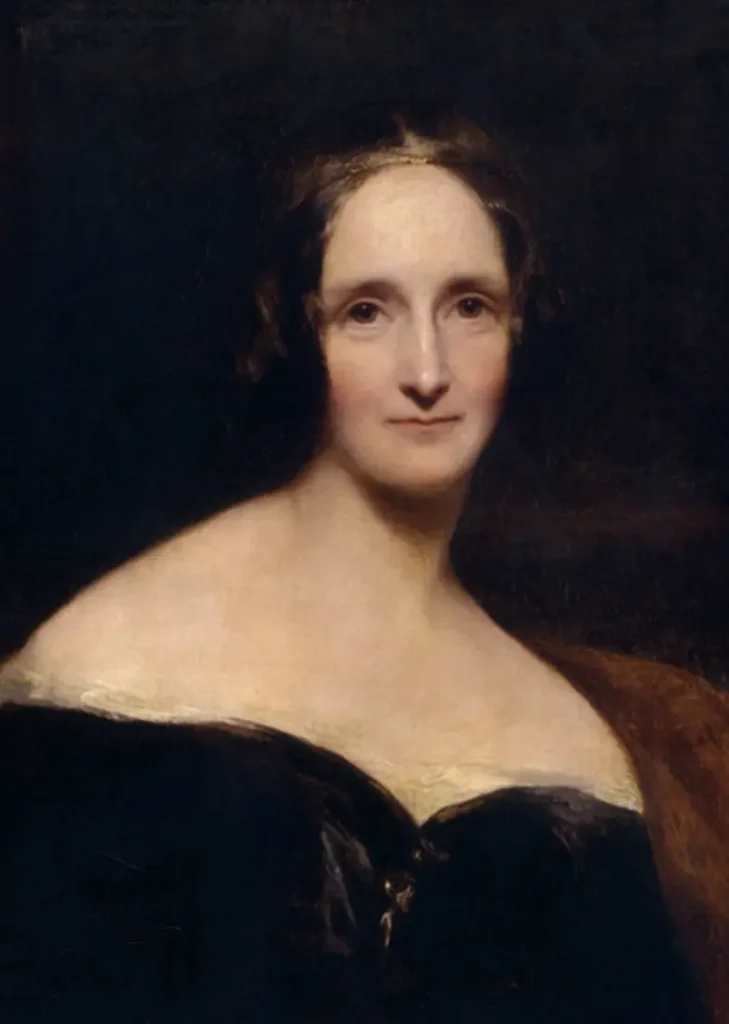
Mary Wollstonecraft Shelley was an English novelist, essayist, biographer and travel writer. The daughter of Mary Wollstonecraft and William Godwin, she began Frankenstein while still a teenager. Its treatment of creation, responsibility, isolation and human recognition established her most enduring place in literary history.
ABOUT THE WORK
Frankenstein
Frankenstein; or, The Modern Prometheus unfolds through a series of nested accounts. The explorer Robert Walton records his Arctic expedition in letters to his sister. After rescuing an exhausted stranger from the ice, he hears Victor Frankenstein’s history: his fascination with natural philosophy, his secret creation of a living being, and the consequences of abandoning it at the moment of its awakening.
At the centre of the novel is the relationship between Victor and the unnamed creature. Intelligent, articulate and initially hopeful, the creature seeks companionship and recognition but repeatedly encounters fear and rejection. Its account complicates Victor’s version of events and forces the reader to consider where responsibility for the ensuing violence belongs.
First published anonymously in 1818, Frankenstein combines Gothic fiction, philosophical enquiry and speculation about the possibilities of science. The novel examines ambition, education, isolation, prejudice and the duties of a creator toward what they bring into the world. This Atlas Media edition presents Mary Shelley’s original 1818 text rather than her substantially revised 1831 version.
WHY IT MATTERS
Why Frankenstein Matters
Frankenstein asks a question that every generation must answer for itself: what do we owe the things we create? Victor Frankenstein’s decisive failure is not simply that he creates life, but that he refuses responsibility for it. He turns away, leaving an intelligent and feeling being without care, community or a name.
That refusal gives the novel its lasting force. Shelley binds scientific ambition to moral obligation and shows how rejection, isolation and fear can help create the very danger they anticipate. Knowledge grants Victor extraordinary power, but neither wisdom nor the courage to accept its consequences.
Frankenstein and the Making of Monstrosity
The creature’s own account complicates any simple division between innocent victim and irredeemable monster. It learns by observing others, develops sympathy and longs to participate in human society. Its later violence is indefensible, yet Shelley insists that readers confront the abandonment, loneliness and repeated rejection preceding it. The novel asks whether monstrosity is created through appearance, action, treatment—or some combination of all three.
These questions extend far beyond nineteenth-century natural philosophy. They remain relevant wherever people create technologies, institutions or systems whose effects may exceed their makers’ intentions. Artificial intelligence, biotechnology and environmental intervention all renew the novel’s warning that the ability to create does not remove the obligation to foresee, care for and answer for what follows.
The Librarium holds Frankenstein as Gothic fiction, as an early landmark of science fiction and as a work that continues to test the relationship between knowledge, power and care. It offers no easy answer. Its value lies in making avoidance impossible.
Edition Record
- First publication
- 1818 · Lackington, Hughes, Harding, Mavor & Jones, London
- Textual basis
- Original 1818 three-volume edition
- Atlas edition
- V1.4 · 2026
- Language
- English
This Atlas Media edition presents Mary Shelley’s original 1818 text, first published anonymously in three volumes. It does not silently incorporate revisions introduced in 1831, when Shelley modified the novel’s language, characterisation, framing and emphasis. The later text remains historically important and is recorded for a future separate Atlas edition, allowing readers to identify clearly which version they are reading and, eventually, compare the two.
Accessibility: Reflowable EPUB with semantic navigation and reader-controlled typography. A visually checked A5 PDF is also provided for print and fixed-layout reading.
Source & Rights
- Text source
- Project Gutenberg
Based on the original 1818 edition. Source transcription produced by Greg Weeks, Mary Meehan and the Online Distributed Proofreading Team, revised by Richard Tonsing, and obtained from Project Gutenberg eBook 41445.
Cover context: Created for the 1831 edition, not the original 1818 edition selected for this Atlas volume.