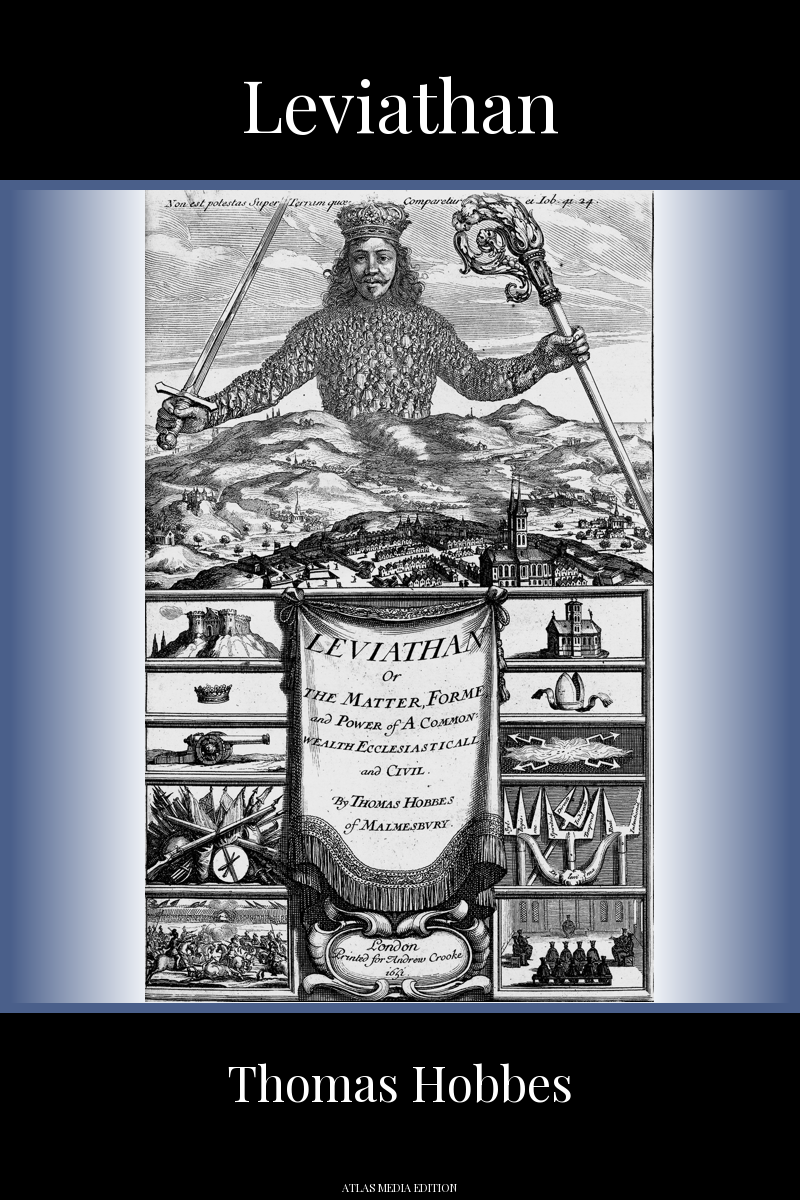
- Treatise
- Political Philosophy
Leviathan
- Published: 1651
- Atlas edition: V0.4 · 2026
- Language: English
ABOUT THE AUTHOR
Thomas Hobbes
1588–1679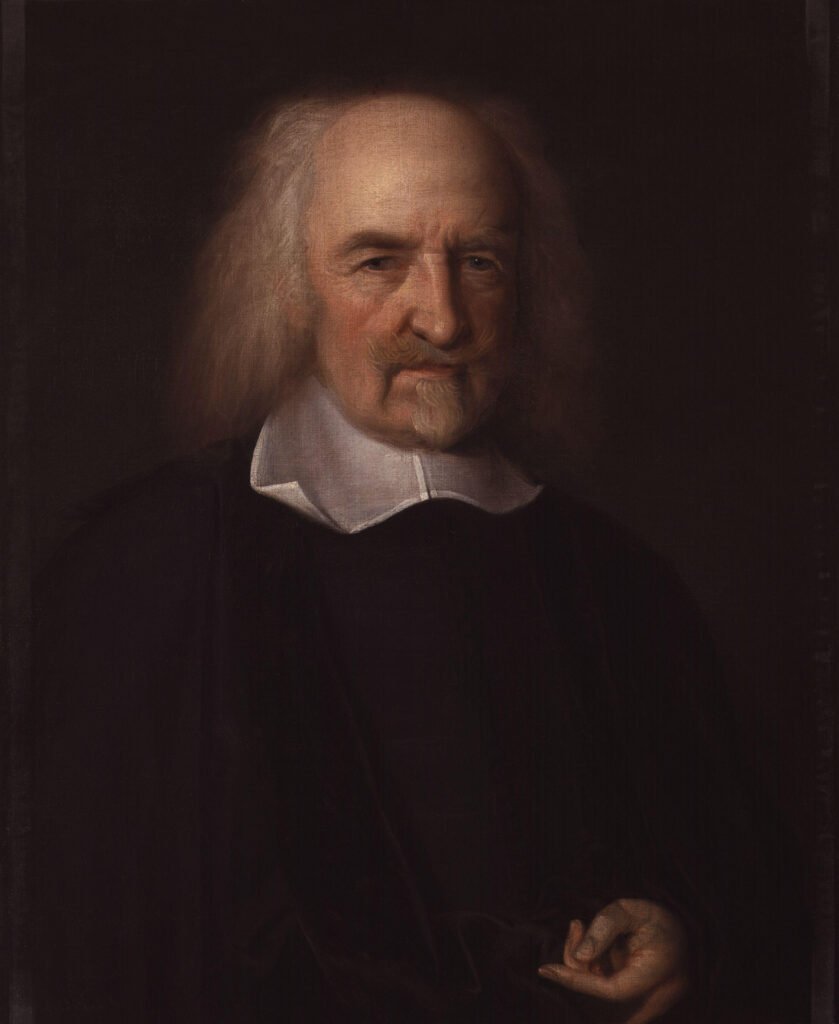
Thomas Hobbes was an English philosopher whose work ranged across political theory, moral philosophy, history, geometry, optics and the study of mind and language. Living through the upheavals surrounding the English Civil Wars, he made the causes of conflict and the conditions of civil peace central problems of philosophy. In Leviathan, Hobbes developed his most influential account of political authority: individuals seeking security establish a common power through covenant and authorisation. His defence of undivided sovereignty remains controversial, but his arguments about consent, obligation, liberty, law and the constructed character of the state helped reshape modern political thought.
ABOUT THE WORK
Leviathan
Leviathan develops Thomas Hobbes’s account of human nature, conflict, political obligation and sovereign authority. Beginning with sensation, imagination, reason and the passions, Hobbes argues that people without an effective common power remain exposed to insecurity and conflict. Civil society emerges when individuals authorise a sovereign capable of maintaining peace, enforcing covenants and determining public law. The work also examines liberty, representation, religion and the relationship between civil and ecclesiastical authority.
WHY IT MATTERS
Why Leviathan Matters
Leviathan and the Limits of Sovereign Power
Leviathan remains especially useful because Hobbes does not allow political authority to rest on custom alone. Government must justify itself through the protection it provides, while citizens must confront the risks created by both disorder and concentrated power. The argument therefore offers more than a defence of sovereignty: it supplies a framework for testing whether authority is effective, legitimate and answerable to the purpose for which it was established. Readers may reject Hobbes’s conclusions while still using his questions to examine modern states, emergency powers and public trust.
Leviathan asks one of political philosophy’s most enduring questions: why should anyone obey a government? Hobbes does not begin with divine right, inherited rank or an assumption that political communities arise naturally. He begins with individuals who are vulnerable, roughly equal in their capacity to threaten one another and deeply concerned with survival. Political authority must therefore be explained as something people construct in response to a shared problem.
Hobbes’s answer is severe. Agreements cannot reliably secure peace when no common power can enforce them. Individuals escape this insecurity by authorising a sovereign strong enough to uphold law and prevent society from collapsing into conflict. That sovereign need not be a monarch, but its authority must be sufficiently unified and effective to perform the protective task for which it was created.
The argument helped establish a distinctly modern way of thinking about the state. Authority is treated as an artificial institution produced through representation and authorisation, not merely as the personal possession of a ruler. At the same time, Hobbes forces readers to confront the danger within his solution: how much liberty may be surrendered in exchange for security, and what protection remains when sovereign power itself becomes threatening?
Those tensions continue wherever governments invoke emergency, public safety, national security or social order. Leviathan matters not because its conclusions must be accepted, but because it makes the bargain between protection and obedience unusually explicit. It gives readers a demanding framework for examining legitimacy, consent, law, fear and the limits of political power—and for asking what a state owes the people whose authority it claims to exercise.
Edition Record
- First publication
- 1651 · Andrew Crooke, London
- Textual basis
- Thomas Hobbes's 1651 English text, using the transcription distributed as Project Gutenberg eBook 3207
- Atlas edition
- V0.4 · 2026
- Language
- English
This Atlas edition presents the 1651 English text. Its digital textual basis was prepared from a Pelican Classics text based on the first edition and records modern transcription choices in spelling, capitalisation, punctuation and Greek transliteration. The revised Latin edition of 1668 is not included. Gutenberg packaging and branding have been replaced while the source contributors are acknowledged.
Accessibility: Reflowable EPUB with concise semantic navigation and reader-controlled typography. A visually checked A5 PDF is also provided for print and fixed-layout reading. Detailed internal argument headings remain within each chapter while the principal contents presents the four Parts and forty-seven Chapters.
Source & Rights
- Text source
- Project Gutenberg

Based on Thomas Hobbes's 1651 English text. Source transcription prepared by Edward White and David Widger and obtained from Project Gutenberg eBook 3207. Cover artwork: the 1651 frontispiece engraved by Abraham Bosse in collaboration with Hobbes; British Library digitisation, CC0.