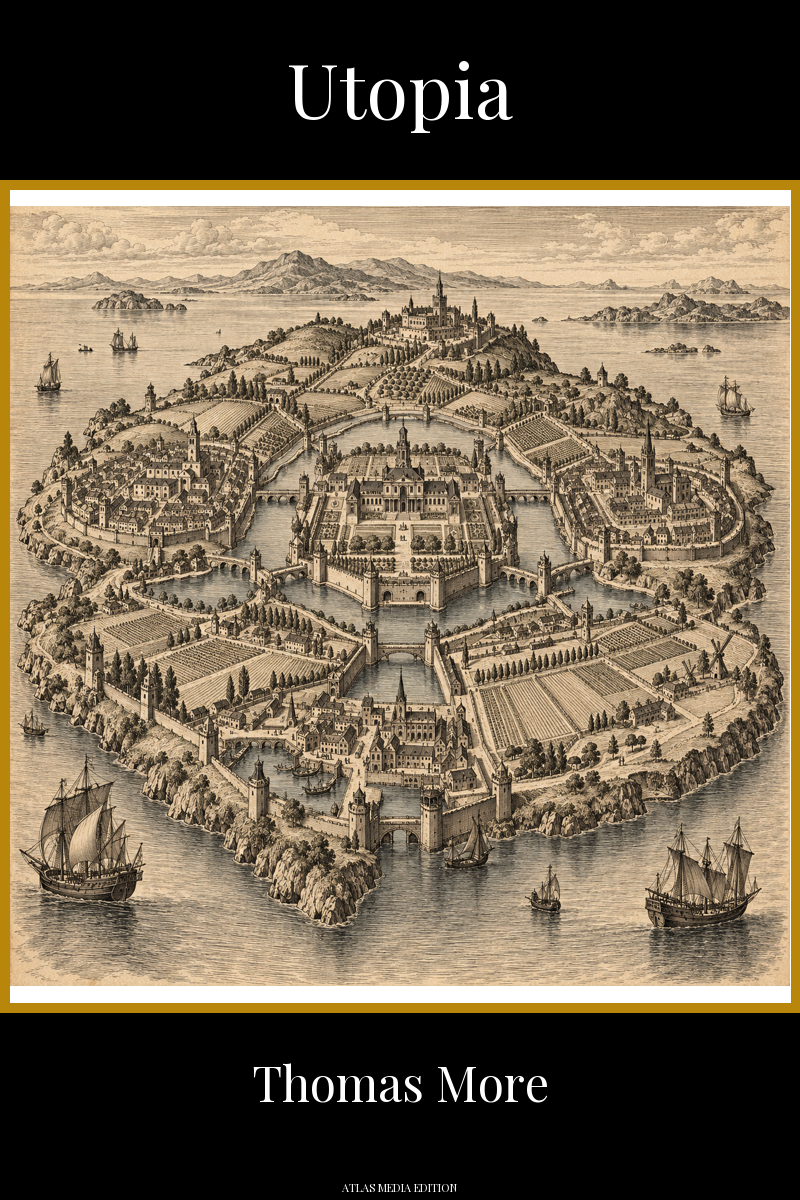
- Other
- Utopian Fiction
- Philosophy
Utopia
- Published: 1516
- Atlas edition: V1.4 ·
- Language: Latin
ABOUT THE AUTHOR
Thomas More
1478–1535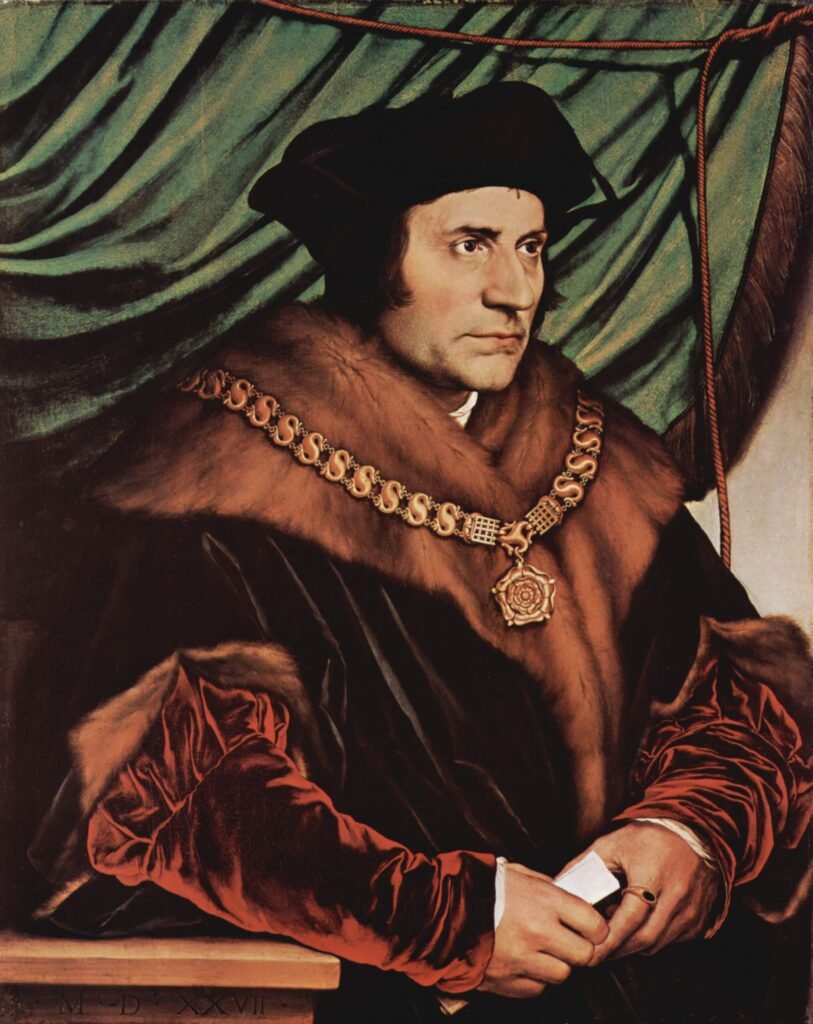
Thomas More (1478–1535) was an English lawyer, humanist scholar, diplomat and political figure. Educated in London and at Oxford before studying law at Lincoln’s Inn, he became known for his learning, public service and friendship with leading Renaissance humanists including Erasmus. More entered Parliament, served on diplomatic missions and eventually became Lord Chancellor under Henry VIII.
More wrote Utopia in Latin while engaged in diplomatic work in the Low Countries. First published at Louvain in 1516, the book combines travel narrative, political argument and social criticism through an account of an imagined island society. Its title gave the English language the word “utopia”, while the work’s ambiguities continue to invite debate over which of its institutions More meant readers to admire, question or recognise as satire.
More resigned as Lord Chancellor in 1532 amid conflict over royal supremacy and Henry VIII’s break with the Roman Catholic Church. His refusal to accept the king’s supremacy over the church in England led to his conviction for treason and execution in 1535. His life and writings remain central to discussions of Renaissance humanism, conscience, authority, law and the uses of political imagination.
ABOUT THE WORK
Utopia
Utopia presents Thomas More’s account of an imagined island society through a conversation involving the traveller Raphael Hythloday. Its first part examines poverty, punishment, enclosure, war, royal counsel and the social conditions of sixteenth-century Europe. Its second describes Utopian institutions: communal property, organised labour, public education, religious plurality and a political order designed to restrain private ambition. The work does not offer a simple programme. Its invented names, framing dialogue and deliberate tensions leave readers to decide where More is proposing reform, testing an argument or using irony to expose the limits of ideal schemes. This Atlas edition presents Gilbert Burnet’s 1684 English translation with Henry Morley’s nineteenth-century introduction.
WHY IT MATTERS
Why Utopia Matters
Utopia matters because it created one of the most durable forms of political thought: the imagined society used to examine the real one. More does not begin with a list of reforms. He builds distance between his readers and familiar institutions, allowing private property, punishment, war, labour, education and religious practice to appear strange enough to be questioned.
How Utopia Questions the Real World
Utopia was written in Latin in 1515 and 1516, while More was a London lawyer and an envoy for Henry VIII, and it was first printed at Louvain in 1516 with the help of his friend Erasmus. It was addressed to an international audience of humanist scholars, which helps explain its learned jokes, its invented names and its playful framing letters.
The book’s form is part of its argument. In Book One, More presents himself in conversation with his friend Peter Giles and the traveller Raphael Hythloday, debating whether a wise person should advise kings at all. In Book Two, Hythloday describes the island of Utopia in detail. The contrast between a troubled real Europe and an orderly imagined island invites readers to compare them.
The book’s first part grounds that experiment in contemporary problems. Hythloday condemns the execution of thieves while poverty and dispossession help produce theft, criticises rulers attracted to conquest, and doubts whether honest counsel can survive in courts organised around power. These arguments turn social suffering from an individual moral failure into a question about institutions and incentives.
The island described in the second part offers striking alternatives. Property is held in common, working hours are limited, education is widely valued and public institutions organise the distribution of necessities. Yet the society also contains coercion, hierarchy, slavery and strict regulation. The tension is essential. “Utopia” means both a good place and no place, and the traveller’s name signals learned nonsense. The form prevents the reader from treating every practice as More’s direct recommendation.
Utopia and the Ideal Society
More also gave the world a word. Utopia comes from Greek roots meaning “no place”, with a pun on “good place”. The name soon became a general term for any imagined perfect society, and later generations coined “dystopia” for its dark mirror. Few book titles have entered everyday language so completely.
That ambiguity has kept the work alive across very different political traditions. Socialists, liberals, religious thinkers, communitarians and critics of total planning have all found arguments to engage with in its pages. The book helped establish utopian writing as both aspiration and warning: a method for imagining that society could be otherwise, and for asking what freedom or complexity might be lost when an ideal is imposed.
The history of this edition also matters. More wrote the work in Latin; the text presented here is Gilbert Burnet’s 1684 translation, accompanied by Henry Morley’s later introduction. It should therefore be read as a historical English rendering with its own vocabulary and interpretive character, not as a transparent substitute for More’s original prose. Preserving those contributors makes the edition’s lineage visible.
More’s own life gives Utopia a sharper edge. He rose to become Lord Chancellor of England, then refused to accept Henry VIII as head of the Church in England and was executed in 1535. Readers have long noticed the distance between the tolerant, reasoned island of the book and the political dangers its author faced.
Utopia remains useful not because it settles the design of a just society, but because it disciplines the act of imagining one. It asks who benefits from institutions that appear natural, what assumptions an alternative system carries, and how ideals behave when translated into rules. Those are enduring questions for political philosophy, public policy and every project that tries to picture a better future.
Edition Record
- First publication
- 1516
- Textual basis
- Gilbert Burnet's 1684 English translation of Thomas More's Utopia, with Henry Morley's introduction, using the transcription distributed as Project Gutenberg eBook 2130
- Atlas edition
- V1.4 ·
- Language
- Latin
This Atlas edition presents Gilbert Burnet’s 1684 English translation with Henry Morley’s signed introduction. It must not be described as Ralph Robinson’s 1551 translation. Project Gutenberg packaging is replaced while the translation, introduction and source contribution remain identified.
Accessibility: Reflowable EPUB with semantic navigation and reader-controlled typography. A checked fixed-layout PDF will be supplied only after its separate production and visual-review gate is completed.
Source & Rights
- Text source
- Project Gutenberg
- Cover image
- Cover image source
Utopia by Thomas More; translated by Gilbert Burnet, with an introduction by Henry Morley. Source text prepared from Project Gutenberg ebook 2130.