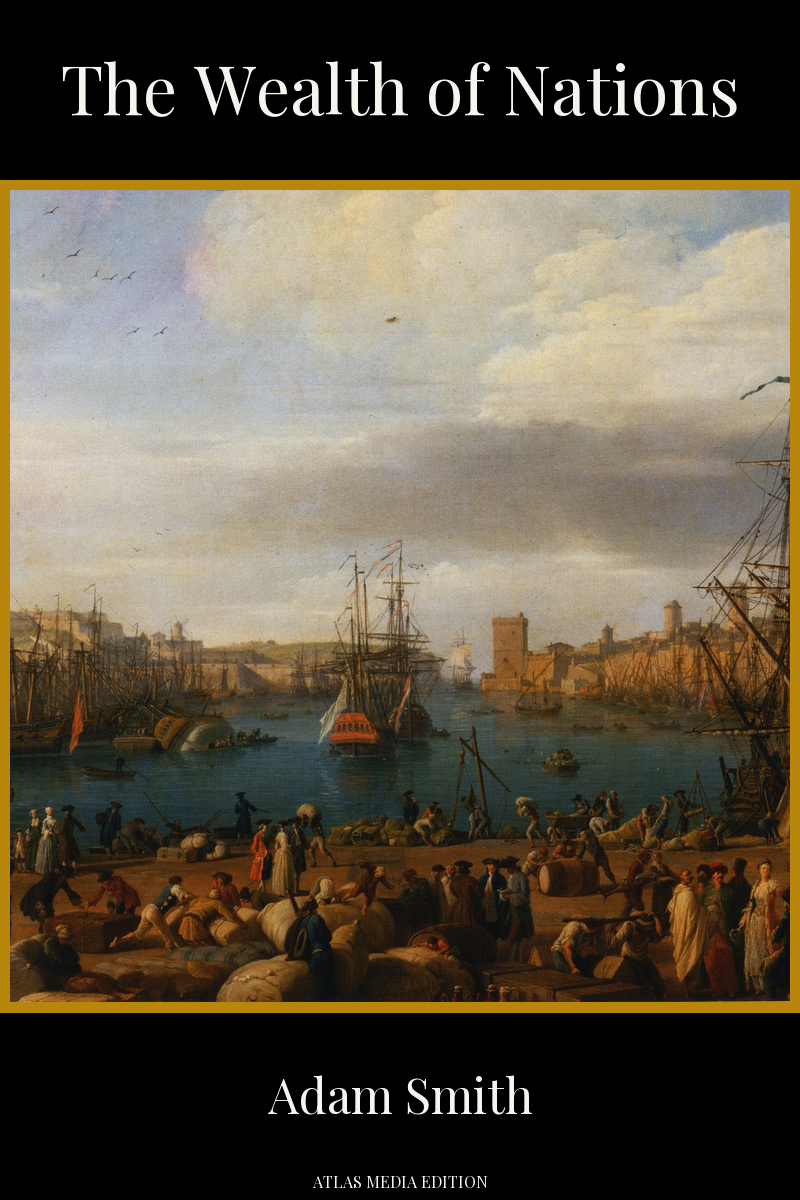
- Novel
The Wealth of Nations
- Published: 1776
- Atlas edition: V1.3 ·
- Language: English
ABOUT THE AUTHOR
Adam Smith
1723–1790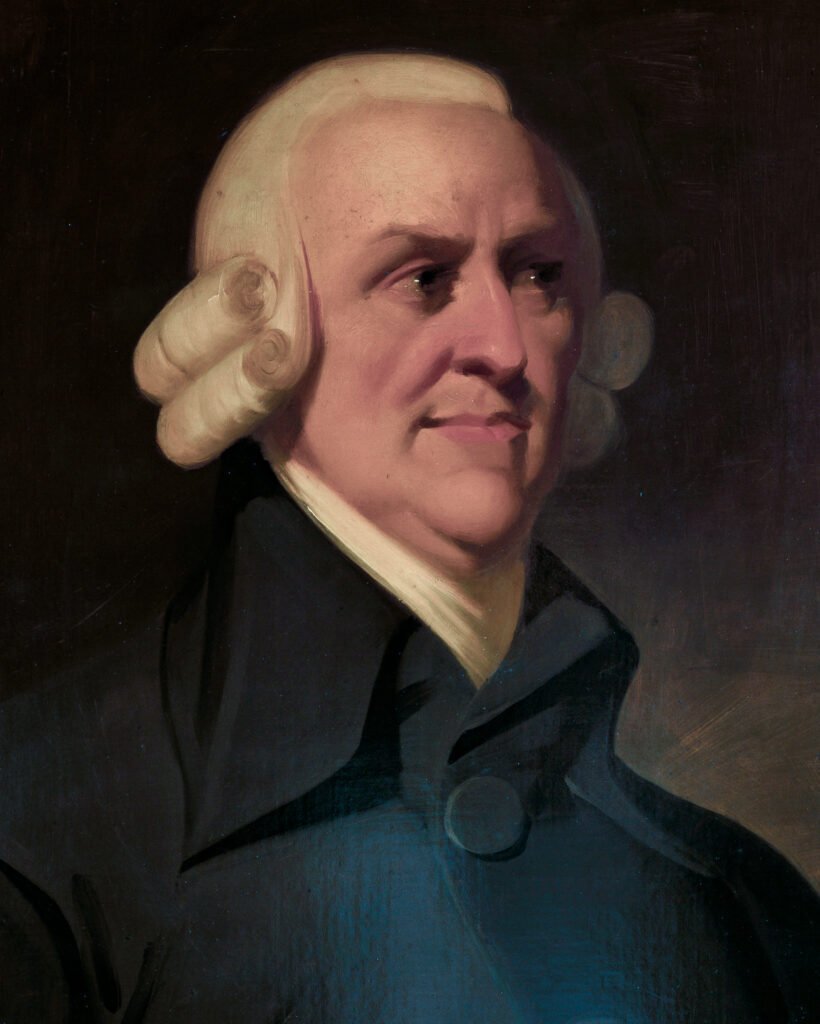
Adam Smith (1723 to 1790) was a Scottish economist and moral philosopher, and a leading figure of the Scottish Enlightenment. Born in Kirkcaldy, Fife, he studied at the University of Glasgow and at Oxford.
He later held a professorship at Glasgow, where he taught moral philosophy and wrote The Theory of Moral Sentiments (1759). A tutoring post then took him travelling through Europe, where he met leading thinkers of his time. The Wealth of Nations followed in 1776 and is regarded as his principal work.
ABOUT THE WORK
The Wealth of Nations
The Wealth of Nations is Adam Smith’s inquiry into how nations become prosperous. Its full title is An Inquiry into the Nature and Causes of the Wealth of Nations, and it was published in two volumes on 9 March 1776. Smith set out to explain how commercial societies produce wealth, how that wealth is shared, and which public policies help or hinder it.
The book opens with the division of labour. In a famous example, Smith describes a small workshop making pins. One worker alone could perhaps make one pin a day, and certainly not twenty. Divided into about eighteen separate operations, ten workers could make upwards of forty-eight thousand. Specialisation, he argues, is the main source of rising productivity, and its extent is limited by the size of the market.
Exchange makes this division possible, and Smith locates its motive in self-interest. “It is not from the benevolence of the butcher, the brewer, or the baker that we expect our dinner,” he writes, “but from their regard to their own interest.” From there Book I explains money, prices, wages, profits and rent, and how competition tends to pull market prices toward their natural level.
Book II examines capital, which Smith calls stock: how it is accumulated, how it is employed, and the difference between labour that produces lasting value and labour that does not. Book III traces how Europe’s towns and countryside developed after the fall of Rome, and why the progress of wealth followed an unnatural order there.
Book IV is Smith’s critique of mercantilism, the prevailing belief that national wealth lies in gold and silver, protected by tariffs, monopolies and trade restrictions. He argues that such policies serve merchants and manufacturers at the public’s expense. It is here, in a discussion of foreign trade, that he writes of a merchant who, seeking only his own gain, is led by an invisible hand to promote an end which was no part of his intention.
Book V turns to the state. Smith does not argue that government should do nothing. He describes its duties as defence, justice, and certain public works and institutions that private enterprise would not provide, including the education of ordinary people. He also discusses taxation and public debt.
Smith’s own lively examples run throughout: the price of corn across centuries, the conduct of trading companies, the wages of labourers in Britain and in the American colonies. Five editions appeared during his lifetime, the last in 1789.
WHY IT MATTERS
Why The Wealth of Nations matters
The Wealth of Nations matters because it helped create economics as a field of study. Smith drew together observations about work, trade, prices and government into one system of explanation. Later economists, from David Ricardo to the present, have built on his account or argued against it, and phrases such as the division of labour and the invisible hand remain part of public debate.
What The Wealth of Nations actually argues
The book is often reduced to a single slogan in favour of free markets. Read in full, it is more careful and more critical. Smith warns that people of the same trade seldom meet together without the conversation ending in a conspiracy against the public, or a scheme to raise prices. He worries that repetitive work could leave labourers as stupid and ignorant as it is possible for a human creature to become, and he proposes public schooling as a remedy. The invisible hand appears only once in the whole work.
The Wealth of Nations and its world
Smith wrote during the Scottish Enlightenment, as commercial and early industrial societies were replacing older economic orders. His criticism of colonial monopolies and trade restrictions was aimed at real policies of his day, including Britain’s management of its colonies. Seeing those targets helps readers separate his arguments from later uses of his name.
Smith’s earlier book, The Theory of Moral Sentiments (1759), examined sympathy and moral judgment. Reading The Wealth of Nations with that background shows an author interested in how self-interest and social feeling work together, rather than one who praised self-interest alone. For readers in economics, history, politics or business, the full text remains the best way to meet the argument behind the reputation.
Edition Record
- First publication
- 1776
- Textual basis
- Source text: Project Gutenberg, https://www.gutenberg.org/ebooks/3300
- Atlas edition
- V1.3 ·
- Language
- English
Prepared from the recorded source and the reviewed Atlas working edition.
Accessibility: EPUB and PDF are offered where approved; accessibility features have not been independently certified.
Source & Rights
- Text source
- Project Gutenberg

The Wealth of Nations by Smith, Adam. Source text prepared from Project Gutenberg ebook 3300.