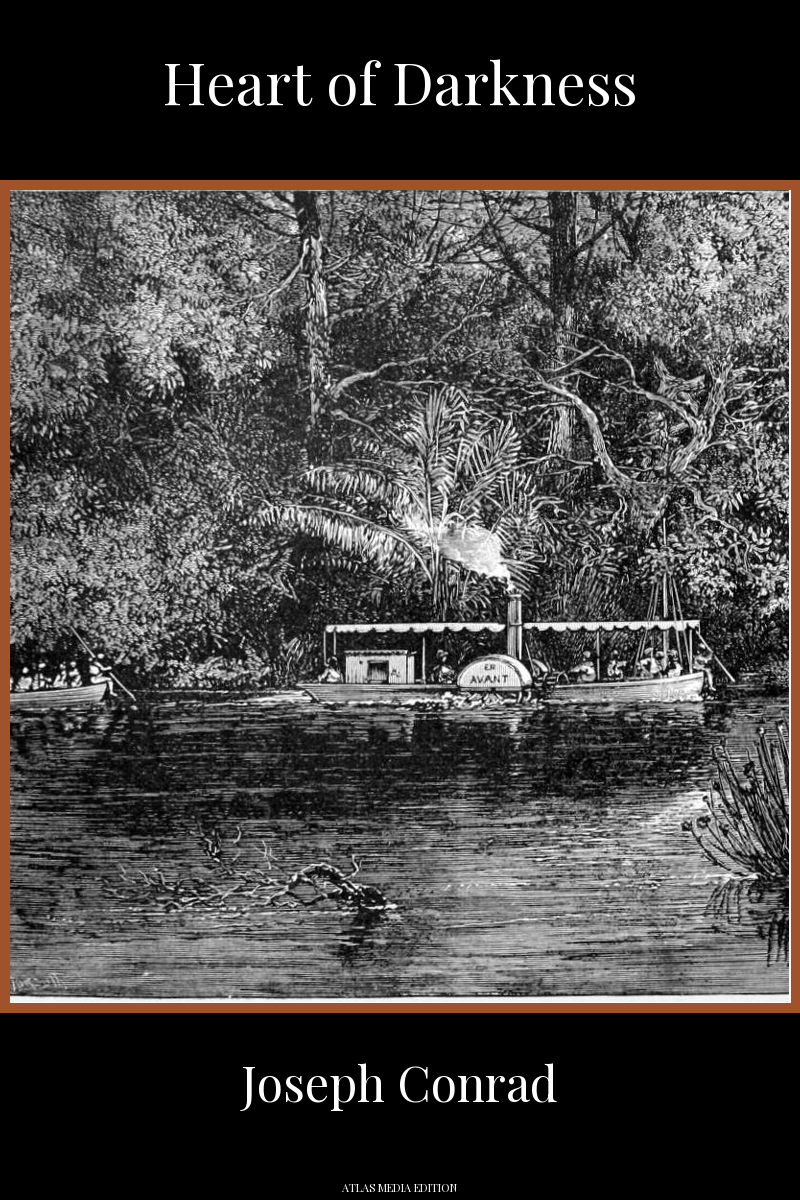
- Novel
Heart of Darkness
- Published: 1899
- Atlas edition: V1.3 ·
- Language: English
ABOUT THE AUTHOR
Joseph Conrad
1857–1924Joseph Conrad (1857 to 1924), born Józef Teodor Konrad Korzeniowski, was a Polish-British novelist and story writer, regarded as one of the great prose stylists in English though he did not speak the language fluently until his twenties.
He spent years at sea before turning to writing, and many of his novels and stories have nautical settings. In 1890 he served on a steamer on the Congo River, the journey that lies behind Heart of Darkness.
ABOUT THE WORK
Heart of Darkness
Heart of Darkness is Joseph Conrad’s short novel about a voyage up a great African river, told by the seaman Charles Marlow. First published in 1899, it is widely read as a critique of European colonialism and as a study of power and moral collapse.
The story opens on a yacht anchored in the Thames at dusk. As the light fades over London, Marlow remarks that this place too “has been one of the dark places of the earth”, and begins to tell his listeners about the time he went to Africa.
Through his aunt’s connections, Marlow is hired by a Belgian trading company to captain a river steamer. Conrad never names the river or the country, but at the time he wrote, the Congo Free State was the private colony of King Leopold II of Belgium, and Conrad himself had served on a Congo steamer in 1890.
On the coast and at the company’s stations, Marlow sees waste, cruelty and absurdity: a French warship firing into the forest at an unseen enemy, abandoned machinery, and African workers chained, starved and dying. The company’s officials, interested only in ivory, are petty, jealous and idle.
At the Central Station Marlow finds his steamer sunk and waits months for rivets to repair it. The station manager, who seems to have no talent except staying healthy, distrusts Kurtz and may welcome his failure. Marlow begins to suspect that the company’s talk of progress covers simple greed.
Again and again Marlow hears of Mr Kurtz, the company’s most successful agent, who runs a station deep in the interior and sends back more ivory than all the rest. Kurtz is spoken of as a remarkable man, an emissary of progress. Marlow becomes fascinated by him before they ever meet.
The journey upriver is slow and dreamlike. The steamer has to be repaired, the forest closes in, and the boat is attacked from the banks. When Marlow at last reaches the inner station, he finds that Kurtz has set himself up as a kind of god among the local people, and that heads on stakes surround his house.
Kurtz is gravely ill. Marlow takes him aboard for the voyage back, and hears him speak of his plans and his pride. Kurtz dies on the steamer, and his last words are “The horror! The horror!”
Back in Europe, Marlow visits Kurtz’s fiancée, the Intended, who still believes in his goodness. When she asks for his last words, Marlow cannot bring himself to tell her, and says instead that the last word Kurtz spoke was her name.
WHY IT MATTERS
Why Heart of Darkness matters
Heart of Darkness matters because it confronted European readers with the violence behind colonial trade at a time when that trade was often described as civilising work. Conrad drew on his own journey of 1890, and the book’s images of exploitation along the river have shaped how later generations picture the colonial Congo.
Reading Heart of Darkness critically
The novella is also one of the most argued-over books in English. In a 1975 lecture, the Nigerian novelist Chinua Achebe called it “an offensive and deplorable book” that dehumanised Africans, pointing out that its African characters rarely speak and serve mainly as a backdrop for a European story. Others defend Conrad’s attack on imperialism while accepting the limits of his view. Reading the text in full lets readers weigh both arguments.
The narrative art of Heart of Darkness
The book’s title has entered everyday language, and Kurtz’s last words are among the most quoted lines in modern fiction. Their meaning is left open: a judgement on Kurtz’s own life, on the colonial enterprise, or on human nature itself.
Conrad tells the story at two removes: an unnamed narrator reports what Marlow says. Marlow himself is unsure of what he saw, and his telling is full of gaps, hesitations and images of mist and darkness. This layered, uncertain style influenced many modernist writers.
Heart of Darkness and Apocalypse Now
Many people know this story without having read it. Francis Ford Coppola’s 1979 film Apocalypse Now, written by Coppola and John Milius, moves Heart of Darkness from the Congo of the 1890s to the Vietnam War. Captain Willard travels upriver into Cambodia to find Colonel Kurtz, played by Marlon Brando: Conrad’s river journey, and even Kurtz’s name, carried into a new war. The film shared the Palme d’Or at Cannes in 1979.
It was not the first attempt to film the book. Orson Welles adapted it for radio in 1938 and planned it as his first film for RKO in 1939, but that version was never made.
The book has been widely republished and translated. Its questions remain open: what happens to people given unchecked power far from home, and what do comfortable societies prefer not to know about the source of their wealth?
Edition Record
- First publication
- 1899
- Textual basis
- Source text: Project Gutenberg, https://www.gutenberg.org/ebooks/219
- Atlas edition
- V1.3 ·
- Language
- English
Prepared from the recorded source and the reviewed Atlas working edition.
Accessibility: EPUB and PDF are offered where approved; accessibility features have not been independently certified.
Source & Rights
- Text source
- Project Gutenberg

Heart of Darkness by Conrad, Joseph. Source text prepared from Project Gutenberg ebook 219.