- Novel
Alice’s Adventures in Wonderland
- Published: 1865
- Atlas edition: V1.3 ·
- Language: English
ABOUT THE AUTHOR
Lewis Carroll
1832–1898Lewis Carroll was the pen name of Charles Lutwidge Dodgson (1832 to 1898), an English author, poet, mathematician, photographer and Anglican deacon who lived most of his life at Christ Church, Oxford.
His best-known works are Alice’s Adventures in Wonderland (1865) and its sequel Through the Looking-Glass (1871). He was noted for word play, logic and fantasy, and his poems Jabberwocky and The Hunting of the Snark are classics of literary nonsense.
ABOUT THE WORK
Alice’s Adventures in Wonderland
Alice’s Adventures in Wonderland is Lewis Carroll’s story of a girl who follows a White Rabbit down a rabbit hole into a world where logic turns upside down. First published in 1865, with illustrations by John Tenniel, it remains one of the best-known books in English.
The tale began on a summer boat trip on the river near Oxford in 1862, when Carroll told a story to three young sisters, among them Alice Liddell. He later wrote it out and expanded it into the book.
Alice, bored on a riverbank, sees a White Rabbit hurry past looking at a pocket watch. She follows him down a hole and falls slowly into a hall of locked doors. A bottle marked DRINK ME shrinks her; a cake marked EAT ME makes her grow until her head touches the ceiling. Much of the book plays with her changing size and her uncertain sense of who she is.
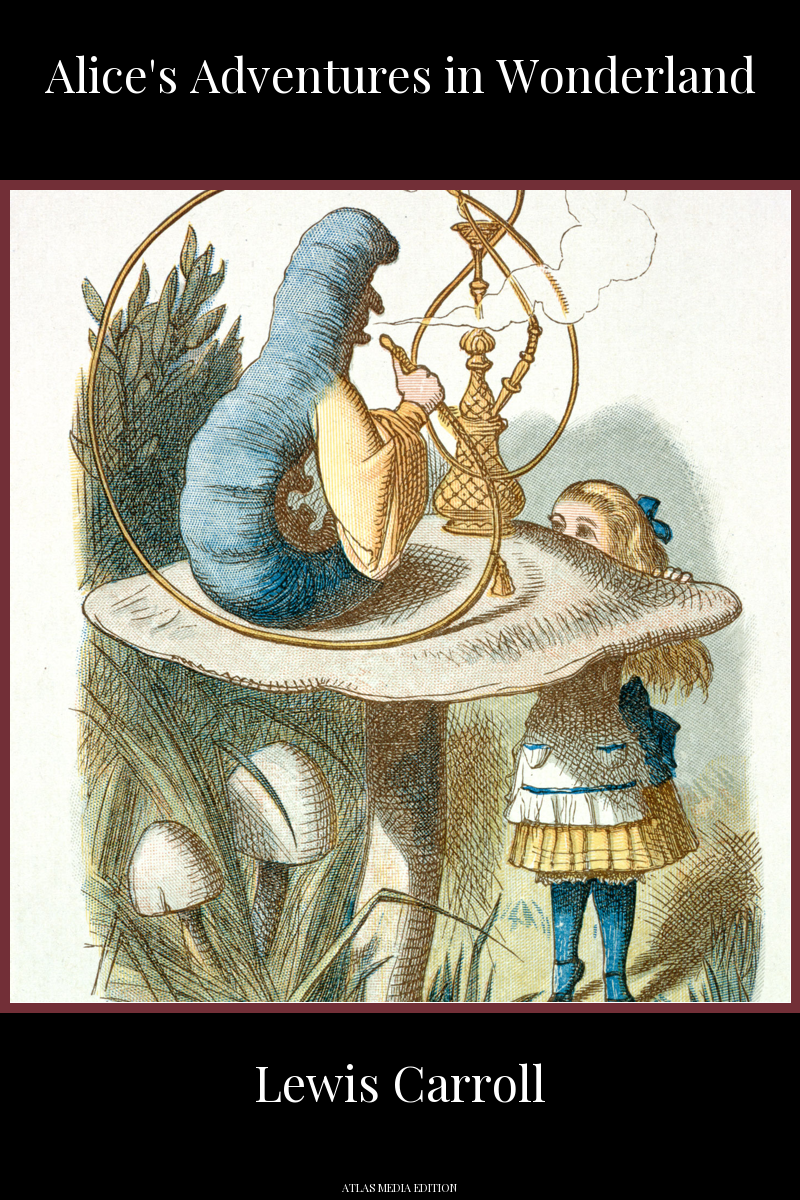
She swims through a pool of her own tears with a crowd of animals, then meets a Caterpillar smoking a hookah on a mushroom, who asks her, rudely and repeatedly, who she is. In the Duchess’s kitchen a baby turns into a pig, and the grinning Cheshire Cat appears and vanishes, telling Alice that everyone there is mad.
At the Mad Tea-Party, the Hatter, the March Hare and a sleepy Dormouse are stuck at six o’clock, forever taking tea, asking riddles that have no answers. Alice then reaches the garden of the Queen of Hearts, who plays croquet with flamingos and hedgehogs and orders beheadings at every turn.
The Mock Turtle and the Gryphon tell her about their lessons under the sea and perform the Lobster Quadrille. The story ends at the trial of the Knave of Hearts, accused of stealing tarts. As the court’s nonsense grows, Alice grows too, defies the Queen, and wakes on the riverbank to find it was a dream.
Throughout, Alice tries to make sense of things by the rules she learned at home and at school. She recites lessons that come out wrong, argues with creatures who twist her words, and is told off for being rude by characters far ruder than she is.
Carroll fills the book with parodies of poems Victorian children learned by heart, puns, riddles and logical puzzles, so that it can be read as a children’s adventure and as a game with language.
John Tenniel’s illustrations, made for the first edition, fixed the look of Alice and the creatures she meets for generations of readers.
WHY IT MATTERS
Why Alice's Adventures in Wonderland matters
Alice’s Adventures in Wonderland matters because it changed what writing for children could be. Many earlier children’s books were written mainly to teach lessons; Carroll wrote to delight, and he trusted young readers with jokes, absurdity and ideas.
Nonsense and logic in Alice’s Adventures in Wonderland
The book is a landmark of literary nonsense, but its nonsense has rules. Carroll was a mathematician and logician, and many scenes turn on arguments that sound reasonable but lead somewhere impossible. Adults have long enjoyed it for this reason, and philosophers and logicians still quote it.
The reach of Alice’s Adventures in Wonderland
Its characters and phrases have passed into everyday language: the rabbit hole, the Mad Hatter, the Cheshire Cat’s grin, “curiouser and curiouser”. The book has been translated into many languages and adapted for stage, film, music and art.
Alice herself is part of its appeal. She is curious, impatient and sometimes rude, and she keeps asking questions in a world where adults talk nonsense with total confidence. Readers of any age can recognise that experience.
The story also gives shape to a feeling many readers know: being small in a world of confusing rules made by others. Alice’s growing and shrinking, and her repeated question about who she really is, have been read as an image of growing up.
Reading the original text, with its parodies, puns and unanswerable riddles, shows how much of the fun lives in Carroll’s language rather than in later retellings. Carroll continued Alice’s adventures in Through the Looking-Glass (1871).
Edition Record
- First publication
- 1865
- Textual basis
- Source text: Project Gutenberg, https://www.gutenberg.org/ebooks/11
- Atlas edition
- V1.3 ·
- Language
- English
Prepared from the recorded source and the reviewed Atlas working edition.
Accessibility: EPUB and PDF are offered where approved; accessibility features have not been independently certified.
Source & Rights
- Text source
- Standard Ebooks

Alice's Adventures in Wonderland by Lewis Carroll, with the illustrations of John Tenniel. Source text and illustrations prepared from the Standard Ebooks edition (released CC0), itself based on Project Gutenberg's transcription and Internet Archive scans.