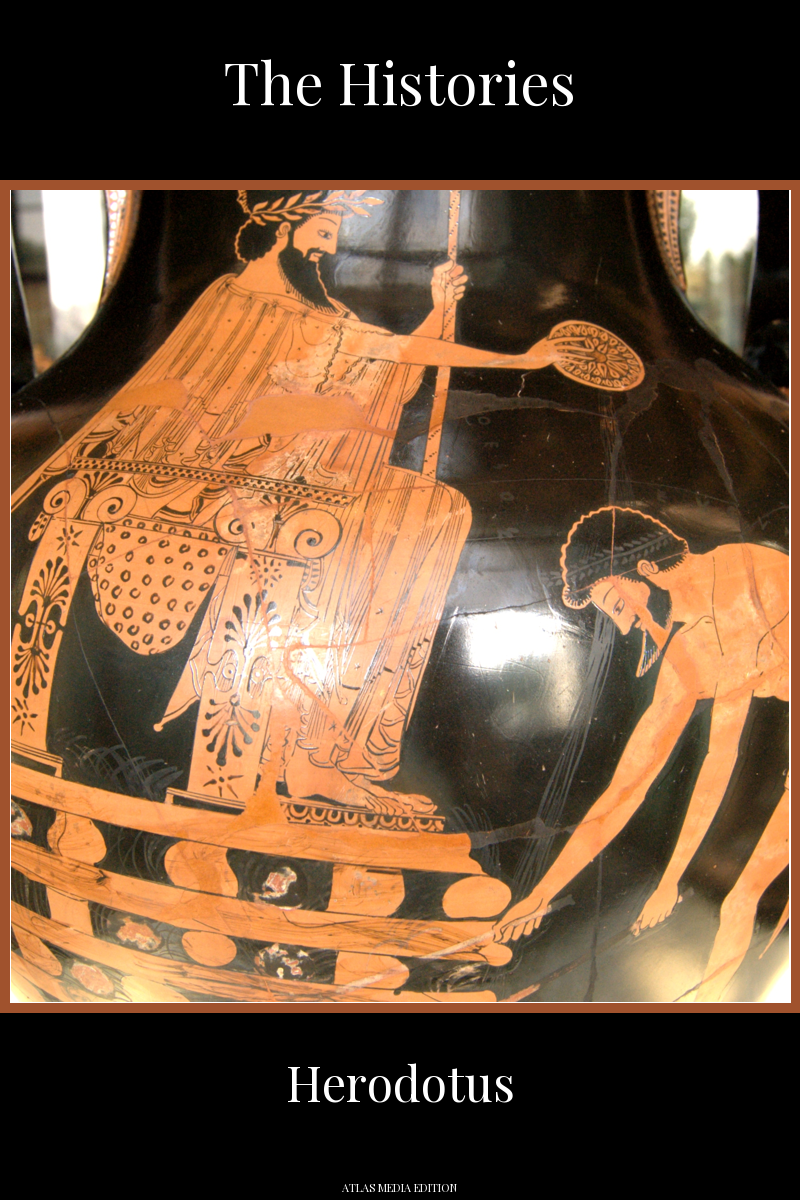
- Novel
The Histories
- Published: c. 440 BC
- Atlas edition: V1.3 ·
- Language: Ancient Greek
ABOUT THE AUTHOR
Herodotus
-484–-430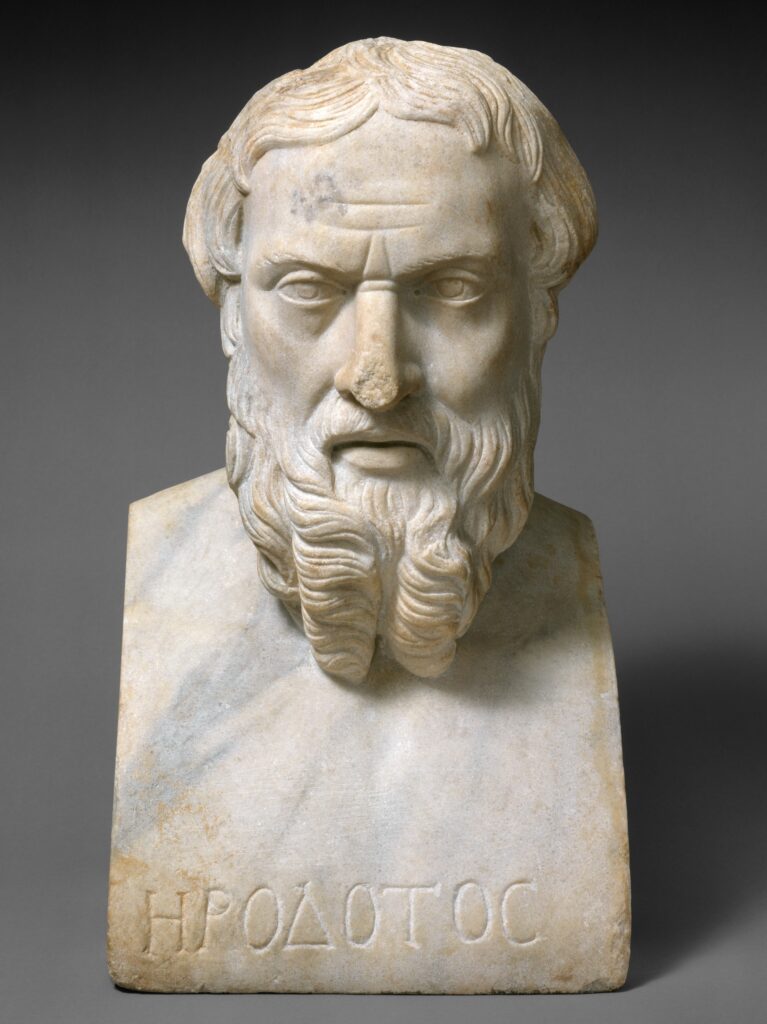
Herodotus (about 484 to about 425 BC) was a Greek historian and geographer from the city of Halicarnassus, now Bodrum in Turkey, which was under Persian control in his lifetime. He later became a citizen of Thurii in southern Italy. He has been called the Father of History, a title given to him by the Roman orator Cicero.
ABOUT THE WORK
The Histories
The Histories is the great work of Herodotus, the Greek writer from Halicarnassus who has been called the Father of History. Written in the 5th century BC, it is one of the earliest accounts of the rise of the Persian Empire and of the causes and events of the wars between Persia and the Greek city-states. This Atlas Media edition uses G. C. Macaulay’s complete English translation, in all nine books.
Herodotus states his purpose at the very start: to prevent the traces of human events from being erased by time, and to preserve the fame of the remarkable achievements of both Greeks and non-Greeks, above all the reasons they went to war with one another.
The Histories opens with the kings of Lydia. It tells how Gyges took the throne, and how Croesus, the richest king of his age, asked the Athenian lawgiver Solon who was the happiest man in the world, and did not like the answer.
From Lydia the story widens with the growth of Persia under Cyrus, Cambyses and Darius. Herodotus travels with it, describing the customs, beliefs and landscapes of Egypt, Scythia, Arabia and India, often in long and memorable digressions.
The later books turn to the great war itself. They tell of the Ionian revolt, the Persian defeat at Marathon, and the vast invasion led by Xerxes, whose army Herodotus counts at more than five million men. At Thermopylae, Leonidas and his small force hold the pass for three days until a traitor shows the Persians a path around them.
The Greek fleet then defeats the Persians at Salamis, and the work ends as the invasion collapses and the Greeks carry the war back towards Asia.
The work was later divided into nine books, each conventionally named after one of the nine Muses, from Clio to Calliope. Throughout, Herodotus reports what he was told, compares accounts, and sometimes says plainly which version he does not believe.
WHY IT MATTERS
Why The Histories matters
The Histories matters because it is considered the founding work of history in Western literature. Although it is not an impartial record, it remains one of the most important sources for the ancient world, and it established history as a form of enquiry in its own right.
The Histories and the idea of history
The Greek word historia meant enquiry. Herodotus questioned witnesses, travelled, weighed rival stories and set them side by side, so that readers could see the evidence as well as the conclusion. That method, more than any single fact, is his legacy.
Archaeology has sometimes come to his defence. Finds at the now-submerged Egyptian city of Heracleion support his claim, long without other evidence, that the city was founded during the Egyptian New Kingdom.
He was also a superb storyteller, and later writers argued about whether that made him less reliable. The Roman orator Cicero, who gave him the title Father of History, also said his work was full of legends. Later historians often preferred Thucydides for his accuracy, even though Thucydides built on foundations Herodotus had laid.
Herodotus knew the Athenian theatre well. Several passages echo Aeschylus’s play The Persians, including the observation that the defeat of the Persian fleet at Salamis brought down the land army as well. Not every ancient reader admired him: the satirist Lucian of Samosata went so far as to deny the Father of History a place among the famous on the Island of the Blessed.
Reading The Histories today
The Histories is long, but it rewards being read in parts. Book I, with Croesus and Solon, is a natural place to begin. Book II is given almost entirely to Egypt, its river, its monuments and its customs, and shows Herodotus at his most curious. Books VII to IX carry the war through Thermopylae and Salamis to its end.
Its questions still feel current. How do empires grow, and why do they overreach? What do different peoples owe to their customs, and what happens when those customs meet? And how can anyone know what really happened, when every witness has a story to tell?
Edition Record
- First publication
- c. 440 BC
- Textual basis
- Source text: Project Gutenberg, https://www.gutenberg.org/ebooks/2707
- Atlas edition
- V1.3 ·
- Language
- Ancient Greek
Prepared from the recorded source and the reviewed Atlas working edition.
Accessibility: EPUB and PDF are offered where approved; accessibility features have not been independently certified.
Source & Rights
- Text source
- Project Gutenberg

The Histories by Herodotus; translated by G. C. Macaulay. Source text prepared from Project Gutenberg ebooks 2707 and 2456 (Volumes 1 and 2), joined into one edition.