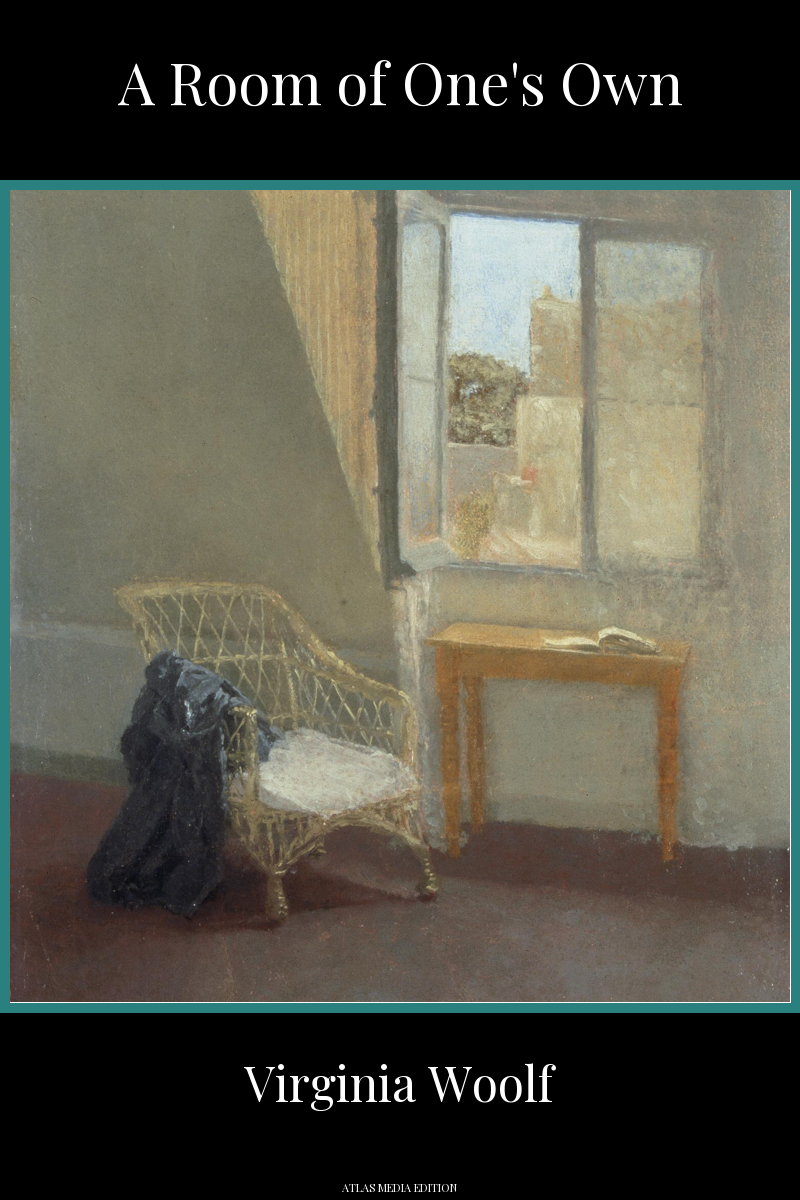
- Novel
A Room of One’s Own
- Published: 1929
- Atlas edition: V1.3 ·
- Language: English
ABOUT THE AUTHOR
Virginia Woolf
1882–1941Virginia Woolf (1882 to 1941), born Adeline Virginia Stephen in South Kensington, London, was an English writer and one of the most influential modernist authors of the twentieth century. She was educated at home and later at King’s College London.
After her father’s death in 1904 she moved with her siblings to Bloomsbury and became a founding member of the Bloomsbury Group. She married Leonard Woolf in 1912, and in 1917 they founded the Hogarth Press, which published much of her work.
Her novels include Mrs Dalloway (1925), To the Lighthouse (1927) and Orlando (1928). She also wrote more than 500 essays and reviews, among them A Room of One’s Own (1929) and Three Guineas (1938). She died on 28 March 1941 in the River Ouse near her Sussex home.
ABOUT THE WORK
A Room of One’s Own
A Room of One’s Own by Virginia Woolf is a book-length essay, first published in 1929, that grew from two talks she gave to women students at Cambridge in October 1928. She was asked to speak on women and fiction. Her answer, offered as “an opinion upon one minor point”, has become one of the most quoted sentences in English criticism: a woman must have money and a room of her own if she is to write fiction.
Rather than lecture, Woolf tells a story. A narrator who invites us to call her Mary Beton, Mary Seton or Mary Carmichael wanders through an invented university called Oxbridge and its poorer women’s college, Fernham. She is turned off a lawn reserved for fellows, refused entry to a library without a letter of introduction, and served a rich lunch at a men’s college and a thin dinner at the women’s.
The Argument of A Room of One’s Own
From those small contrasts the essay builds a case about money, leisure and education. The narrator goes to the British Museum to learn why women have been poor and finds shelves of books by men about women, many of them angry. She concludes that the conditions of a writer’s life shape what can be written, and that women had long been denied both the income and the privacy that writing requires.
The most famous passage imagines that Shakespeare had a wonderfully gifted sister, called Judith. Woolf follows her as she runs away to London, is laughed at by theatre managers and comes to a tragic end, her genius wasted. The point is not that such a woman existed, but that the history of literature records only those who had the means to write.
Women Writers in A Room of One’s Own
The later chapters trace the women who did write, from Aphra Behn to Jane Austen, the Brontës and George Eliot, and ask how anger, interruption and a shared sitting room marked their books. The narrator then opens a new novel by an imagined writer, Mary Carmichael, and is struck by a simple sentence: “Chloe liked Olivia.” Here, she suggests, is something fiction has hardly shown, women seen in relation to one another rather than only to men.
The essay closes with Woolf’s idea, borrowed from Coleridge, that a great mind is androgynous, and with a charge to her listeners: to earn their own money and rooms, and to write, so that Shakespeare’s sister may one day be born again.
WHY IT MATTERS
Why A Room of One's Own matters
A Room of One’s Own matters because it changed how readers think about literary history. Before it, the absence of women from the canon was often taken as a verdict on their talent. Woolf turned the question around and asked about rooms, money, schooling and time, the material conditions that make writing possible. That shift from genius to circumstance now runs through literary criticism, history and debates about who gets to make art.
It is also a model of how to argue. Woolf invents her university, her narrator and her novelist, and says so plainly, yet the essay persuades through observation, irony and patient detail rather than statistics or slogans. Readers can watch an argument assemble itself from a closed library door, a plate of prunes and custard, and a row of books in the British Museum.
Reading A Room of One’s Own Today
A Room of One’s Own is widely read as a founding text of feminist criticism, and Woolf’s figure of Judith Shakespeare has become shorthand for talent lost to circumstance. The essay also raises questions it does not settle: about class, since five hundred a year was a comfortable income in 1929; about the women it leaves out; and about whether the androgynous mind it praises is an ideal or an escape. Those open edges are part of why it remains taught and argued over.
For a library, A Room of One’s Own belongs beside the works it discusses and the later writers it made room for. It is short enough to read in an afternoon, and it rewards the reader who notices how much of its case is carried by humour. This edition offers the complete essay, with its six chapters as Woolf published them.
Edition Record
- First publication
- 1929
- Textual basis
- Source text: Project Gutenberg Australia, https://gutenberg.net.au/ebooks02/0200791h.html
- Atlas edition
- V1.3 ·
- Language
- English
Prepared from the recorded source and the reviewed Atlas working edition.
Accessibility: EPUB and PDF are offered where approved; accessibility features have not been independently certified.
Source & Rights
- Text source
- Project Gutenberg Australia

A Room of One's Own by Virginia Woolf. Source text prepared from Project Gutenberg Australia eBook 0200791.