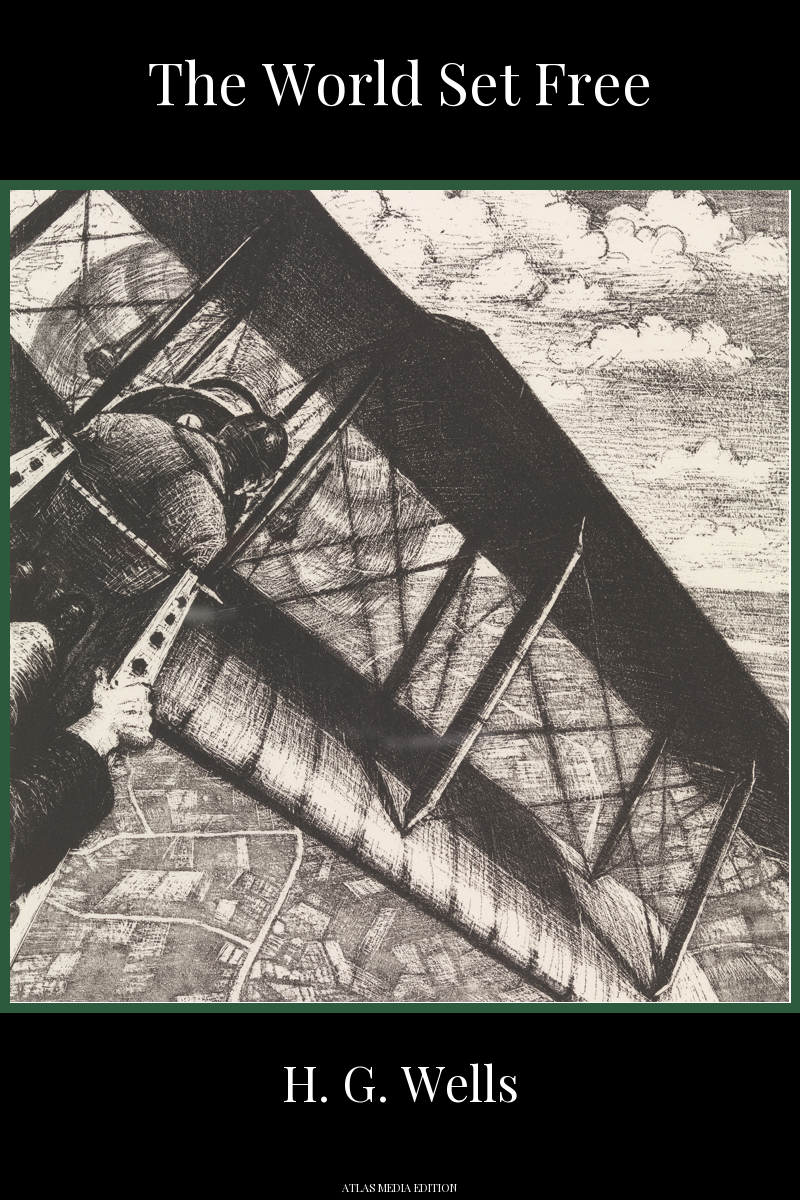
- Novel
The World Set Free
- Published: 1914
- Atlas edition: V1.3 ·
- Language: English
ABOUT THE AUTHOR
H. G. Wells
1866–1946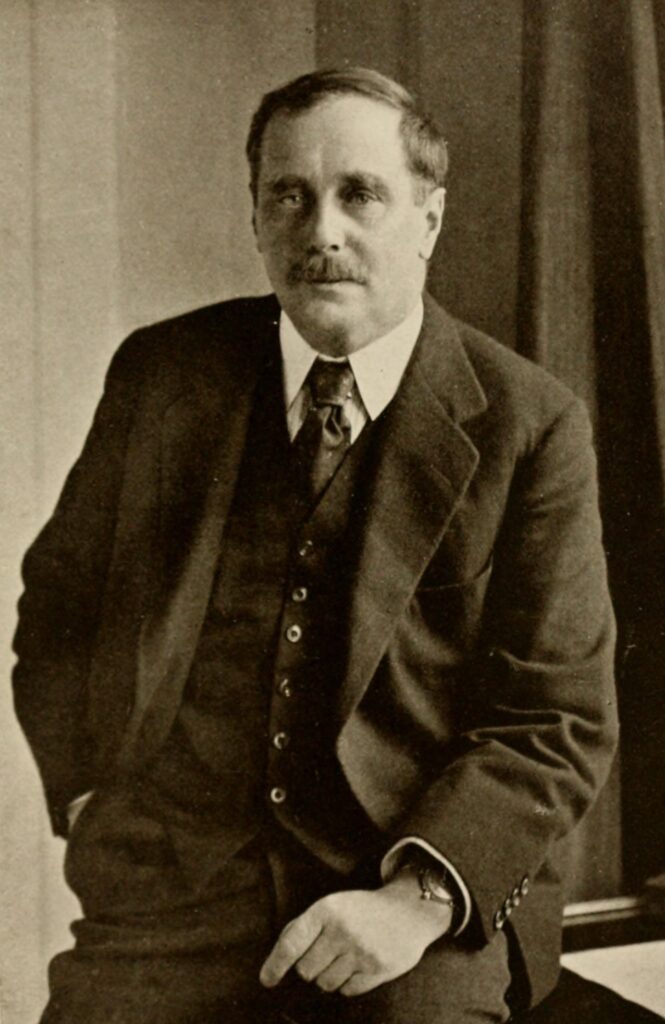
H. G. Wells (1866 to 1946) was an English writer who worked in many genres, producing more than forty novels and dozens of short stories alongside social commentary, history and popular science.
He is best known for science fiction novels such as The Time Machine, and has sometimes been called a father of science fiction. In his lifetime he was also a prominent social critic with a progressive vision, writing utopian works and imagining technologies before they existed.
ABOUT THE WORK
The World Set Free
The World Set Free is a novel by H. G. Wells, written in 1913 and published in 1914. In his preface, dated 1921, Wells describes it as the latest of a series of three fantasias of possibility, stories that turn on the possible future development of some contemporary force or group of forces. The book is dedicated to Frederick Soddy’s Interpretation of Radium, and Wells acknowledges that the story owes long passages to the eleventh chapter of that book.
The work is organised as a preface, a prelude titled The Sun Snarers, and five chapters: The New Source of Energy, The Last War, The Ending of War, The New Phase, and The Last Days of Marcus Karenin.
The prelude opens with a sweeping account of human history as the history of the attainment of external power. Wells calls man the tool-using, fire-making animal and traces his rise from a savage sheltering in holes in the rocks, armed with a rough flint or a fire-pointed stick, to a creature who adds the strength of the horse and the ox, the force of water and wind, and tools of copper and then iron. He describes the slow work of necessity, which sharpened the tiger’s claw and refined the clumsy Orchippus into the horse, and which also shaped early humans. Their herds grew larger, taboos made sons tolerable to their fathers, and huts, garments and stored food let people spread into colder climates. Leisure brought thought, pictorial art and pottery, and the early dream that a man might snare the sun.
The preface tells us what the later chapters are built around. Wells places the coming of a great war in the year 1956, a delay he attributes partly to a habit of being a slow prophet and partly to a wish to give the chemist time to advance toward the release of atomic energy. He notes that some details of his imagined opening of the war proved close to the real thing: an alliance of the Central Empires, a campaign through the Netherlands, and the despatch of the British Expeditionary Force. He also points to his forecast that no great general, no Alexander or Napoleon, could emerge under modern conditions.
Wells admits that the misses outnumber the hits. What he thinks still matters is the main thesis: that because of the growth of scientific knowledge, separate sovereign states and empires are no longer possible, and that clinging to the old system heaps disaster upon disaster and may destroy the race. The story imagines a sort of epidemic of sanity among rulers and leaders, with figures such as King Egbert, meant to be God’s Englishman, leading mankind toward a bold effort of salvage and reconstruction, with gatherings of leading men from rival nations at Brissago in Switzerland.
By 1921 Wells sees that dream as unfulfilled. He contrasts it with the League of Nations at Geneva, which he calls poor and obscure, and he suggests that the world has grown accustomed to a glide toward disintegration. He sees a plain idea of a human commonweal only in the working class movement, tied to the prospect of profound and possibly violent social revolution. The preface closes by calling the book’s dream of educated rulers reshaping the world one that has so far remained a dream.
WHY IT MATTERS
Why The World Set Free matters
The World Set Free matters first as a document of how a major writer tried to think through the consequences of scientific discovery. Wells builds his story on the idea that the release of atomic energy would be a crowning revolution in human potentialities. The book therefore sits at an early point in the literary imagination of nuclear power, and it is still read for that reason. Its debt to Frederick Soddy’s work on radium shows how closely Wells followed contemporary science and tried to translate it into narrative.
It also matters because of the argument at its centre. Wells is less interested in gadgets than in politics. He claims that scientific knowledge has made separate sovereign states untenable, and that the old order can only lead to repeated catastrophe. Whether or not a reader accepts this, the claim frames debates about war, technology and international order that have not gone away.
The preface adds a second layer of interest. Written in 1921, after the Great War had actually happened, it shows an author judging his own predictions with candour. He counts his hits, admits that the misses far outnumber them, and confesses he has been a slow prophet. That honesty is a useful reminder that forecasting in fiction is an argument about possibility, not a promise of events.
The preface also records disappointment. Wells had imagined an outbreak of creative sanity among rulers, and he found instead a weak League and a world growing used to decline. His remark that the lessons of disaster pale into disregard is a pointed observation about human habit and institutional inertia.
Finally, the prelude gives the novel a long view. By starting with the first fire-makers and tool-users, Wells presents atomic power as the latest step in a very old story of gaining external power. Readers can approach the book as science fiction, as political thought, and as a historical witness to the anxieties of 1913 and 1914, and each reading rewards attention.
Edition Record
- First publication
- 1914
- Textual basis
- Source text: Project Gutenberg, https://www.gutenberg.org/ebooks/1059
- Atlas edition
- V1.3 ·
- Language
- English
Prepared from the recorded source and the reviewed Atlas working edition.
Accessibility: EPUB and PDF are offered where approved; accessibility features have not been independently certified.
Source & Rights
- Text source
- Project Gutenberg

The World Set Free by Wells, H. G. (Herbert George). Source text prepared from Project Gutenberg ebook 1059.