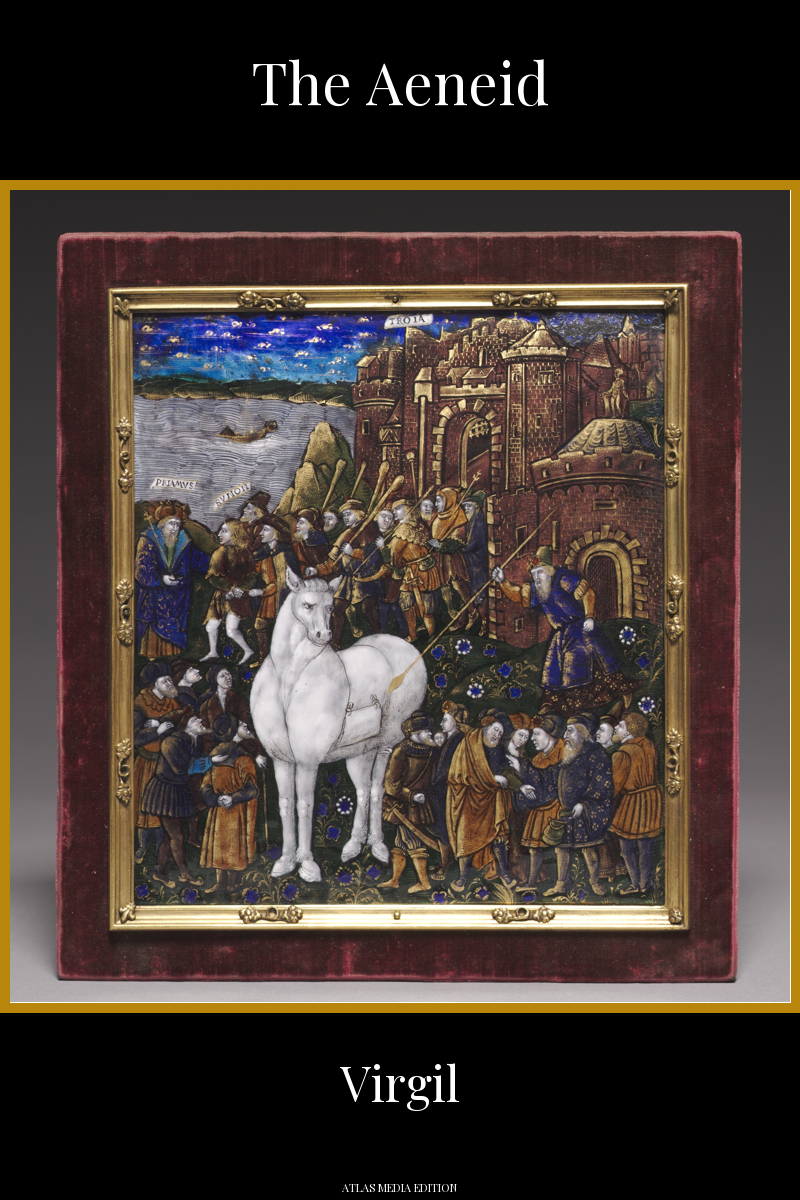
- Novel
The Aeneid
- Published: c. 19 BC
- Atlas edition: V1.3 ·
- Language: Latin
ABOUT THE AUTHOR
Virgil
-70–-19
Virgil was a Roman poet, born in 70 BC and died in 19 BC, according to the supplied metadata. He is credited as the author of the Aeneid, which the Wikipedia introduction says he wrote between 29 and 19 BC. It comprises 9,896 lines in dactylic hexameter. The note supplied with the evidence says Virgil died in 19 BC with the poem unfinished. This edition uses the English translation by John Dryden, who lived from 1631 to 1700.
ABOUT THE WORK
The Aeneid
The Aeneid by Virgil is the Roman national epic, here read in John Dryden’s English translation, which the Project Gutenberg edition presents in twelve books. The poem opens with the famous announcement of arms and the man, a Trojan exile forced by fate and by the unrelenting hatred of Juno to leave his homeland. Long labours by sea and land lie ahead of him before he can win the Latian realm, build the destined town, restore his banished gods to rites divine, and settle a succession from which the Alban fathers and the long glories of Rome will come.
The first book sets the machinery of the whole poem in motion. The narrator asks the Muse to explain the causes and the crimes behind Juno’s anger, and then gives them: she loves Carthage, she has heard a rumour that Trojan descendants will one day ruin it, and she nurses older grievances, including the judgment of Paris that disdained her beauty. For seven years the Trojan survivors have been tossed by storms and scattered across the sea. Such time and toil, the poem says, were required to found the Roman name.
As the Trojan fleet leaves the Sicilian shores, Juno bitterly declares that she cannot be defeated, and she goes to the cave of Aeolus, the king who restrains the struggling winds. She promises him a nymph as a bride if he will sink or disperse her enemies. Aeolus strikes the mountain with his spear and the winds rush out. Thunder, darkness and towering waves overwhelm the ships. Aeneas lifts his hands and wishes that he had died beneath the walls of Troy, beside Hector and Sarpedon, rather than face such a death.
The storm wrecks or strands several vessels, among them the ship of Orontes, whose pilot is flung overboard before the whole ship goes down. Neptune hears the uproar, rises serene above the waves, and rebukes the winds for trespassing on his realm. He calms the sea, and the nymphs and Triton help free the ships from the shoals. Dryden compares the god’s authority to that of a grave and pious man who quiets an angry mob with sober words.
The weary Trojans make for the Libyan shore. According to the argument supplied at the head of the book, Aeneas arrives with his own ship and six more at an African port. Venus appeals to Jupiter on behalf of her son, and Jupiter comforts her and sends Mercury to secure a kind reception for the Trojans among the Carthaginians. Aeneas goes out to explore, meets his mother disguised as a huntress, and is carried in a cloud to Carthage. There he finds friends he had thought lost and is entertained by the queen.
Dido, through the device of Venus, begins to feel a passion for him and asks for the history of his adventures since the siege of Troy. That account fills the next two books. The later books, as the contents list shows, continue through twelve parts and carry the story forward toward Italy and the destiny announced in the opening lines.
WHY IT MATTERS
Why The Aeneid matters
The Aeneid matters because it joins a personal story of exile to the story of a whole civilization. Aeneas is not a free hero chasing glory. He is driven by fate, and the opening lines make plain that his suffering is the price of Rome. The poem asks what it costs a person and a people to found an empire, and it never lets the reader forget that cost.
The first book already shows the tension that runs through the work. The gods quarrel over human lives, and Juno’s rage seems out of proportion to its target. Her question, whether heavenly minds can show such high resentment, is one the poem leaves open. Readers have long argued over whether Virgil celebrates Roman power or quietly mourns what it demands.
The poem also answers Homer. It takes the world of the Iliad and the Odyssey and reframes it from the side of the defeated Trojans. Aeneas recalls the fallen heroes of Troy with grief, and the story turns the memory of a lost city into the seed of a new one. This pattern of borrowing and transforming earlier literature became a model for later European writers.
Dryden’s translation adds a second layer of interest. It is a seventeenth-century English version in rhymed couplets, and it carries the energy and grandeur of its own age. Reading it shows how one great poet can serve another, and how a classical text is renewed whenever it is translated. The storm, the wrecks and Neptune’s calming of the sea are rendered with vivid force.
Finally, the work endures because its themes are still familiar: displacement, duty against desire, the power of anger, and the hope of a home. Readers who meet the poem at its start find a story of refugees at sea, and that image keeps the ancient epic close to present concerns.
Edition Record
- First publication
- c. 19 BC
- Textual basis
- Source text: Project Gutenberg, https://www.gutenberg.org/ebooks/228
- Atlas edition
- V1.3 ·
- Language
- Latin
Prepared from the recorded source and the reviewed Atlas working edition.
Accessibility: EPUB and PDF are offered where approved; accessibility features have not been independently certified.
Source & Rights
- Text source
- Project Gutenberg
The Aeneid by Virgil; translated by Dryden, John. Source text prepared from Project Gutenberg ebook 228.