- Novel
Space, Time and Gravitation
- Published: 1920
- Atlas edition: V1.3 ·
- Language: English
ABOUT THE AUTHOR
Arthur Eddington
1882–1944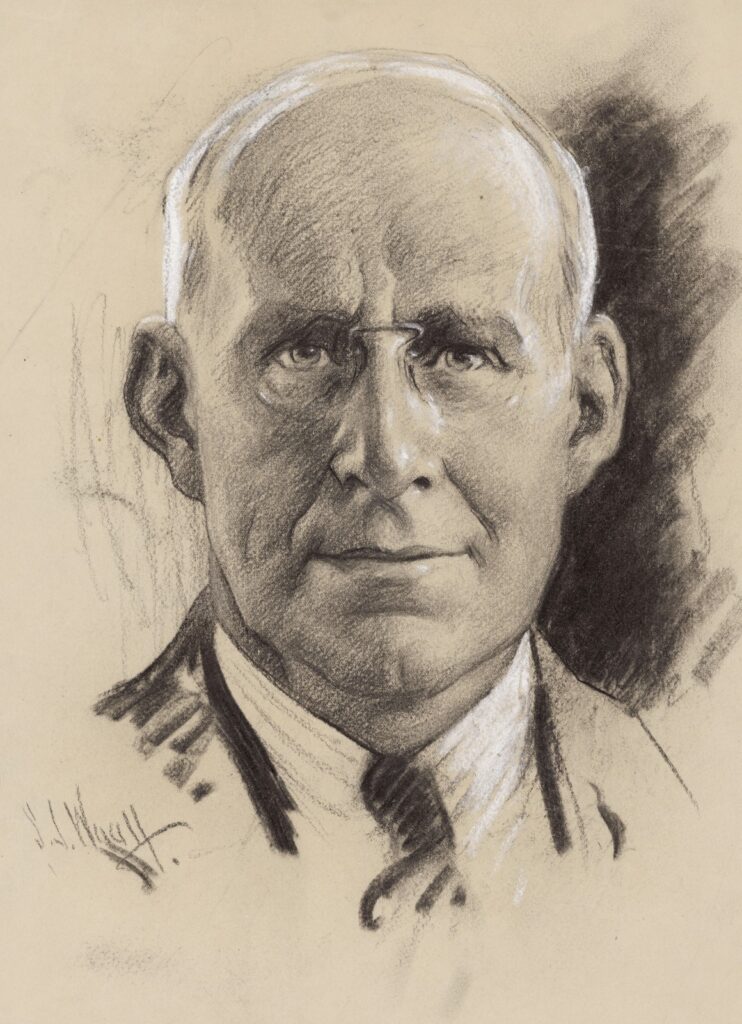
Arthur Stanley Eddington (1882 to 1944) was a British astronomer and physicist. The title page of this book names him as M.A., M.Sc., F.R.S., and Plumian Professor of Astronomy and Experimental Philosophy at Cambridge. His 1920 outline of general relativity was published by Cambridge University Press and addressed readers outside the specialist circle of physics.
ABOUT THE WORK
Space, Time and Gravitation
Space, Time and Gravitation: An Outline of the General Relativity Theory is a short work of popular science by the Cambridge astronomer Arthur Stanley Eddington, published by Cambridge University Press in 1920. It explains Einstein’s general theory of relativity to educated readers without heavy mathematics. It opens with a dialogue among a physicist, a pure mathematician and a relativist on the meaning of geometry. Twelve chapters follow, covering the FitzGerald contraction, relativity, four dimensions, fields of force, curved space, the new law of gravitation, the bending of light, other tests, energy, infinity and electricity. Mathematical notes and a historical note close the book.
WHY IT MATTERS
Why read it
Few scientific books teach you to doubt something you have never questioned. Eddington begins with a triangle and one of Euclid’s propositions, and within a page the reader is asking what a length actually is. That is the gift of this book: it does not hand over relativity as a finished marvel, it rebuilds the ground beneath it, so that the strange theory feels like a reasonable consequence of careful thought about measurement.
It is also a document of a precise moment. It was written just after the 1919 eclipse expeditions, and its frontispiece shows the eclipse instruments at Sobral. A reader meets a theory still new, still contested, explained by a scientist who had helped test it. The prose is witty, humane and lucid, which is rarer than it should be in scientific writing.
Reading it closely
The prologue is the key to the method. Eddington stages a conversation among an experimental Physicist, a pure Mathematician and a Relativist, and lets each voice expose the limits of the others. The Mathematician says he cannot tell whether Euclid’s proposition is true, only that it follows from axioms. The Physicist trusts measurement. The Relativist presses until the Physicist must admit he is, in his own word, hazy about strict definitions.
The argument turns on a circle. Length is defined by a rigid scale, and a rigid scale by constant length. The Relativist compares this to the clock and time-gun in Egypt, each set by the other. His escape is to define the ideal rod by physical qualities such as expansion with temperature, before introducing length at all. Space geometry thus becomes a branch of physics, a “space-field” comparable to a magnetic field, whose laws must be found by experiment.
The form matters. Dialogue lets objections be voiced and answered, and the Relativist’s admission that his interests lie in “the upper structure” while sometimes the foundations must be deepened is a neat image for the whole book. The contents then climb in order from contraction to gravitation, light, energy and cosmology, ending with the nature of things, so that physics gradually shades into philosophy.
Then and now
The book appeared from Cambridge University Press in 1920, soon after the eclipse observations that made general relativity famous, and it served English readers who wanted an account from a leading practitioner. Its specific tests have since been joined by many others, and later texts use more modern mathematics and data. Its standing has shifted from current explanation to a classic of exposition, valued for clarity and for showing how the theory was first understood and argued.
A way in
Start with the prologue and follow the argument about rigid scales slowly; everything later depends on it. Then read the chapters on four dimensions and on weighing light. Treat the appendix of mathematical notes as optional, and watch how Eddington uses analogy in place of equations.
Edition Record
- First publication
- 1920
- Textual basis
- Source text: Wikisource, https://en.wikisource.org/wiki/Space_Time_and_Gravitation
- Atlas edition
- V1.3 ·
- Language
- English
Prepared from the recorded source and the reviewed Atlas working edition.
Accessibility: EPUB and PDF are offered where approved; accessibility features have not been independently certified.
Source & Rights
- Text source
- Wikisource

Space, Time and Gravitation by Arthur Stanley Eddington. Source text transcribed by Wikisource contributors (https://en.wikisource.org/wiki/Space_Time_and_Gravitation).