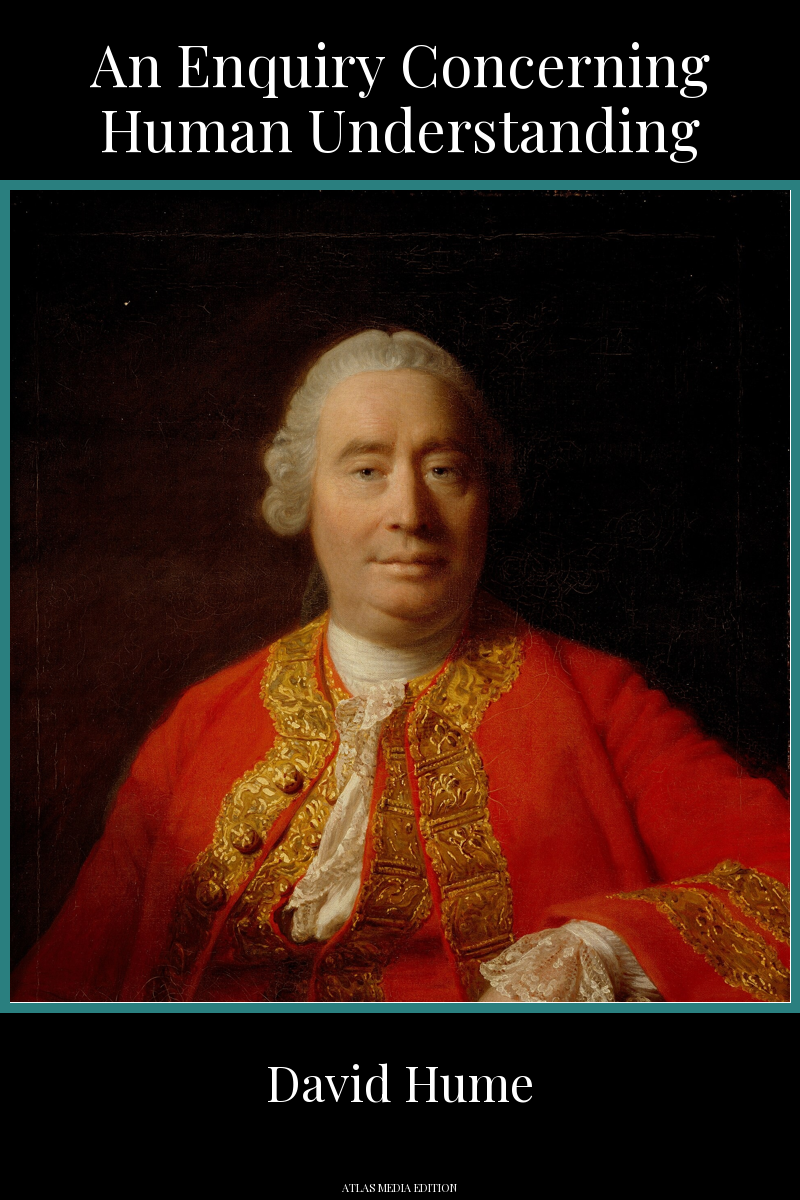
- Novel
An Enquiry Concerning Human Understanding
- Published: 1748
- Atlas edition: V1.4 ·
- Language: English
ABOUT THE AUTHOR
David Hume
1711–1776
David Hume (1711 to 1776) was a Scottish philosopher, usually classed with the empiricists. His best known work on the limits of knowledge appeared in English in 1748 as Philosophical Essays Concerning Human Understanding, and took its familiar title in a 1757 edition.
ABOUT THE WORK
An Enquiry Concerning Human Understanding
This is a philosophical treatise by the Scottish empiricist David Hume, first published in English in 1748 under the title Philosophical Essays Concerning Human Understanding. It asks what human beings can know, and how far experience can carry us.
Hume examines the origin of ideas, the nature of cause and effect, induction, free will, miracles and the limits of reason. He argues that knowledge of the world rests on experience and habit rather than on logic alone. It is a classic of empiricism and a short, readable route into Hume’s philosophy.
WHY IT MATTERS
Why read it
Few books make you doubt so politely. Hume asks how you know the sun will rise tomorrow, and the ground begins to move.
What it gives a reader is a method for catching your own assumptions in the act. You think you see one event force another. Hume asks you to look again and report what you actually observe. The exercise is unsettling, funny at times, and surprisingly hard to escape.
It is also a work of style. Hume wanted to be read by educated people, not only by specialists, and the prose moves with the ease of a good conversationalist. The opening section, on the easy and the abstruse kinds of philosophy, shows him arguing for exactly the blend he practises.
The result is a book short enough for a weekend that has shaped debates on science, religion and the mind ever since.
Reading it closely
The argument is built in steps, and each step is small.
Hume begins with a claim about the mind: our ideas are copies of earlier impressions. This gives him a test. When a grand term seems empty, ask which experience it comes from. If none can be found, the term deserves suspicion.
He then divides objects of reason into relations of ideas, such as mathematics, and matters of fact, which rest on experience. Cause and effect belong to the second group. We never perceive a necessary link between events. We see one thing follow another, again and again, and the mind forms a habit of expecting the second. Necessity, he concludes, is a feeling in us rather than a feature of the world.
This is the problem of induction. Reasoning from past to future assumes that nature is uniform, and that assumption cannot be proved without circular argument.
Hume does not leave us in despair. He proposes a mitigated scepticism, one that accepts custom as the guide of life and keeps inquiry modest. His tone matters here. He writes as a companion, using examples from billiard balls to everyday expectation, and he sets his boldest claims beside plain common sense. The opening plea, “Be a philosopher; but, amidst all your philosophy, be still a man,” states the temper of the whole.
Then and now
The Enquiry was a recasting of ideas Hume had first set out in an earlier and longer work, and it took the new title only in a 1757 edition, according to the evidence supplied. Its fame has grown steadily since.
Later philosophers treated it as a central text. Hume’s treatment of causation and induction became a problem every serious account of science has had to face, and his empiricism remains a standard starting point in university courses.
Its reputation has shifted from provocation to foundation. What once looked like a threat to established belief now reads as a rigorous clarification of what reason can and cannot do. Few philosophical books of its era are read as widely today.
Controversies
The book’s chapter on miracles has long been contested. Hume argues that testimony for a miracle will always be weaker than the uniform experience against it. Religious readers have disputed this, and philosophers still argue over whether his reasoning is sound or circular.
His account of causation is also debated. Some read him as denying real causal connection, others as denying only that we can know it. Scholars continue to disagree.
A way in
Start with Section I for the tone, then move to Sections IV and V, where the central argument lives. Read Section X on miracles last, as a test of the method.
Watch for the move from “what do I actually experience?” to “what do I merely assume?” Pause at each example and try to resist it.
Edition Record
- First publication
- 1748
- Textual basis
- Source text: Standard Ebooks, https://standardebooks.org/ebooks/david-hume/an-enquiry-concerning-human-understanding
- Atlas edition
- V1.4 ·
- Language
- English
Prepared from the recorded source and the reviewed Atlas working edition.
Accessibility: EPUB and PDF are offered where approved; accessibility features have not been independently certified.
Source & Rights
- Text source
- Standard Ebooks

An Enquiry Concerning Human Understanding by David Hume. Source text prepared from the Standard Ebooks edition (https://standardebooks.org/ebooks/david-hume/an-enquiry-concerning-human-understanding).