- Novel
Animal Farm
- Published: 1945
- Atlas edition: V1.6 ·
- Language: English
ABOUT THE AUTHOR
George Orwell
1903–1950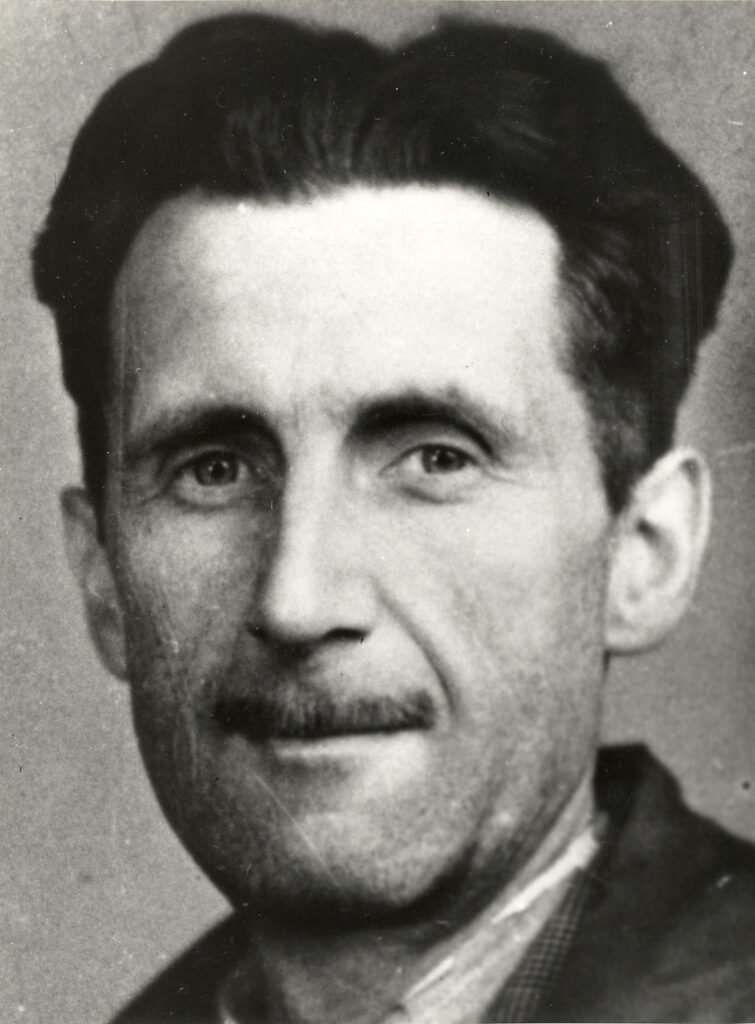
George Orwell was the pen name of Eric Arthur Blair (1903–1950), an English novelist, essayist and journalist. Born in Motihari, India, and educated at Eton, he served with the Indian Imperial Police in Burma from 1922 to 1927 before turning to writing. His early books, including Down and Out in Paris and London (1933) and The Road to Wigan Pier (1937), reported on poverty and working life. He fought with the POUM militia in the Spanish Civil War and was wounded in 1937, an experience recorded in Homage to Catalonia (1938).
During the Second World War he worked for the BBC and became literary editor of Tribune. Animal Farm (1945) and Nineteen Eighty-Four (1949) brought him a lasting international readership, and essays such as “Politics and the English Language” (1946) remain widely read. He died of tuberculosis in London in January 1950.
ABOUT THE WORK
Animal Farm
Animal Farm tells how the animals of Manor Farm drive out their neglectful owner, Mr Jones, and set out to run the farm for themselves. The rebellion is inspired by old Major, a prize boar who, shortly before his death, describes a dream of a world without human masters and teaches the others the song “Beasts of England”.
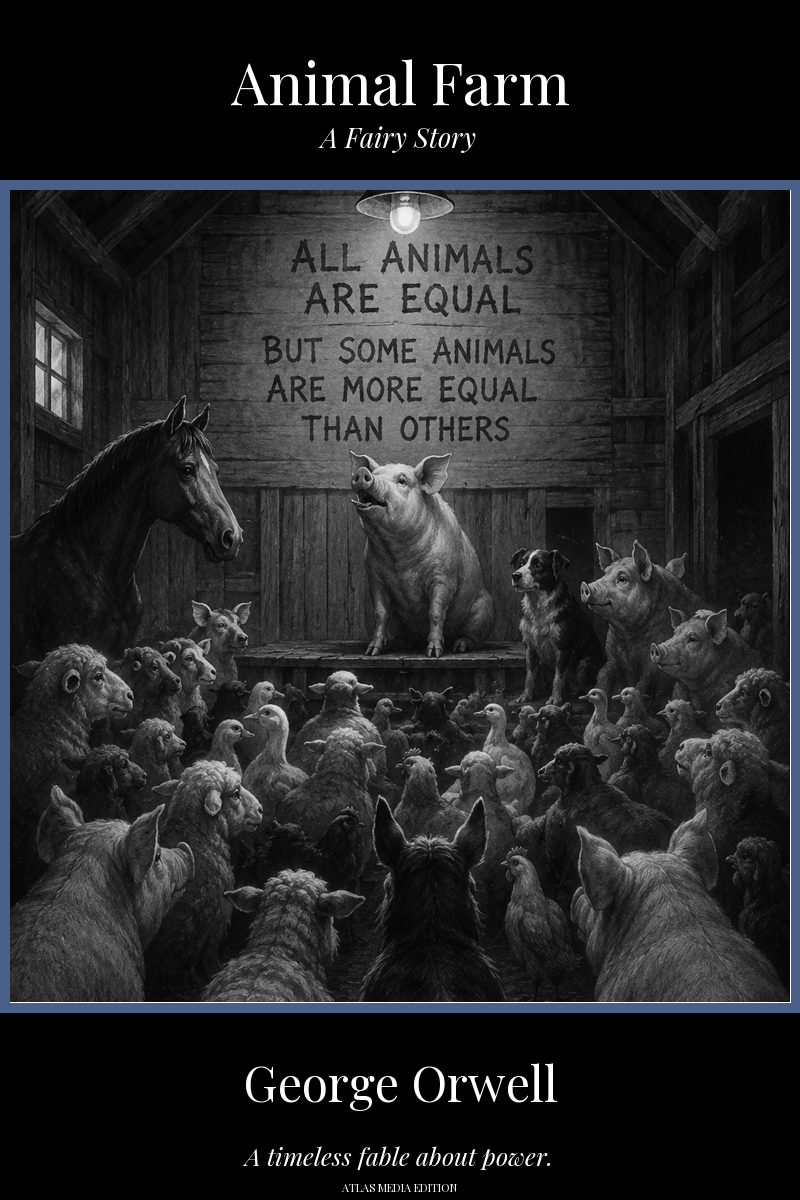
The pigs, the cleverest animals, organise the new order. Its principles, called Animalism, are painted on the barn wall as Seven Commandments, beginning with the promise that all animals are equal. Under Snowball and Napoleon the animals bring in the harvest, defend the farm at the Battle of the Cowshed and plan an ambitious windmill.
Then Napoleon uses a pack of dogs he has raised in secret to drive Snowball out. With the help of Squealer, his persuasive spokesman, he rewrites history, quietly alters the commandments and grows rich on the work of animals such as the devoted cart-horse Boxer. By the end of Animal Farm, the creatures outside the farmhouse window can no longer tell the pigs from the men.
WHY IT MATTERS
Why Animal Farm Matters
Animal Farm compresses a political history into a short, plainly told fable. Orwell subtitled it “A Fairy Story”, and its simple language, animal characters and clear sequence of events make it readable by children while giving adults a precise account of how a revolution can be betrayed.
Readers commonly see in Animal Farm an allegory of the Russian Revolution and its aftermath under Stalin, with Napoleon and Snowball echoing Stalin and Trotsky. Orwell had seen factional suppression at first hand in Spain, and he later explained that he wanted to expose the myth of the Soviet system in a story almost anyone could understand.
How Animal Farm Reached Print
The book was written between late 1943 and early 1944, while Britain was allied with the Soviet Union. Several publishers turned it down. One withdrew after consulting the Ministry of Information, and another replied that it was not the right moment for such a book. Secker & Warburg finally published it in August 1945.
That difficulty is part of the book’s story. Orwell’s concern was not only with dictators but with the willingness of free societies to avoid inconvenient truths. The episode shows how political caution can shape what readers are allowed to see, even without formal censorship.
Why Animal Farm Still Matters
The force of Animal Farm comes from its clarity. Readers watch a revolution made in the name of equality turn into a new hierarchy through small steps: rewritten rules, convenient explanations, the removal of rivals and the labour of those who trust the leadership most.
Squealer is one of the book’s lasting achievements. His explanations, statistics and threats of Jones’s return show how language can make injustice sound reasonable. Each change to the commandments is minor on its own, and the animals’ uncertain memory of the original wording is exactly what makes the changes work.
Boxer gives the story its emotional centre. His mottoes, “I will work harder” and “Napoleon is always right”, express a loyalty the leaders exploit to the end. His fate is the moment many readers remember longest, because it shows the cost of trust placed in the wrong hands.
Other animals show different ways of living under such a system. Benjamin, the old donkey, sees more than he says and trusts no one, yet his cynicism changes nothing until it is too late. Mollie, the vain mare, slips away to a life of ribbons and sugar, and Clover, the motherly horse, senses that something has gone wrong without the words to name it.
Moses the raven, who tells of a paradise called Sugarcandy Mountain, leaves with Jones and later returns, tolerated by the pigs. Readers have long debated what Orwell meant by him. In a few pages, Animal Farm suggests how promises of a better world elsewhere can serve those who hold power here.
The single commandment finally left on the barn wall, that all animals are equal but some animals are more equal than others, has become shorthand for privilege disguised as principle. Animal Farm continues to be read well beyond its original target as a study of how language and loyalty can be used to keep power.
The book’s reach has grown far beyond its first readers. Animal Farm has been translated into many languages, adapted for radio, stage and screen, including a British animated film in 1954, and is widely studied in schools. Its brevity is part of that success: a reader can finish it in an afternoon and spend years noticing how often its patterns recur.
Edition Record
- First publication
- 1945
- Textual basis
- George Orwell's 1945 text, using the transcription distributed by Project Gutenberg Australia (eBook 0100011)
- Atlas edition
- V1.6 ·
- Language
- English
This Atlas edition presents the text of the 1945 novella. Orwell’s proposed preface, “The Freedom of the Press”, is not included: it was first published in 1972 and is not covered by this edition’s rights record. The underlying text is public domain in Australia and the United Kingdom. It remains protected in the United States; this territorial assessment does not claim worldwide public-domain status.
Accessibility: Reflowable EPUB with semantic navigation and reader-controlled typography. A visually checked A5 PDF is also provided for print and fixed-layout reading.
Source & Rights
- Text source
- Project Gutenberg Australia
The underlying text is public domain in Australia and the United Kingdom. It remains protected in the United States; this territorial assessment does not claim worldwide public-domain status.