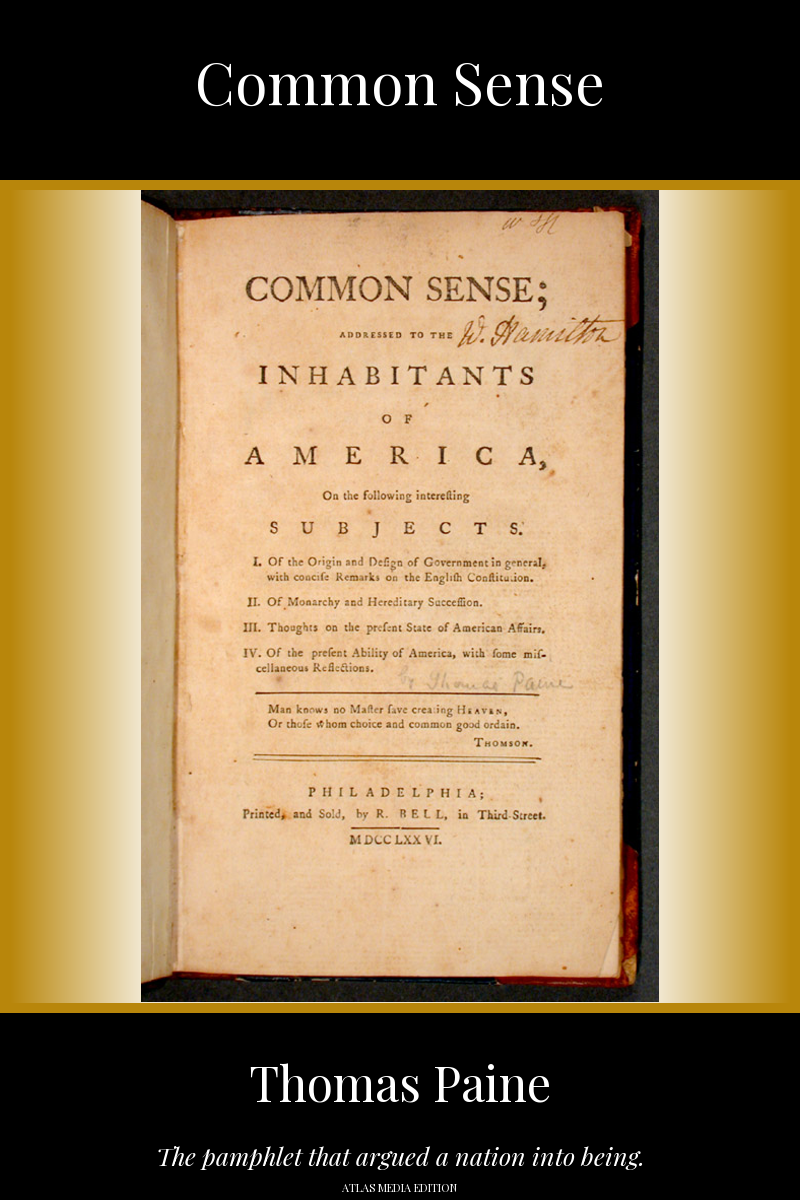
- Novel
Common Sense
- Published: 1776
- Atlas edition: V1.5 ·
- Language: English
ABOUT THE AUTHOR
Thomas Paine
1737–1809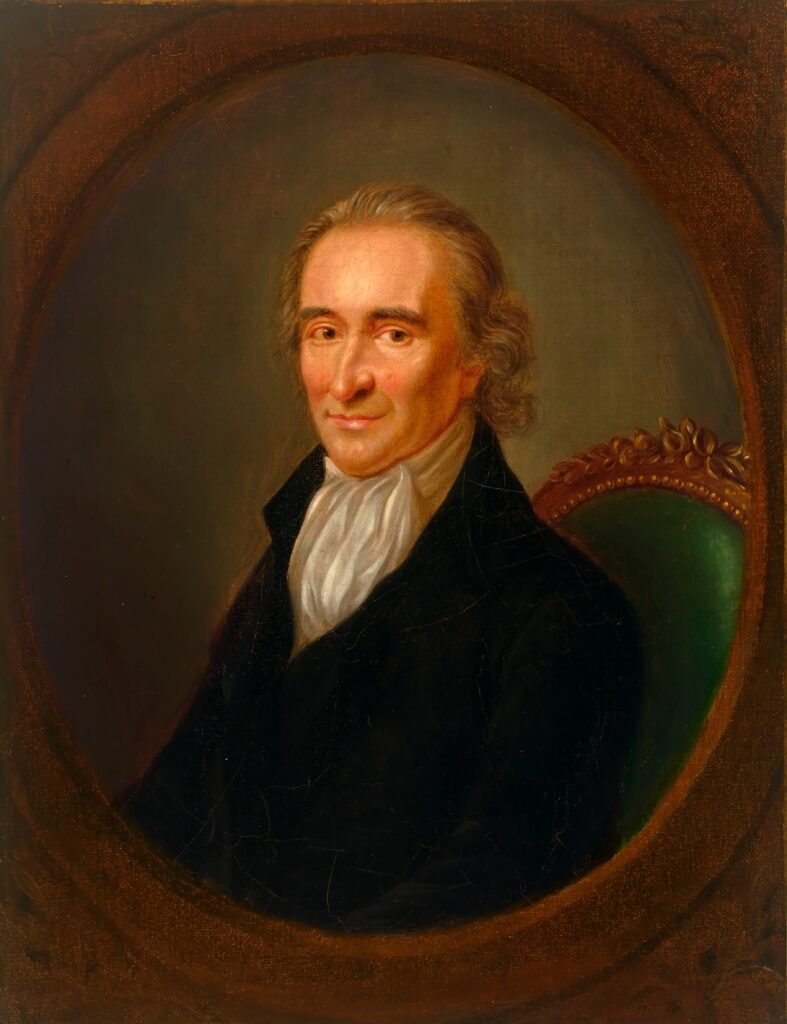
Thomas Paine (1737–1809) was an English-born writer and political thinker whose pamphlets helped shape the American and French revolutions. Born in Thetford, Norfolk, he worked as a corset-maker and an excise officer before emigrating to Philadelphia in 1774 with a letter of introduction from Benjamin Franklin. Common Sense, published in January 1776, made him one of the most widely read writers in America.
His American Crisis essays followed during the war. In Rights of Man (1791–92) he defended the French Revolution, and he was elected to France’s National Convention, then imprisoned during the Terror. The Age of Reason (1794–1807) criticised organised religion and damaged his reputation in America. He died in New York in 1809.
ABOUT THE WORK
Common Sense
Common Sense is Thomas Paine’s argument that the American colonies should declare independence from Britain. Published anonymously in Philadelphia in January 1776, when many colonists still hoped for reconciliation with the King, it set out the case for a complete break in plain language anyone could follow.
Paine begins with first principles. Society, he writes, is produced by our wants and government by our wickedness, so government is at best a necessary evil, to be judged by how well it secures freedom and safety. He then attacks monarchy and hereditary succession as unreasonable in themselves, and the English constitution as less balanced than its admirers claimed.
The second half of Common Sense turns to the colonies’ situation: the costs of staying tied to Britain, the strength America already had, and practical proposals for a continental government. This Atlas edition presents the enlarged text printed in Philadelphia in February 1776, with Paine’s Appendix and his address to the Quakers.
WHY IT MATTERS
Why Common Sense Matters
Common Sense matters because it changed what ordinary colonists thought was possible. Before January 1776, independence was mostly discussed cautiously, among political leaders. Paine put the argument in front of farmers, artisans and soldiers, and made separation sound not only lawful but reasonable and urgent.
Its reach was extraordinary for its time. The pamphlet was reprinted across the colonies, read aloud in taverns and army camps, and argued over in newspapers. Within six months the Continental Congress had adopted the Declaration of Independence, and many readers then and since have seen Common Sense as one of the forces that prepared public opinion for it.
How Common Sense Makes Its Case
The pamphlet is short and carefully built. Its four sections move from the origin and design of government, through monarchy and hereditary succession, to the present state of American affairs and the colonies’ ability to stand alone. Each step prepares the next, so that by the time Common Sense reaches its practical proposals, independence feels like the only sensible conclusion.
Paine’s method is part of his importance. He avoided the Latin quotations and legal citations that filled most political writing of the period, and argued from experience and plain reasoning instead. His famous line, “‘Tis time to part”, lands because the preceding pages make it feel like the conclusion of common sense rather than a leap.
He also widened the stakes. “The cause of America is in a great measure the cause of all mankind,” he wrote in the Introduction, presenting the dispute not as a local quarrel over taxes but as a test of whether people could govern themselves without kings.
Common Sense first appeared without Paine’s name, attributed only to “an Englishman”. Paine had arrived in Philadelphia just over a year earlier, and the anonymity let the argument stand on its own rather than on the reputation of a newcomer. His authorship soon became widely known, and the pamphlet made him famous on both sides of the Atlantic.
The pamphlet is not neutral, and it was not meant to be. Paine wrote as an advocate, and loyalist writers answered him sharply. Reading Common Sense alongside its opponents shows how fiercely the question of independence was contested in 1776.
Paine did not grow rich from his most successful work. He later said he had given up his share of the profits to support the American cause, and reprints by other printers spread the text further than any single edition could. Its influence came from circulation rather than ownership.
Reading Common Sense Today
Common Sense remains a foundational document for anyone studying democratic government. Its arguments about consent, representation and the danger of inherited power continue to appear in debates about constitutions far beyond America.
It is also a model of persuasive writing. Teachers use Common Sense to show how structure, plain language and a confident voice can carry a complex political argument to a wide audience. Its short sections also make it practical to read in full in a single sitting, which is rare for a document of such consequence. Paine’s later works, Rights of Man and The Age of Reason, extended the same approach to Europe and to religion.
This edition includes the Appendix Paine added after the first printing, which answers the King’s speech to Parliament, and his address to the Religious Society of Friends. Together they show Paine responding to events as they unfolded, which is how Common Sense was first read: as part of a living argument.
Edition Record
- First publication
- 1776 · Robert Bell, January 1776; enlarged edition with an Appendix and an address to the Quakers later in 1776
- Textual basis
- Thomas Paine's text in the enlarged edition printed by W. & T. Bradford, Philadelphia, 14 February 1776, using the transcription distributed as Project Gutenberg eBook 147
- Atlas edition
- V1.5 ·
- Language
- English
This Atlas edition presents the enlarged 1776 text, including the Appendix and the address to the Religious Society of the People called Quakers. The cover reproduces the title page of the first edition (Robert Bell, January 1776). Project Gutenberg branding has been removed while the digital source is acknowledged.
Accessibility: Reflowable EPUB with semantic navigation and reader-controlled typography. A visually checked A5 PDF is also provided for print and fixed-layout reading.
Source & Rights
- Text source
- Project Gutenberg

Common Sense by Thomas Paine (1776). Prepared from Project Gutenberg eBook 147.