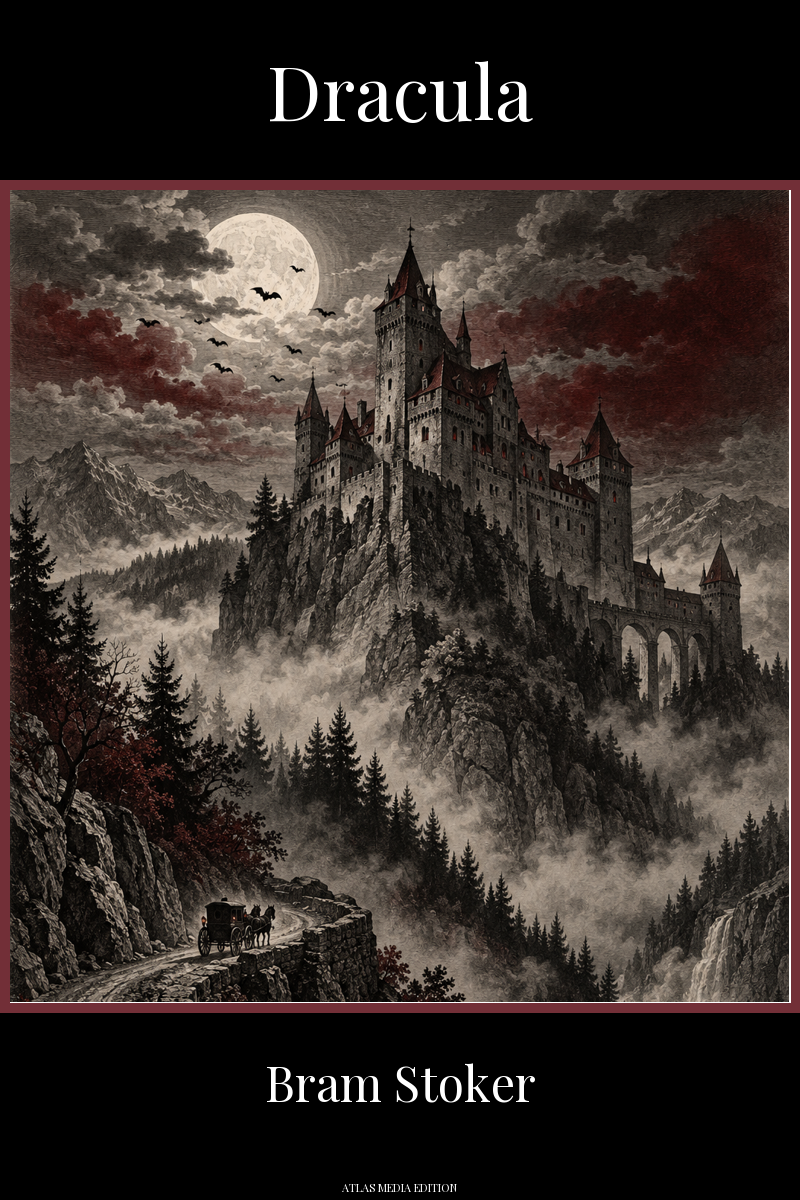
- Novel
Dracula
- Published: 1897
- Atlas edition: V1.3 ·
- Language: English
ABOUT THE AUTHOR
Bram Stoker
1847–1912Bram Stoker (1847–1912) was a novelist whose working life also included civil service, journalism and theatre management. He worked with the actor Henry Irving, serving as his private secretary and business manager. His association with Irving is documented in historical material preserved by the Bram Stoker Estate. Alongside his fiction, Stoker wrote Personal Reminiscences of Henry Irving, drawing on that professional relationship. A contemporary obituary describes the several occupations he pursued and singles out Dracula among his novels. Published in 1897, Dracula brings his literary work into this collection alongside the records of a life closely connected with the theatre.
ABOUT THE WORK
Dracula
Published in 1897, Bram Stoker’s Dracula stands within a vampire tradition older than the Count himself. European folklore had long imagined dangerous beings returning from the dead, while John Polidori’s The Vampyre (1819) and Sheridan Le Fanu’s Carmilla (1872) had already brought vampires into literary fiction. Stoker gave that developing tradition a character and story that became central to its later popular life.
The story of Dracula
The novel begins with Jonathan Harker travelling to Transylvania to arrange a property purchase for Count Dracula. His apparently routine professional visit becomes an encounter with imprisonment and supernatural danger. When the threat reaches England, Lucy Westenra’s illness draws her friends and doctors into an investigation that their familiar explanations cannot resolve. Abraham Van Helsing joins the struggle, while Mina Harker gathers the records that allow the group to understand their experiences together.
Reading Dracula through its documents
Journals, letters, telegrams, newspaper reports and recorded observations carry the story. This documentary form places an ancient threat inside a world of train timetables, medical expertise and new communications. Reading the novel invites questions about who is believed, what counts as evidence and how people respond when their assumptions fail. It also offers a Gothic exploration of bodily vulnerability, intimacy, power and the fear of losing control.
The novel’s documents can be read as more than a device for suspense. An account written close to an event may contain uncertainty that a later explanation smooths away. As the records accumulate, the reader can notice the distance between what a character experiences and what the group eventually concludes. Dracula makes that process part of the reading experience: its supernatural danger is encountered through ordinary habits of observing, writing, remembering and comparing.
Dracula on screen
Dracula’s later history reaches well beyond the printed page, as the BFI’s history of vampire films illustrates. F. W. Murnau’s Nosferatu (1922) adapted Stoker’s story without authorisation. Bela Lugosi’s Dracula (1931) helped establish the Count’s familiar screen presence, while Christopher Lee’s performance in Hammer’s Dracula (1958) offered another influential interpretation. Those portrayals show how adaptation changes a character’s appearance, manner and emotional meaning. Stoker’s threatening Count, the elegant screen seducer and the sympathetic vampires of later stories belong to an evolving tradition. Returning to the novel reveals one of its formative texts, before the accumulated imagery of later versions became familiar.
WHY IT MATTERS
Why Dracula matters
Dracula helped turn an older vampire tradition into a cultural reference point that continues to be reimagined across fiction, theatre, cinema and television. Its significance lies both in Stoker’s novel and in the long afterlife of the character: later storytellers have repeatedly changed what the vampire looks like, what it wants and how an audience is invited to feel about it.
Desire, fear and the human vampire
The vampire is especially suited to an unsettling mixture of attraction and fear. A recognisably human figure can offer beauty, intimacy or escape from ageing while making those desires dangerous. Immortality depends on taking life from others; closeness can become possession; admiration can become submission. Read through that tension, vampire stories provide ways to explore desire, jealousy, dependence, exclusion and the exercise of power. Sympathy and horror can occupy the same encounter.
Gender and authority in Dracula
Reading Dracula also means attending to its Victorian assumptions. The characters’ different roles invite questions about gender, social position and the authority granted to doctors, husbands and other experts. Mina’s practical work is central to the group’s understanding, even as others try to protect her by excluding her from parts of their investigation. That tension gives readers more to consider than a simple contest between good and evil.
Dracula in popular memory
That emotional range helps explain the figure’s adaptability. Stoker’s Count is principally a predatory threat, while later fiction and adaptations have also developed seductive lovers, conflicted outsiders and comic figures. Each interpretation adds to a shared image without exhausting it. More than a century after publication, readers can recognise Dracula before they have opened the book. Reading the original lets us examine how a Victorian story entered popular memory, how that memory has transformed it, and why its uneasy relationship between humanity and monstrosity still invites new interpretations.
For readers coming from film or television, the book offers a useful point of comparison. Which features belong to Stoker’s text, and which have become familiar through performance, costume or later storytelling? Reading Dracula alongside an adaptation turns recognition into inquiry. The differences can reveal how another period or medium reshapes fear and desire, and how a story remains recognisable while its emphasis changes.
Edition Record
- First publication
- 1897
- Textual basis
- Source text: Project Gutenberg, https://www.gutenberg.org/ebooks/345
- Atlas edition
- V1.3 ·
- Language
- English
Prepared from the recorded source and the reviewed Atlas working edition.
Accessibility: EPUB and PDF are offered where approved; accessibility features have not been independently certified.
Source & Rights
- Text source
- Project Gutenberg
- Cover image
- Cover image source
Dracula by Stoker, Bram. Source text prepared from Project Gutenberg ebook 345.