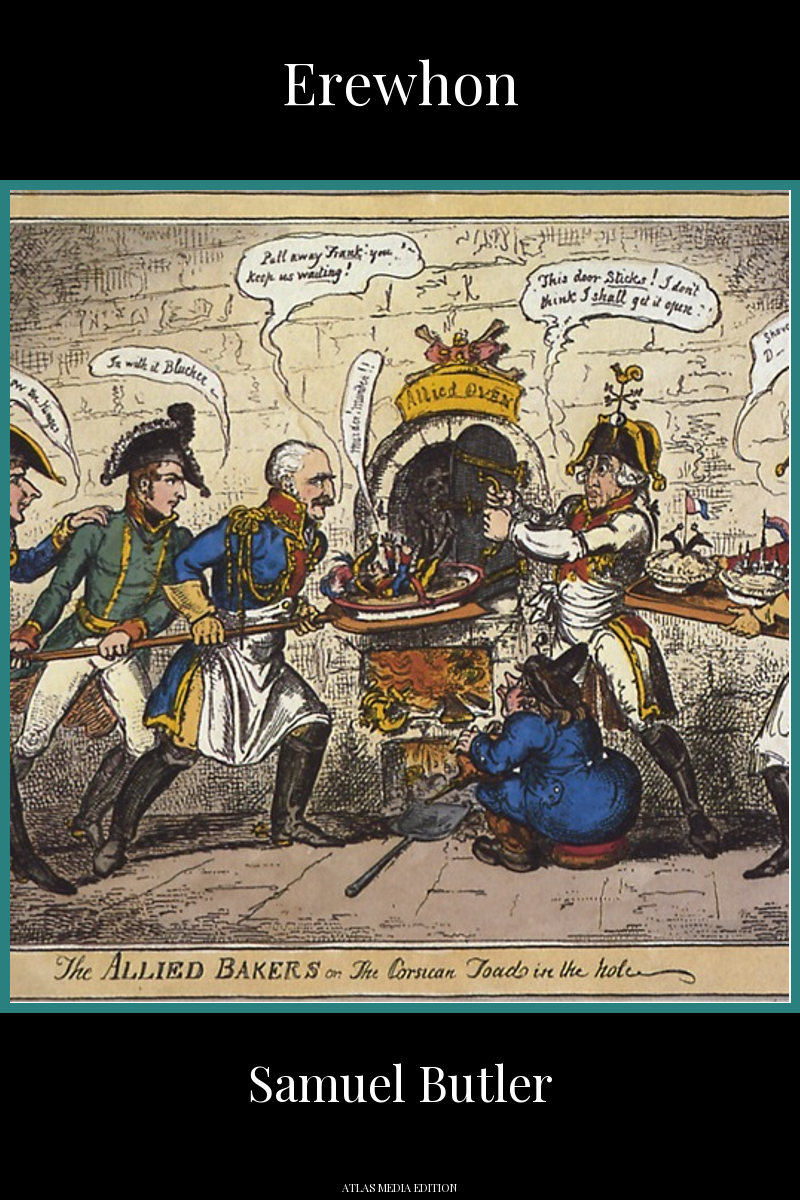
- Novel
Erewhon
- Published: 1872
- Atlas edition: V1.4 ·
- Language: English
ABOUT THE AUTHOR
Samuel Butler
1835–1902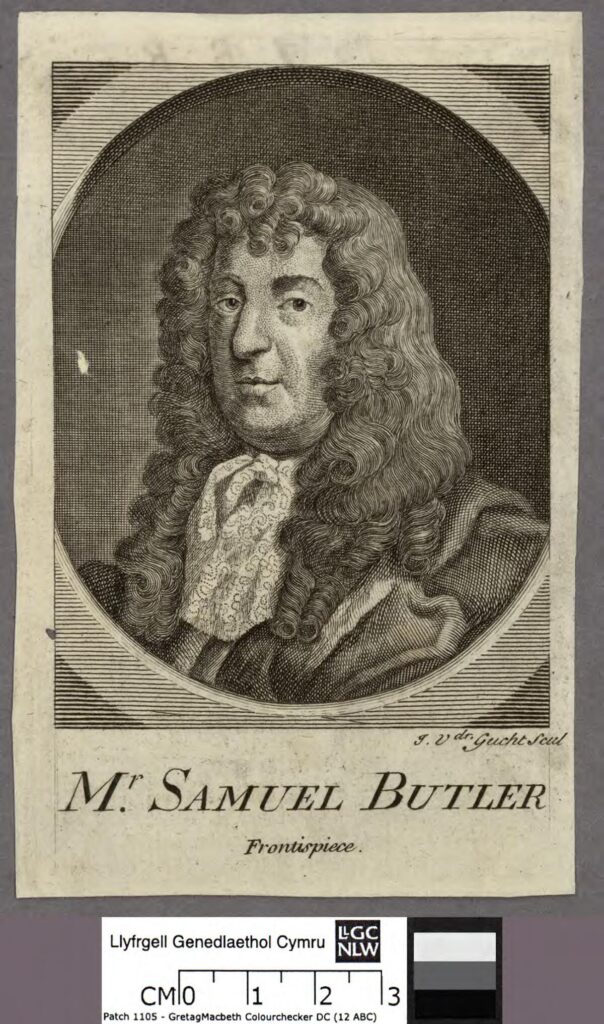
Samuel Butler (1835 to 1902) was an English writer. His own prefaces to Erewhon record that he lived for a time in the Upper Rangitata district of the Canterbury Province of New Zealand, and that he hoped to succeed as a painter, occasionally having work hung at Royal Academy exhibitions. He also names Life and Habit, published in November 1877, as a later book. Erewhon appeared at the end of March 1872.
ABOUT THE WORK
Erewhon
Erewhon, or Over the Range, by Samuel Butler, is a satirical utopian novel narrated by a young Englishman who goes out to a colony, which the author’s own preface places in the Upper Rangitata district of the Canterbury Province of New Zealand. The opening chapters, titled Waste Lands, In the Wool-Shed, Up the River, The Saddle and The River and the Range, follow the narrator as a sheep-station hand who wants to learn what lies beyond the great range of mountains. Butler says in a later preface that these chapters were drawn from that district, with modifications he found convenient.
With the sixth chapter, Into Erewhon, the narrator crosses the range and enters a hidden country. The strange name is pronounced as a word of three syllables, all short, as the first preface insists. The chapters First Impressions, In Prison and To the Metropolis show him taken into custody by the inhabitants and then brought toward their capital, learning their customs as he goes.
The central chapters present the Erewhonians as a people whose values are turned upside down. Their chapters are titled Current Opinions, Some Erewhonian Trials, Malcontents and The Views of the Erewhonians Concerning Death. The titles alone suggest a society where moral and legal categories are reversed, including a trial of a man for being in a consumption, which Butler mentions among his early drafts. The institution of the Musical Banks, which Butler says he also drafted early, gives the narrator a further view of how the people keep up a public show of belief that they do not truly hold.
Later chapters turn to Ydgrun and the Ydgrunites, Birth Formulae and The World of the Unborn. These take up questions of belief, responsibility and the origins of human life. What They Mean By It and The Colleges of Unreason continue the satire against established education and learned institutions.
The best known section is the three chapters on The Book of the Machines. Butler explains that the germ of this material was an article called Darwin among the Machines, signed Cellarius and published in the Press newspaper at Christchurch on June 13, 1863. He later rewrote and enlarged it for the Reasoner in 1865. In the book it becomes an Erewhonian argument about the place of machines in the life of the community. Butler insists in his second preface that it was not meant to laugh at Mr. Darwin, for whom he professes profound admiration.
Two further chapters follow, on the rights of animals and the rights of vegetables, each presented as the views of an Erewhonian thinker. The narrator then plans his Escape, and the Conclusion closes the account.
The prefaces also describe the book’s history. Butler says he finished it by 1871, that Chapman and Hall declined it on May 1 of that year, and that it appeared at the end of March 1872 after he took it to Mr. Trübner. The first edition sold in about three weeks, and a second edition with a new preface followed on June 9, 1872. Later he issued a revised and enlarged edition.
WHY IT MATTERS
Why Erewhon matters
Erewhon matters because it uses a travel narrative to examine the habits of the society that produced it. Butler does not offer a blueprint for a better world. He builds a country in which familiar attitudes toward illness, crime, religion and education are inverted, so that the reader sees how arbitrary those attitudes may be.
The book is also an early and influential piece of writing about machines. The chapters on the Book of the Machines treat technology as something that might develop in ways its makers do not control. Butler’s own prefaces show the idea began as a newspaper article in 1863 and grew through several rewrites. Readers who return to those chapters today often find them a striking forerunner of later arguments about automation and artificial intelligence, though that reading is an interpretation and not Butler’s stated aim.
The second preface is revealing about how Butler wanted to be read. He denies that he meant to ridicule Darwin, and he denies that he meant to deny human responsibility. He also admits the book contains inconsistencies and blames them, with deadpan humor, on the Erewhonians. That tone of ironic evasion is part of the satire, and it makes the book harder to pin down than a simple attack on any one target.
The publication story adds to its interest. A work that a publisher’s reader judged unlikely to be popular became an unlooked-for success, helped by early reviews in the Pall Mall Gazette and the Spectator. Butler credits part of this to the sound of a new and unknown voice.
For a modern reader the book remains a lively example of Victorian satire. It rewards attention to its structure, in which a plain colonial opening gives way to an increasingly strange and argumentative society. It is useful for anyone studying utopian and dystopian fiction, debates about science and religion, or the long history of fears and hopes about technology.
Edition Record
- First publication
- 1872
- Textual basis
- Source text: Project Gutenberg, https://www.gutenberg.org/ebooks/1906
- Atlas edition
- V1.4 ·
- Language
- English
Prepared from the recorded source and the reviewed Atlas working edition.
Accessibility: EPUB and PDF are offered where approved; accessibility features have not been independently certified.
Source & Rights
- Text source
- Project Gutenberg

Erewhon by Butler, Samuel. Source text prepared from Project Gutenberg ebook 1906.