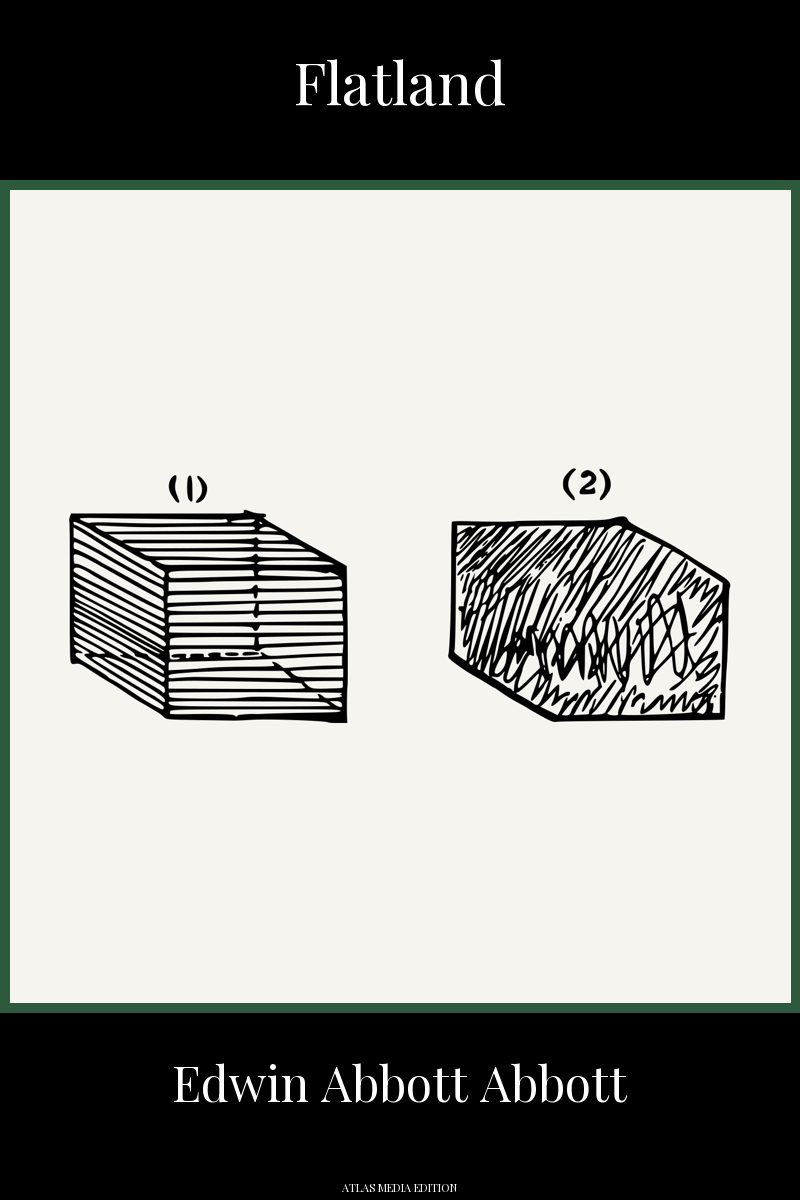
- Novel
Flatland
- Published: 1884
- Atlas edition: V1.3 ·
- Language: English
ABOUT THE AUTHOR
Edwin Abbott Abbott
1838–1926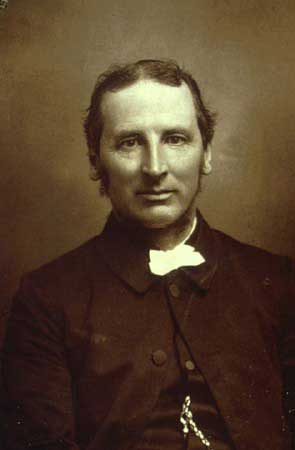
Edwin A. Abbott (Edwin Abbott Abbott) was born in 1838 and died in 1926. He was an English theologian, Anglican priest and schoolmaster. He is best known for Flatland, a satirical novella first published in 1884 by Seeley and Co. of London.
ABOUT THE WORK
Flatland
Flatland: A Romance of Many Dimensions is a satirical novella narrated by A Square, a citizen of a two-dimensional world where women are Lines, workers are Isosceles Triangles and priests are Circles. He describes the laws, class system and customs of his society. Then a Sphere from the third dimension lifts him out of his plane and shows him Spaceland.
The Square returns to preach the third dimension and is imprisoned for it. A classic of Victorian science fiction and mathematical fiction, it argues that imagination must stretch beyond what we can see, and it mocks rank, dogma and complacency along the way.
WHY IT MATTERS
Why read it
Few books teach you to see so much with so little. This one asks you to imagine a world with no up, then to imagine that your own world has a direction you cannot point to. That is a hard thing to do, and the narrator makes it feel like a game.
It also gives a reader a satire that stings. The social ladder of Flatland, with its fixed ranks and its polite cruelty, will look familiar. You come for the geometry and stay for the uncomfortable mirror.
It is short, strange and quick. Almost nothing else is a mathematical thought experiment, a social comedy and a parable of faith in one sitting.
Reading it closely
The book is built in two halves, and the shape carries the argument. Part I, “This World”, describes Flatland with the dry confidence of a local historian. Part II turns to other worlds, and the confident voice meets something it cannot explain.
The narrator is the key device. A Square is respectable, pedantic and proud, and he is blind to his own prejudice. His account of women, who are mere Lines, is delivered as plain fact. The reader sees what he cannot, and the irony does the work.
The method is analogy. The Square cannot grasp the Sphere until he is shown a line world, Lineland, whose king cannot grasp him. Each step teaches the reader how to reason about a fourth dimension by the same pattern, from point to line to square to cube and on.
The opening image of the penny, which becomes a straight line when your eye sits at the table’s edge, shows the style: a homely object, a clear demonstration. The Square’s last answer, that Flatlanders cannot measure their own “height”, turns the argument back on the reader. The idea closes the trap gently: you too may be missing a dimension.
Then and now
The book appeared in 1884, and the preface to the second and revised edition says the first had required a second edition “with unexpected celerity”. It was treated at first as a clever curiosity.
Its standing grew in the twentieth century, when ideas of higher dimensions and relativity gave it fresh interest. Teachers of mathematics and physics adopted it, and it is now widely read as an early classic of science fiction.
Readers today often value it as much for its satire as for its geometry. It remains in print and, as a public domain text, is freely available.
Controversies
The book’s treatment of women has drawn criticism. The Square describes them as dangerous, thoughtless Lines, and critics have charged him with being a woman-hater. The 1884 preface raises this objection itself and has the Square partly disown such views, saying he writes as a Historian who has taken on the opinions of his world.
Readers still disagree. Some see sharp satire of Victorian attitudes; others find the prejudice too well drawn to excuse. The text itself leaves both readings open.
A way in
Start with Part I, chapter one, and try the penny experiment on a real table. Read the preface after the novella if you prefer, since it gives away the Square’s fate. Watch the narrator’s tone, especially on women and rank, and notice where he is most sure of himself.
Edition Record
- First publication
- 1884
- Textual basis
- Source text: Standard Ebooks, https://standardebooks.org/ebooks/edwin-a-abbott/flatland
- Atlas edition
- V1.3 ·
- Language
- English
Prepared from the recorded source and the reviewed Atlas working edition.
Accessibility: EPUB and PDF are offered where approved; accessibility features have not been independently certified.
Source & Rights
- Text source
- Standard Ebooks

Flatland by Edwin A. Abbott. Source text prepared from the Standard Ebooks edition (https://standardebooks.org/ebooks/edwin-a-abbott/flatland).