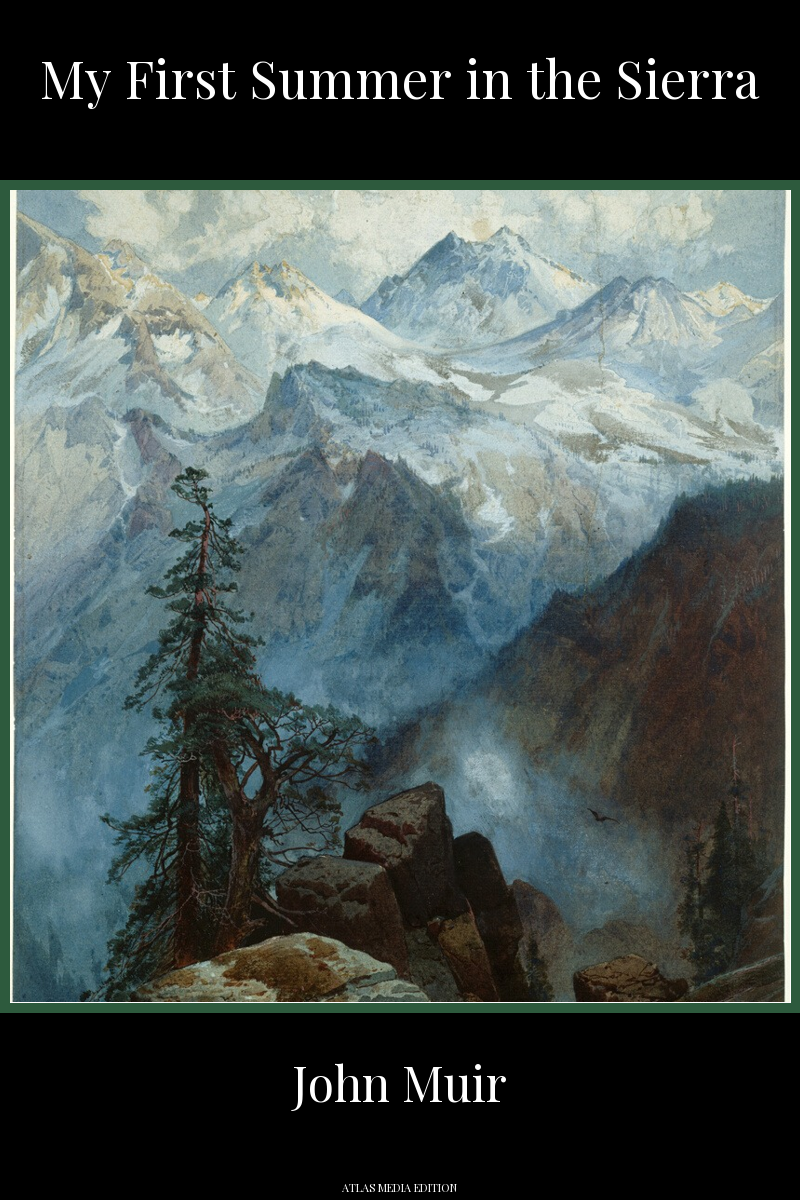
- Novel
My First Summer in the Sierra
- Published: 1911
- Atlas edition: V1.3 ·
- Language: English
ABOUT THE AUTHOR
John Muir
1838–1914John Muir (1838 to 1914) was the author of My First Summer in the Sierra. The supplied evidence records his birth and death years and identifies him as the creator of the work. It describes the book as based on a summer in the Sierra in 1869, when he went into the mountains with a sheep flock, and it notes his earlier experience of the Yosemite region. A biographical source also says he lived in a cabin for two years and wrote about this period in the book, dated 1911.
ABOUT THE WORK
My First Summer in the Sierra
My First Summer in the Sierra is John Muir’s account of the months he spent in the high country of California in 1869. The text opens on June 3 of that year, when Muir leaves a ranch near French Bar on the Tuolumne River with a flock of sheep, bound for the headwaters of the Merced and Tuolumne rivers. The book is built from the notes he kept at the time, and the volume in the evidence is the Sierra Edition printing of 1917 from Houghton Mifflin, which carries a 1911 copyright in Muir’s name.
The first chapter explains how he came to go. The Central Valley dries out by the end of May, and flocks are driven up to the cool green pastures of the mountains. Muir longs for the Sierra but has little money and worries about bread. A sheep owner, Mr. Delaney, offers him work: go along with the shepherd and the flock, make sure the shepherd does his duty, and stay free to study plants, rocks and scenery. Muir doubts he is the right man, since he does not know the upper country, its rivers, or the animals that prey on sheep, but Delaney brushes these worries aside.
Muir also gains a companion, a St. Bernard named Carlo, entrusted to him by a hunter who fears the plains heat will kill the dog. The scene of the dog listening to the two men and choosing to follow Muir shows the attention to animal character that runs through the book.
The party that sets out includes Delaney, the shepherd Billy, two helpers for the first days, and Muir with a notebook tied to his belt. Muir describes the flock in motion: the irregular triangle of sheep, the eager leaders, the dawdling tail end, and the mothers and lambs who know one another’s voices amid the din. The midday heat, the panting animals and the tawny foothills, with blue oaks and slate slabs like tombstones, give a vivid sense of the lowland journey before the climb begins.
The contents list shows the shape of the whole summer. After the foothills come a camp on the North Fork of the Merced, a bread famine, the move to the high mountains, and a long chapter on the Yosemite. Later chapters take him to Mount Hoffman and Lake Tenaya, a strange experience, the Mono Trail, Bloody Cañon and Mono Lake, the Tuolumne camp, and the return to the lowlands.
The book is also illustrated. It includes photographs of Yosemite Falls, the Domes and Cathedral Peak, and it reproduces sketches Muir made in 1869, such as his camp on the North Fork of the Merced, a sugar pine, and a Douglas squirrel. These show that the observation was visual as well as verbal. The dedication to the Sierra Club, described as a faithful defender of the people’s playgrounds, signals the conservation purpose that later readers associate with Muir.
From the opening chapter alone, the book combines practical detail, humor, natural history and eager anticipation of the mountains. Muir presents himself as an unqualified but willing shepherd’s overseer whose real purpose is to learn, and the narrative follows that curiosity upward through each forest belt as the snow melts.
WHY IT MATTERS
Why My First Summer in the Sierra matters
This book matters because it shows how a particular way of looking at wild land took shape. Muir does not arrive as a tourist or a surveyor. He arrives as a hired hand attached to a commercial flock, and the tension in that arrangement gives the book its interest. The sheep are a means of getting into the mountains, yet the text and the illustration captions make clear that grazing damaged the high meadows. The note that grasses and wild flowers recovered once sheep were barred from Yosemite National Park gives the account an afterlife in conservation history.
The writing is also notable for its attention to ordinary living creatures. Muir listens to mothers and lambs finding one another by voice, and he treats Carlo as a thinking companion. This habit of granting animals individuality, rather than treating them as stock or scenery, is one of the qualities that make his nature writing feel fresh.
The book is useful for readers who want to understand the origins of American wilderness appreciation. It was published in 1911, decades after the summer it describes, yet it keeps the immediacy of journal entries, with dated days and concrete observations of plants, rocks and weather. That blend of scientific curiosity and joy gives it a double appeal as natural history and as personal narrative.
It also records a working landscape of the period: sheep owners, shepherds, hired helpers, bread shortages and the plain economics that sent a young man into the mountains. Muir’s admission that money was scarce keeps the romance grounded.
For a general reader, the book is an accessible entry point to Muir. The prose is lively, the structure follows a clear upward journey, and the places named, Yosemite, Tenaya, Mono Lake and the Tuolumne, remain central to how people think about the Sierra Nevada. The dedication to the Sierra Club further links the book to the movement that Muir helped inspire, which makes it a useful companion to any study of early conservation.
Edition Record
- First publication
- 1911
- Textual basis
- Source text: Project Gutenberg, https://www.gutenberg.org/ebooks/32540
- Atlas edition
- V1.3 ·
- Language
- English
Prepared from the recorded source and the reviewed Atlas working edition.
Accessibility: EPUB and PDF are offered where approved; accessibility features have not been independently certified.
Source & Rights
- Text source
- Project Gutenberg
My First Summer in the Sierra by Muir, John. Source text prepared from Project Gutenberg ebook 32540.