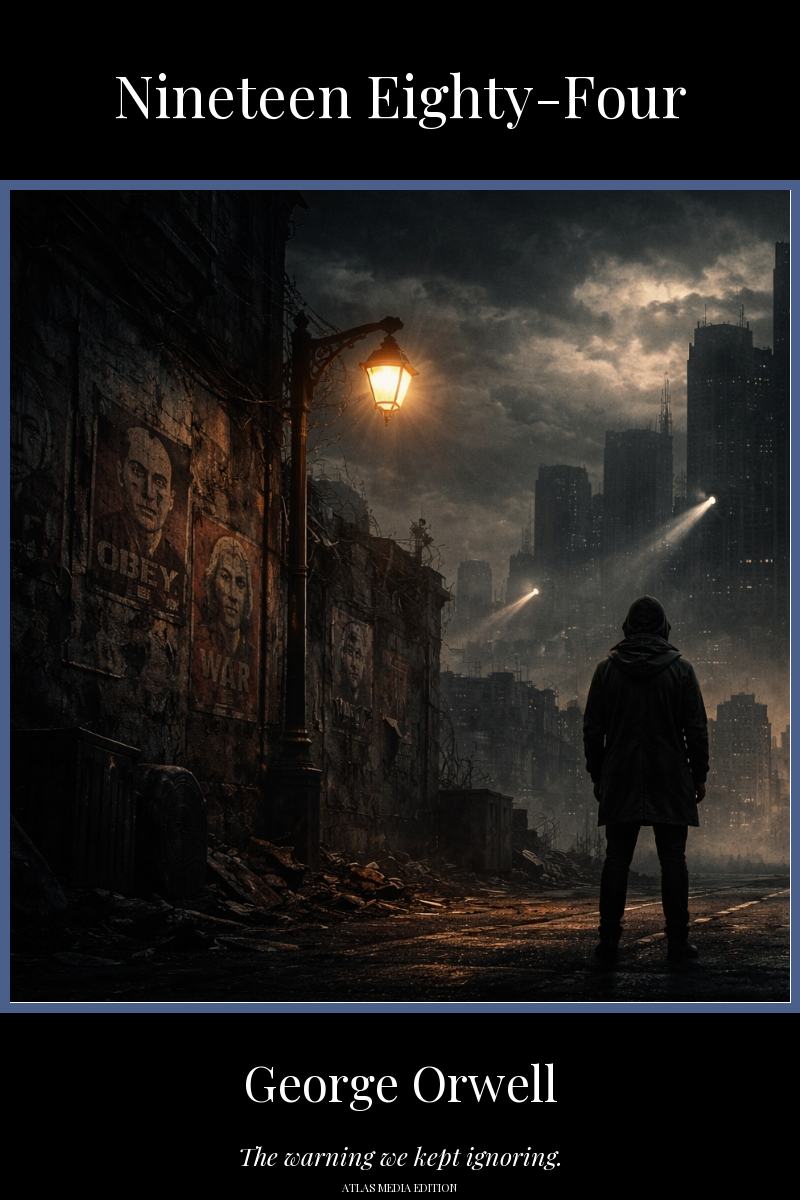
- Novel
Nineteen Eighty-Four
- Published: 1949
- Atlas edition: V1.8 ·
- Language: English
ABOUT THE AUTHOR
George Orwell
1903–1950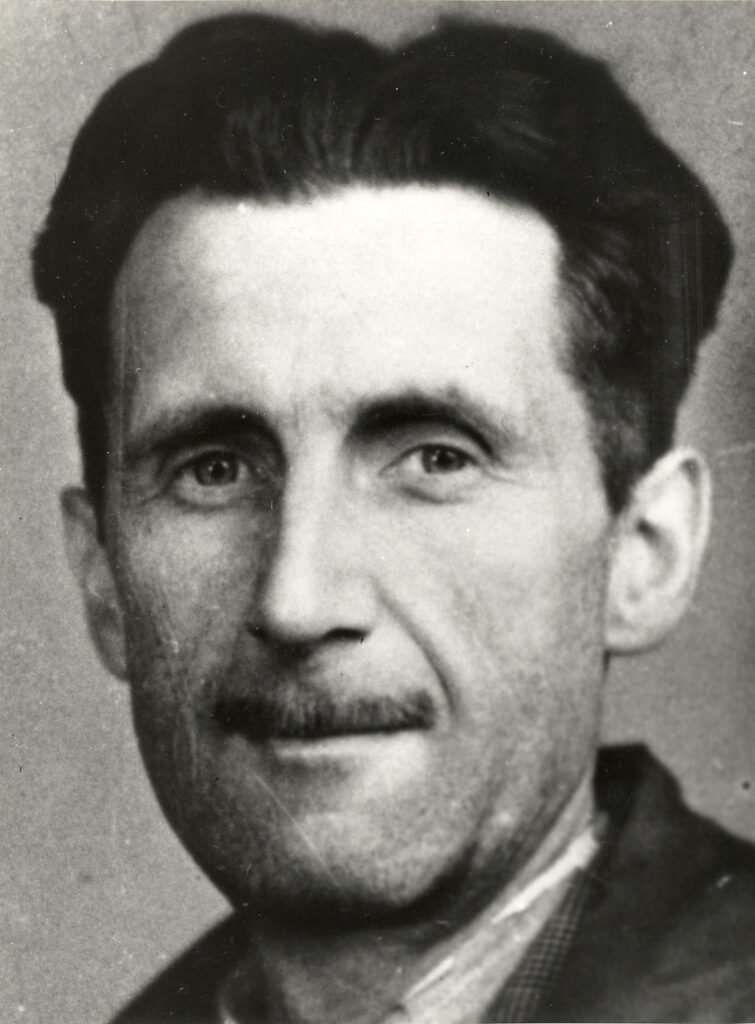
George Orwell was the pen name of Eric Arthur Blair (1903–1950), an English novelist, essayist and journalist. Born in Motihari, India, and educated at Eton, he served with the Indian Imperial Police in Burma from 1922 to 1927 before turning to writing. His early books, including Down and Out in Paris and London (1933) and The Road to Wigan Pier (1937), reported on poverty and working life. He fought with the POUM militia in the Spanish Civil War and was wounded in 1937, an experience recorded in Homage to Catalonia (1938).
During the Second World War he worked for the BBC and became literary editor of Tribune. Animal Farm (1945) and Nineteen Eighty-Four (1949) brought him a lasting international readership, and essays such as “Politics and the English Language” (1946) remain widely read. He died of tuberculosis in London in January 1950.
ABOUT THE WORK
Nineteen Eighty-Four
Nineteen Eighty-Four follows Winston Smith, a minor official in the Records Department of the Ministry of Truth in London, the chief city of Airstrip One in the superstate of Oceania. His job is to rewrite old newspaper reports so that the record always agrees with whatever the ruling Party says now.
The Party, personified by the never-seen Big Brother, watches citizens through telescreens, stages daily Two Minutes Hate sessions and polices thought itself. Winston begins a secret diary, falls in love with Julia, a young woman from the Fiction Department, and finds a hiding place in a room above Mr Charrington’s junk shop.
Hoping that a resistance exists, Winston and Julia trust O’Brien, a member of the Inner Party, who gives them the forbidden book attributed to Emmanuel Goldstein. Their trust is betrayed. In the Ministry of Love and finally Room 101, Winston is broken until he believes what the Party tells him. Nineteen Eighty-Four closes with an appendix, “The Principles of Newspeak”, describing the language the Party designed to make dissent impossible to express.
WHY IT MATTERS
Why Nineteen Eighty-Four Matters
Nineteen Eighty-Four gave the language of politics many of its most enduring words: Big Brother, doublethink, Newspeak, thoughtcrime, the memory hole and Room 101. The adjective “Orwellian” itself largely comes from this novel. Few works of fiction have supplied so much of the vocabulary people use to describe power.
Its significance lies less in predicting particular technologies than in describing how power can work on truth itself: by controlling records, narrowing language and demanding public belief in contradictions. The Party’s slogans, “War is Peace, Freedom is Slavery, Ignorance is Strength”, show the method in miniature.
The idea at the centre of Nineteen Eighty-Four is doublethink: the ability to hold two contradictory beliefs at once and accept both. When the enemy changes in the middle of Hate Week, the crowd adjusts without protest, and the records are corrected to show it was always so. Orwell’s point is that the most effective control is the kind people learn to practise on themselves.
How Nineteen Eighty-Four Took Shape
Orwell drew on experience. He had reported on the Spanish Civil War, where he saw the same events described in opposite ways by rival newspapers, and he spent two years producing wartime broadcasts for the BBC. Both left him alert to how institutions manage what people are allowed to know.
He wrote most of Nineteen Eighty-Four on the Scottish island of Jura in 1947 and 1948, while seriously ill with tuberculosis, under the working title “The Last Man in Europe”. The book was published in June 1949, seven months before his death. That urgency is part of its character: it reads as a final warning rather than a speculative entertainment.
The novel also belongs to a tradition of dystopian fiction. Orwell had reviewed Yevgeny Zamyatin’s We, and read Aldous Huxley’s Brave New World. Where Huxley imagined control through pleasure, Nineteen Eighty-Four imagines control through fear, surveillance and the steady rewriting of the past.
Winston writes in his diary that if there is hope, it lies in the proles, the poor majority the Party barely bothers to watch. The novel never settles whether that hope is realistic. Their songs, crowded streets and ordinary lives stand as the one part of Oceania the Party has not fully captured, and Winston’s admiration for them is one of the book’s few warm notes.
Reading Nineteen Eighty-Four Today
The book has been read as a warning about many systems and has been invoked across the political spectrum. Its endurance comes from that openness. It asks readers to notice when language is used to obscure, when the past is quietly revised, and when agreement is enforced rather than earned.
Nineteen Eighty-Four is also a love story and a study of one mind under pressure. Winston’s small acts of private life, a diary, a paperweight, an afternoon in the countryside, matter because the Party wants nothing left that is personal. The ending is bleak precisely because it shows how much can be taken from a person.
The structure of Nineteen Eighty-Four is part of its effect. Part One builds the world through Winston’s routine; Part Two gives him love, privacy and hope; Part Three takes each of them away in turn. Readers who come to the book knowing only its famous phrases are often surprised by how personal, and how carefully paced, the story is.
Read in full, including its appendix on Newspeak, Nineteen Eighty-Four rewards attention to how its arguments are built. The appendix is written in the past tense, a detail readers have long debated as a hint that the Party did not last for ever.
Edition Record
- First publication
- 1949
- Textual basis
- George Orwell's 1949 text, using the transcription distributed by Project Gutenberg Australia (eBook 0100021)
- Atlas edition
- V1.8 ·
- Language
- English
This Atlas edition presents the text of the 1949 novel, including its appendix. Earlier Atlas packaging from 2025 has been replaced. The underlying text is public domain in Australia and the United Kingdom. It remains protected in the United States; this territorial assessment does not claim worldwide public-domain status.
Accessibility: Reflowable EPUB with semantic navigation and reader-controlled typography. A visually checked A5 PDF is also provided for print and fixed-layout reading.
Source & Rights
- Text source
- Project Gutenberg Australia
The underlying text is public domain in Australia and the United Kingdom. It remains protected in the United States; this territorial assessment does not claim worldwide public-domain status.