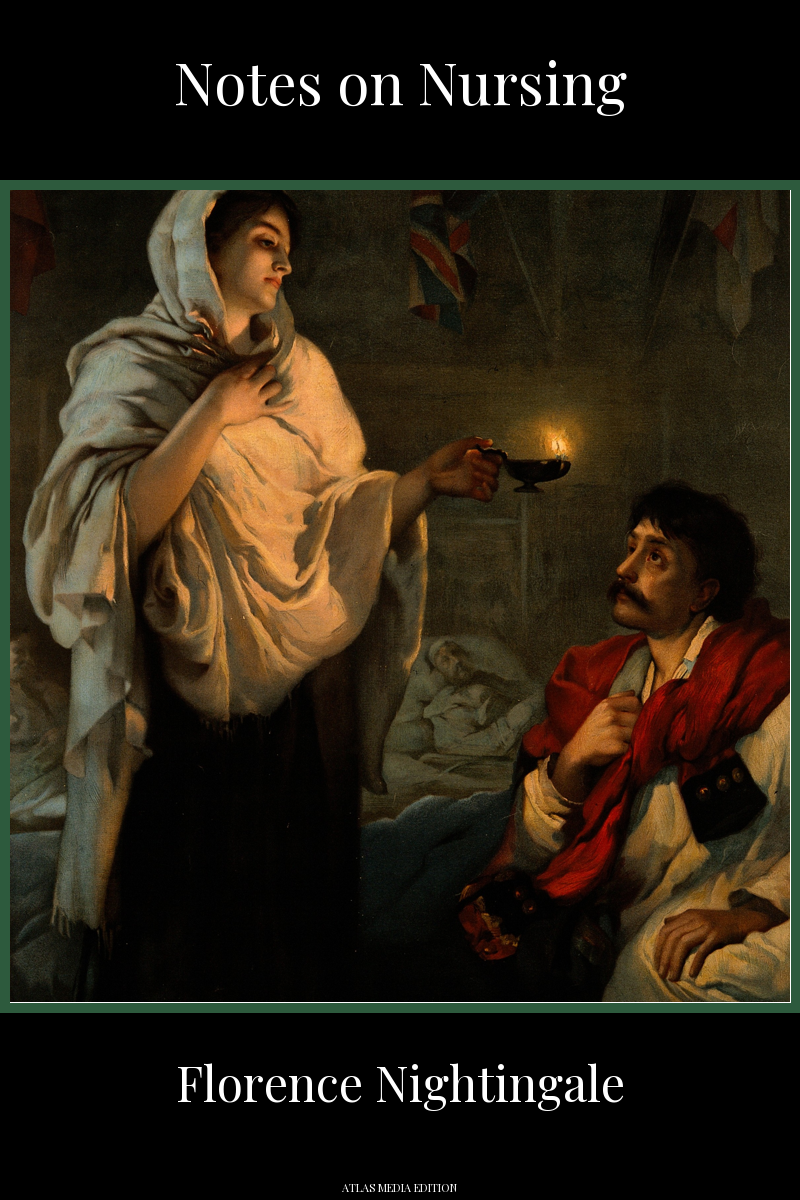
- Novel
Notes on Nursing
- Published: 1859
- Atlas edition: V1.3 ·
- Language: English
ABOUT THE AUTHOR
Florence Nightingale
1820–1910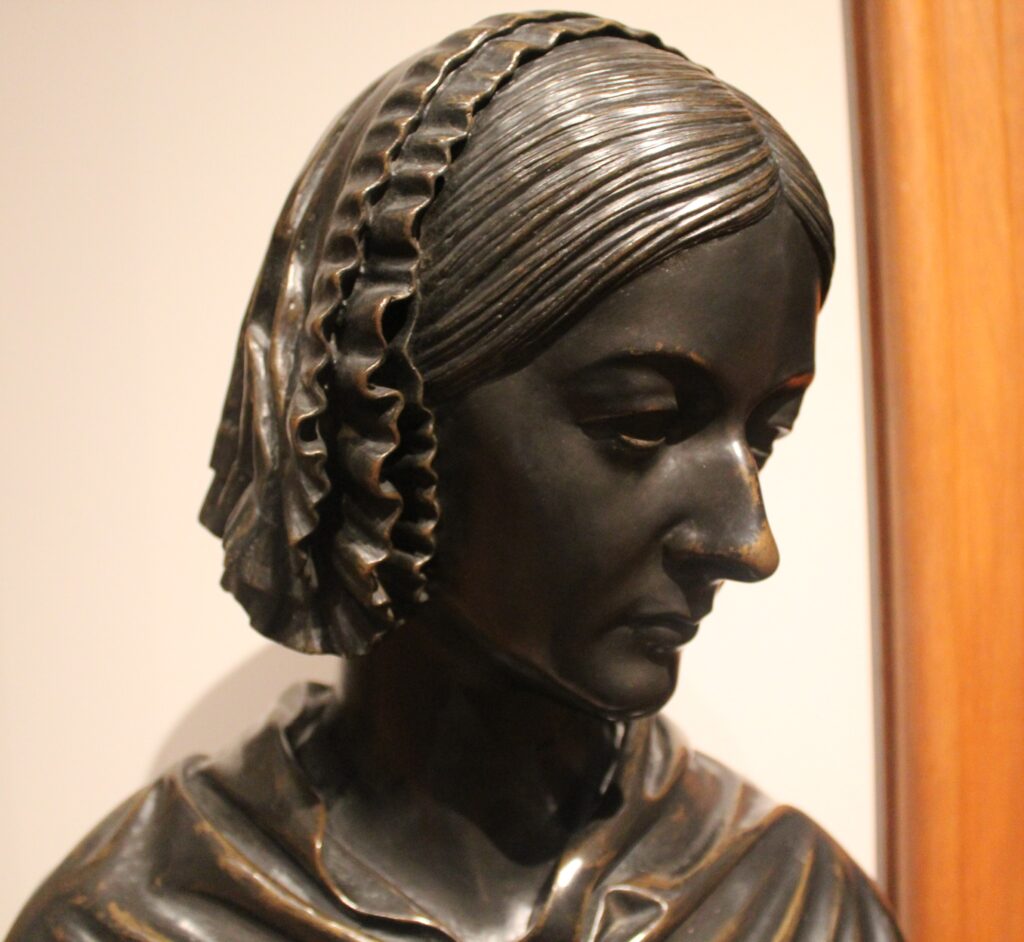
Florence Nightingale (1820 to 1910) is credited as the author of Notes on Nursing: What It Is, and What It Is Not. The supplied evidence gives only her birth and death years. The book was printed in London by Harrison and Sons, and its title page names Harrison, 59 Pall Mall, as bookseller to the Queen. In the preface she addresses women who have personal charge of the health of others.
ABOUT THE WORK
Notes on Nursing
Notes on Nursing: What It Is, and What It Is Not is a book by Florence Nightingale, printed in London by Harrison and Sons, with the imprint line naming Harrison, bookseller to the Queen. In its preface she says the notes are not a rule by which nurses can teach themselves, and not a manual for training nurses. They are meant to give hints for thought to women who have personal charge of the health of others. Her reasoning is that almost every woman in England will at some time have charge of a child or an invalid, so in effect every woman is a nurse.
The opening chapters set out a general principle. Nightingale proposes that disease, at some stage of its course, is a reparative process, an effort of nature to remedy poisoning or decay that began unnoticed long before. She expects objections and answers them with a comparison to Mont Blanc: we should finish making the earth healthy at the bottom before arguing about the summit.
Her central claim is that many symptoms and sufferings assumed to belong to a disease actually come from something else. She names the want of fresh air, light, warmth, quiet and cleanliness, and a lack of punctuality and care in giving food. If a patient is cold, feverish, faint, sick after eating or suffering a bed-sore, she says, the fault is generally not the disease but the nursing.
She therefore redefines the word nursing. It had been limited to giving medicines and applying poultices. She argues it should mean the proper use of fresh air, light, warmth, cleanliness and quiet, and the right choice and administration of diet, all at the least expense of vital power to the patient. She also holds that the very elements of nursing are all but unknown, and she rejects the saying that every woman makes a good nurse. She adds that bad sanitary, architectural and administrative arrangements can make nursing impossible.
The text also turns to the well. The same laws of health apply to the healthy as to the sick. Addressing mothers directly, she cites the high death rates of infants in England and asks whether such suffering is necessary. She criticises a society that teaches girls the elements of astronomy while leaving the laws of health unlearnt, and she answers the complaint that circumstances such as the east wind lie beyond our control.
The first numbered chapter, Ventilation and Warming, gives what she calls the first canon of nursing: keep the air the patient breathes as pure as the external air, without chilling him. She warns against taking air from corridors, halls, kitchens or sewers, and against closed, unused rooms with stagnant air. The contents list continues with chapters on the health of houses, petty management, noise, variety, food, bed and bedding, light, cleanliness, chattering hopes and advices, and observation of the sick, followed by a conclusion and an appendix.
WHY IT MATTERS
Why Notes on Nursing matters
Notes on Nursing matters because it treats care as a matter of environment and attention rather than only of medicine. Nightingale asks the reader to look at the room, the air, the light, the noise and the meal, and to see these as part of treatment. That shift in what counts as care is the book’s lasting contribution.
The work is also notable for its audience. It is not addressed to a professional guild. It speaks to ordinary women who look after children and the sick at home, and it insists that this knowledge is distinct from medical knowledge, which only a profession can have. The preface frames health knowledge as something everyone ought to possess, an idea that sits close to later public health education.
The tone is blunt and argumentative. Nightingale anticipates the objections of her readers and answers them one by one, from the claim that she would do nothing in cholera or fever to the claim that mothers cannot control the winds. This makes the text lively, and it shows a writer who wants to change habits rather than merely describe them.
Her use of figures about infant deaths shows an early reliance on evidence to press a moral and practical point. She links preventable suffering to ignorance and to poor buildings and administration, which places responsibility on institutions as well as individuals.
For modern readers the book offers a clear statement of principles that still shape nursing and hospital design: fresh air, cleanliness, quiet, light and good observation. Some of its theory reflects its time, such as its language about nature and God, and its confident account of how disease works. Read with that in mind, it remains a primary source for how nursing was reconceived as an art of attentive, practical care, and for the voice of one of its most influential advocates.
Edition Record
- First publication
- 1859
- Textual basis
- Source text: Project Gutenberg, https://www.gutenberg.org/ebooks/17366
- Atlas edition
- V1.3 ·
- Language
- English
Prepared from the recorded source and the reviewed Atlas working edition.
Accessibility: EPUB and PDF are offered where approved; accessibility features have not been independently certified.
Source & Rights
- Text source
- Project Gutenberg

Notes on Nursing by Nightingale, Florence. Source text prepared from Project Gutenberg ebook 17366.