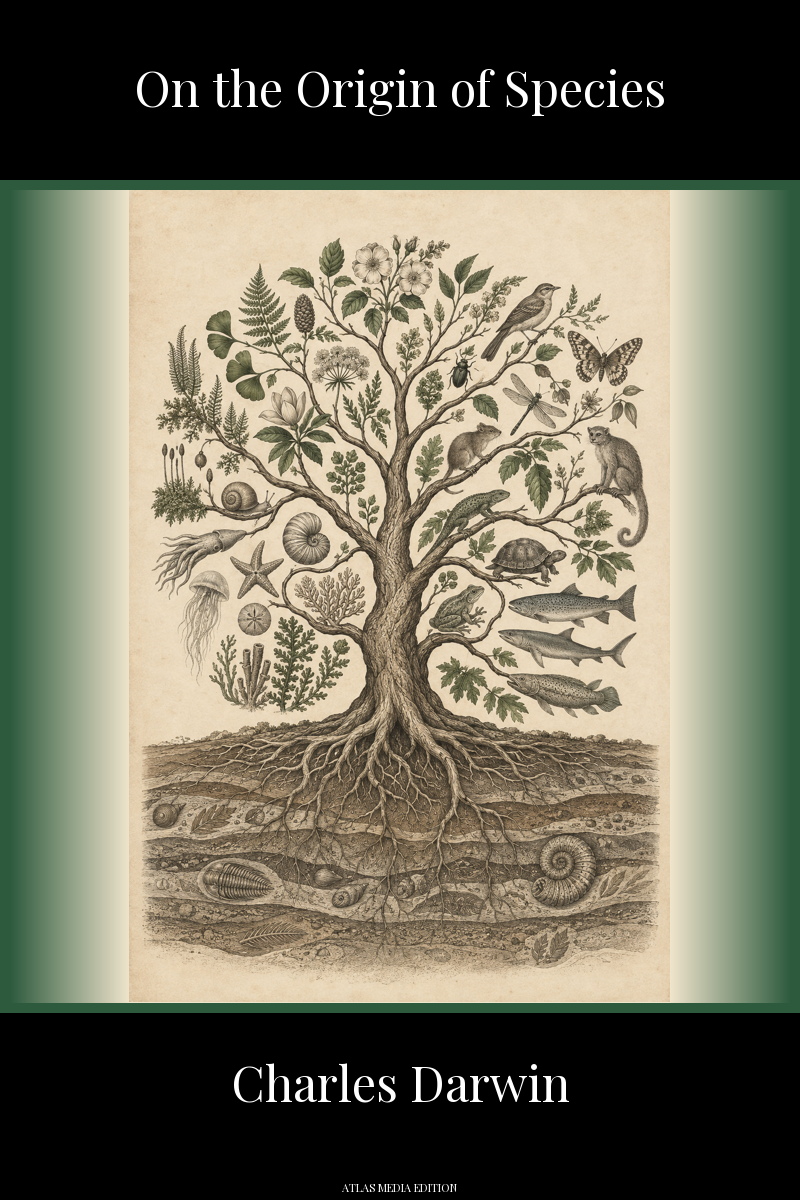
- Treatise
- Science Writing
On the Origin of Species
- Published: 1859
- Atlas edition: V1.9 · 2026
- Language: English
ABOUT THE AUTHOR
Charles Darwin
1809–1882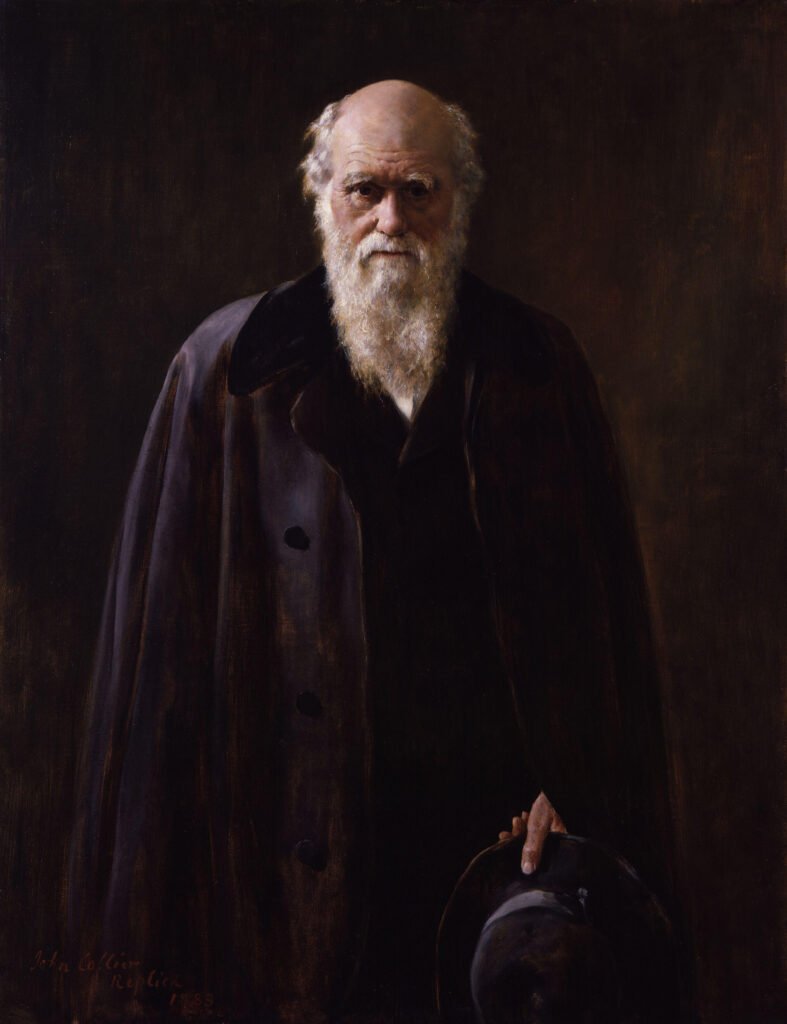
Charles Robert Darwin was an English naturalist whose work transformed the study of life, adaptation and biological diversity. During the voyage of HMS Beagle from 1831 to 1836, he investigated geology, fossils, plants and animals across several continents and islands. He spent the following decades comparing specimens, conducting experiments and assembling evidence for descent with modification. In 1858, Darwin and Alfred Russel Wallace jointly presented accounts of evolution by natural selection; Darwin published On the Origin of Species the following year. His later books examined human evolution, variation under domestication, plant reproduction, animal behaviour and the formation of soil by earthworms. Darwin’s explanations were revised and extended by later discoveries in genetics and evolutionary biology, but natural selection and common descent remain fundamental to modern life science.
ABOUT THE WORK
On the Origin of Species
On the Origin of Species presents Charles Darwin’s evidence-based explanation of how populations change over generations. Drawing on domestication, geographical distribution, fossils, classification, comparative anatomy and observations of variation in nature, Darwin argues that heritable differences can affect survival and reproduction. Natural selection gradually preserves variations suited to particular conditions, while common descent explains both the similarities among living things and their branching diversity. This Atlas edition uses Darwin’s sixth London edition of 1872, the final major edition revised during his lifetime.
WHY IT MATTERS
Why On the Origin of Species Matters
On the Origin of Species matters because it changed how evidence from many areas of natural history could be understood together. Fossils, geographical distribution, anatomical similarities, classification and the observed variability of domesticated organisms had often been treated as separate subjects. Darwin argued that they become connected when species are understood as populations with histories rather than fixed forms created independently of one another.
The book’s central mechanism is natural selection. Individuals within a population vary, some of that variation is inherited, and more organisms are produced than can survive and reproduce. When particular differences help organisms leave more offspring under local conditions, those differences can become more common over many generations. Darwin did not present this as a ladder moving inevitably toward perfection. His recurring image was a branching tree: lineages diverge, adapt, persist or disappear as circumstances change.
Darwin also built an argument about scientific method. Because evolutionary change usually unfolds across periods far longer than a human life, the case could not depend on watching one species transform into another. Instead, Darwin assembled converging evidence and tested whether one historical explanation could make sense of many otherwise disconnected patterns. That structure—patient observation, comparison, causal argument and attention to possible objections—is one reason the book remains valuable even where later science has corrected or extended its details.
Modern evolutionary biology is not identical to Darwin’s 1872 account. Darwin lacked a workable theory of genetics, and later research in heredity, population genetics, molecular biology and ecology substantially refined the explanation of evolutionary change. Alfred Russel Wallace also developed natural selection independently, and their ideas were jointly presented in 1858. Reading Darwin historically therefore means recognising both the achievement of the argument and the larger scientific community through which evolutionary theory developed.
The book is also frequently invoked in arguments it does not actually make. Its subject is the diversification of species, not the origin of life, and it says relatively little about human evolution, which Darwin addressed more directly in later work. The language and assumptions of the Victorian period require critical attention, as do later political ideologies that borrowed evolutionary language to justify hierarchy and inequality. Those appropriations should not be confused with the biological evidence for common descent and natural selection.
On the Origin of Species remains worth reading because it shows a major scientific explanation being constructed in full view. Readers can follow the evidence Darwin considered, the objections he anticipated and the limits of what he could know. The result is both a foundational work in the history of science and a demanding example of how a broad theory earns authority: not by a single dramatic claim, but by explaining many independent observations more coherently than its alternatives.
How Darwin Built the Case for Evolution
Darwin developed his argument gradually, beginning with familiar examples of selective breeding before examining competition, inheritance, adaptation and extinction in nature. He also addressed potential objections, including gaps in the fossil record and the complexity of biological structures.
Later discoveries in genetics, molecular biology and population science substantially refined Darwin’s account. Nevertheless, the central idea that populations evolve through natural processes remains foundational to biology. Reading the original work allows modern readers to see how a transformative scientific theory was constructed, tested and defended.
What On the Origin of Species Explains
On the Origin of Species explains how natural selection can produce adaptation and biological diversity over many generations. Darwin connected variation within populations, competition for limited resources and differences in reproductive success to show how species can gradually change. Common descent also provided a unified explanation for similarities in anatomy, classification and geographical distribution.
Reading Darwin in Historical Context
Modern biology has extended Darwin’s work through genetics, molecular biology and population science. Readers should therefore approach the book as both a foundational scientific argument and a product of the nineteenth century. Its lasting value lies in the breadth of evidence Darwin assembled and in the transparent way he considered difficulties, objections and gaps in contemporary knowledge.
Questions to Consider While Reading On the Origin of Species
When reading On the Origin of Species, notice how Darwin moves between direct observation and broader historical inference. He could not watch evolution unfold across geological time, so he tested whether natural selection and common descent could explain several independent patterns at once.
Useful questions for readers include:
- How does Darwin use selective breeding to introduce natural selection?
- Which observations provide the strongest evidence for common descent?
- How openly does Darwin address evidence that appears to challenge his argument?
- Which parts of the explanation were later strengthened or corrected by genetics?
These questions help distinguish Darwin’s original evidence from later developments in evolutionary biology while showing why the book remains important to the history of scientific reasoning.
Edition Record
- First publication
- 1859 · John Murray, London
- Textual basis
- Charles Darwin's sixth London edition of 1872, using the transcription distributed as Project Gutenberg eBook 2009 and semantic production contributed through Standard Ebooks
- Atlas edition
- V1.9 · 2026
- Language
- English
This Atlas edition presents Darwin’s sixth London edition of 1872, the final major edition revised during his lifetime. It preserves the source transcription and production acknowledgements while replacing inherited source packaging, promotional branding and obsolete cover credits with Atlas production material and a concise Source Production Record.
Accessibility: Reflowable EPUB with semantic navigation and reader-controlled typography. A visually checked A5 PDF is also provided for print and fixed-layout reading. The navigation preserves the preface, historical sketch, introduction, fifteen chapters, glossary, endnotes and list of illustrations.
Source & Rights
- Text source
- Standard Ebooks
Based on Charles Darwin's sixth London edition of 1872. Source transcription by Sue Asscher and David Widger for Project Gutenberg eBook 2009; ebook production by David Grigg, Alex Cabal and Standard Ebooks contributors, whose contributions are dedicated to the public domain under CC0. Cover design and original AI-assisted artwork: Atlas Media.