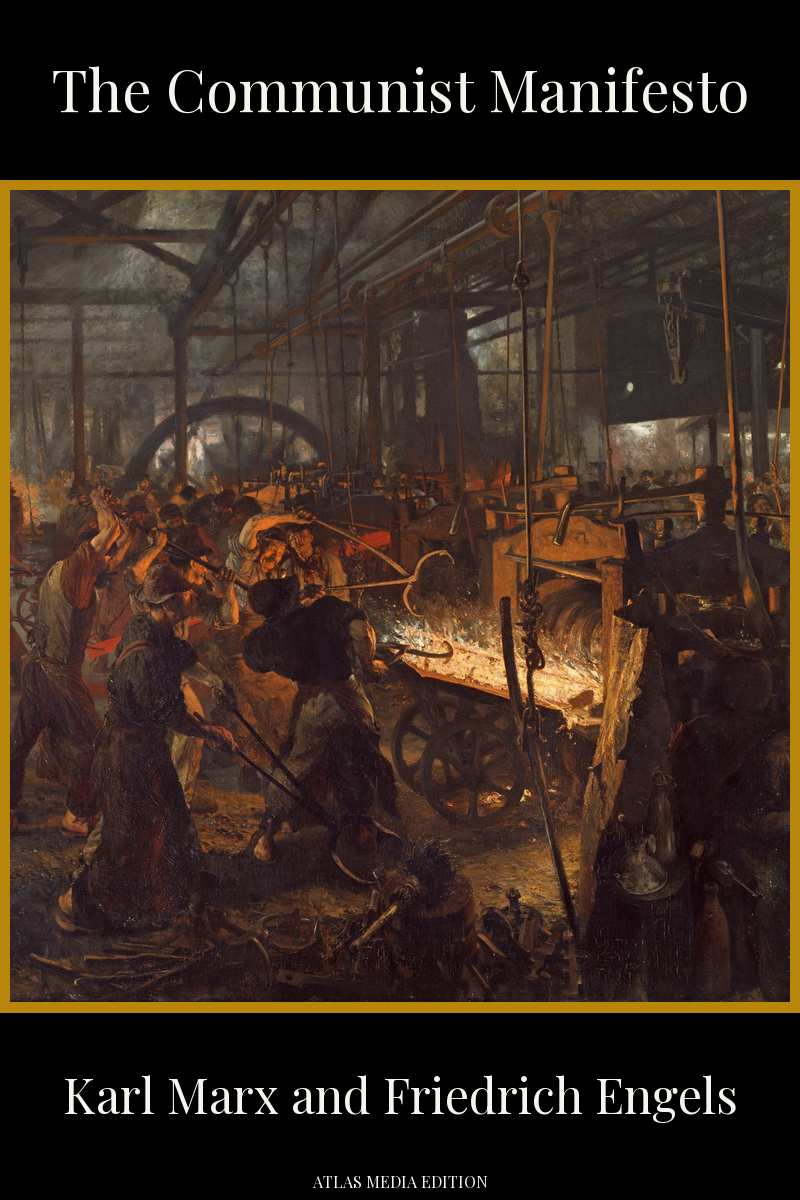
- Novel
The Communist Manifesto
- Published: 1848
- Atlas edition: V1.3 ·
- Language: German
ABOUT THE AUTHOR
Karl Marx and Friedrich Engels
1818–1883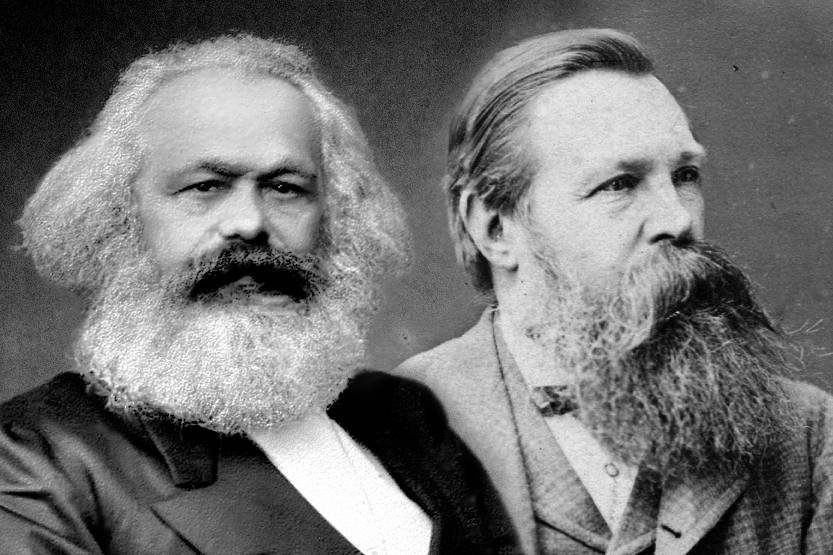
Karl Marx and Friedrich Engels are the joint authors of The Communist Manifesto. This English source presents their political programme in an edition edited by Engels in 1888. Their authorship is recorded in the source title and the work is presented here as historical political writing, subject to editorial review.
ABOUT THE WORK
The Communist Manifesto
The Communist Manifesto by Karl Marx and Friedrich Engels is a short political programme that asks readers to understand society through conflicts over labour, property and power. Its argument begins with a sweeping account of class struggle and develops into a call for workers to organise across national borders. The authors write as participants in a political movement, making the pamphlet a primary source for their aims rather than a detached description of economic life.
The opening section describes the emergence of the bourgeoisie, the class associated with ownership of capital and modern industry. Marx and Engels portray this class as a powerful force of transformation. It breaks older social arrangements, expands markets and changes the organisation of production. Their criticism includes an acknowledgement of capitalism’s extraordinary productive energy. The same forces that create new wealth, they argue, also produce instability, concentration of ownership and dependence on wage labour.
Against the bourgeoisie, the authors place the proletariat: workers who must sell their labour to live. Machinery, competition and the division of work are presented as pressures that make workers increasingly vulnerable while bringing them together in larger workplaces. The pamphlet traces a movement from isolated disputes toward collective organisation. It predicts that the development of industry will create the conditions for workers to challenge the social order that employs them.
The second section explains how the authors distinguish communists from other working-class parties. They claim to represent the common interests of workers across national divisions and the direction of the movement as a whole. Their discussion of property answers objections about freedom, family, education and nationality. The distinction they draw concerns bourgeois ownership and control of production, rather than a simple prohibition on every form of personal possession. Readers should follow the actual argument closely, especially where its terminology differs from everyday usage.
A proposed programme follows, including changes to taxation, inheritance, credit, transport, land and education. These measures belong to the pamphlet’s revolutionary argument and historical setting. They are presented here as the authors’ proposals, without treating them as present-day recommendations or as a complete account of later communist governments. The text’s claims about historical change likewise remain claims to examine, rather than conclusions the catalogue asks readers to accept.
The third section criticises competing forms of socialist writing. Its categories show how fiercely the authors contested other responses to industrial society, including arguments grounded in nostalgia, reform and imagined ideal communities. The final section considers alliances with opposition movements in different countries and ends with an appeal to international solidarity. Read together, the four sections combine historical interpretation, economic criticism, polemic and political strategy. The English source used for this edition identifies itself as the 1888 edition edited by Engels, an important distinction from the original German publication of 1848.
WHY IT MATTERS
Why The Communist Manifesto matters
The Communist Manifesto matters as an unusually concentrated example of political writing: it attempts to explain a social system, identify its opponents and mobilise readers within a single brief work. Its compressed form makes it accessible, but also demands care. Large claims about history appear in a small space, and the force of the rhetoric can make an assertion seem more settled than its supporting argument warrants.
One of the text’s most revealing features is its double view of capitalism. Marx and Engels describe a system capable of enormous innovation while arguing that its achievements generate new conflicts and insecurity. This tension gives readers a useful question to carry into their own reading: how can productive growth coexist with unequal power, unstable livelihoods and recurring crisis? The pamphlet supplies one answer, but its value as a historical source does not depend on agreeing with that answer.
Its account of markets extending across borders also invites examination of the relationship between economic interdependence and political solidarity. The authors move repeatedly between the conditions of individual workers and a much larger picture of world production. Reading those movements closely helps distinguish observation, interpretation and prediction. It also exposes assumptions about whose experiences count and how a broad category such as class can both illuminate and simplify social life.
The work rewards comparison with texts that approach liberty, ownership and government from different premises. A library can place those arguments in conversation without endorsing a political programme. For that purpose, access to the complete text is essential. Familiar slogans cannot substitute for the discussions of property, competing socialist traditions and practical alliances that surround them. This edition offers an opportunity to encounter the argument in context, assess its limits and understand how political language seeks to turn an explanation of the world into collective action.
Edition Record
- First publication
- 1848
- Textual basis
- Source text: Project Gutenberg, https://www.gutenberg.org/ebooks/61
- Atlas edition
- V1.3 ·
- Language
- German
Prepared from the recorded source and the reviewed Atlas working edition.
Accessibility: EPUB and PDF are offered where approved; accessibility features have not been independently certified.
Source & Rights
- Text source
- Project Gutenberg

The Communist Manifesto by Marx, Karl, Engels, Friedrich. Source text prepared from Project Gutenberg ebook 61.