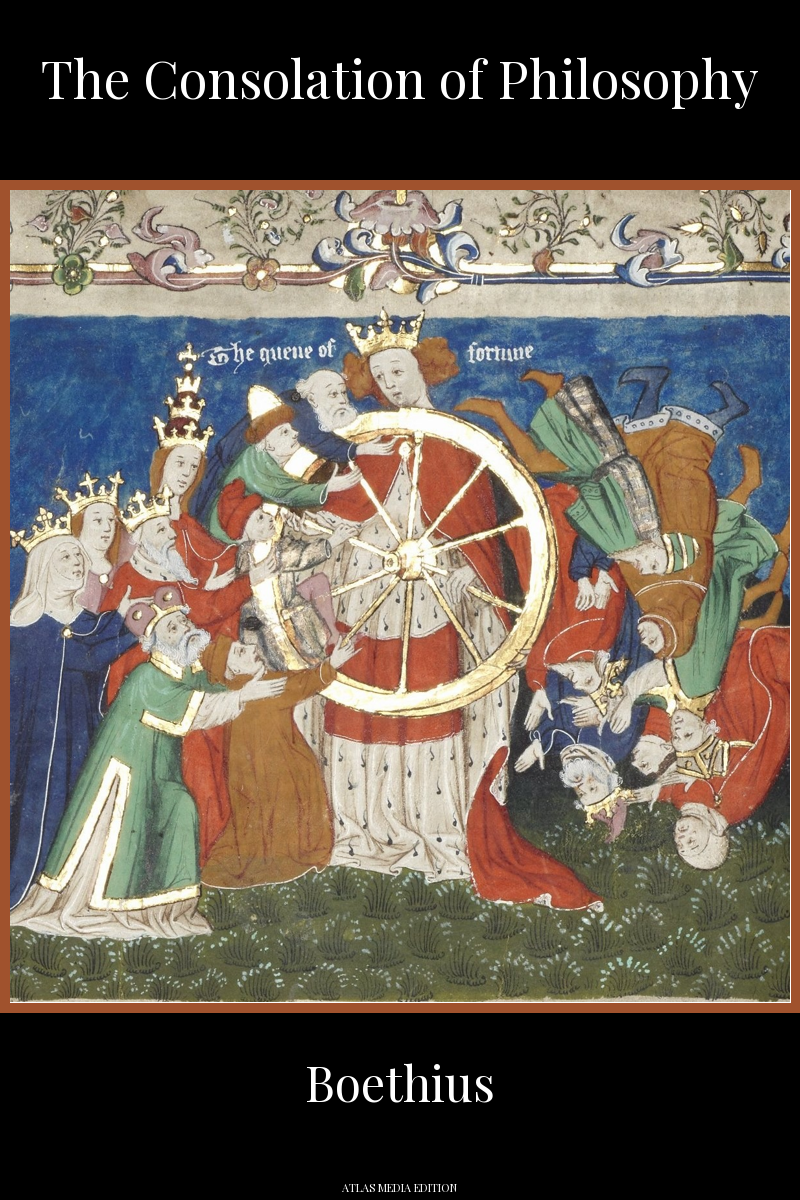
- Novel
The Consolation of Philosophy
- Published: 523
- Atlas edition: V1.3 ·
- Language: Latin
ABOUT THE AUTHOR
Boethius
480–524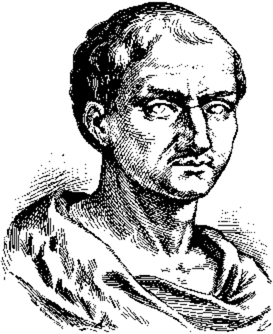
Anicius Manlius Severinus Boethius (c. 480 to 524 CE) was a Roman senator, consul, magister officiorum, polymath, historian and philosopher of the Early Middle Ages. According to the edition’s proem, he belonged to an ancient family, was brought up by Symmachus after his parents died, and later married his daughter. He was sole consul in 510 and was raised by Theodoric to head the civil administration. In 522 his two sons were made joint consuls. Within a year he was imprisoned at Pavia, where the Consolation was written.
ABOUT THE WORK
The Consolation of Philosophy
The Consolation of Philosophy is the work Boethius wrote in prison, and it begins with a man in despair. The Standard Ebooks edition presents a translation based on the Latin text of Peiper, Leipzig, 1874. The opening shows Boethius seated in his cell, grief-stricken and indignant at the injustice of his fall, writing verses that describe his condition. His first poem, a complaint, laments that the Muses who once helped him compose happy verse now guide his pen in sorrow. They alone stayed faithful in the hour of danger. He describes premature old age, white hairs and a shrunken frame, and he wishes for a death that does not come. He also remembers how friends once called him happy, and he concludes that a man who could fall so far was never firmly founded.
While he is thinking in silence, a woman appears above his head. Her face is venerable, her eyes burn with more than human keenness, and her years are many, yet she seems not to belong to our age. Her height shifts: sometimes ordinary, sometimes her forehead seems to strike the sky. Her robe is of imperishable cloth that she wove herself, but it is tarnished and torn by violent hands, each of which has snatched away what it could grasp. On its lower edge is the Greek letter Pi and on its upper edge the letter Theta, with steps like a staircase between them. In her right hand she holds a notebook and in her left a staff.
She sees the Muses of Poetry at his bedside dictating his lamentations and she is angry. She accuses them of feeding his illness with sweet poison, of choking the crop of reason with the thorns of passion, and of accustoming minds to disease instead of freeing them. This man, she says, was nurtured in the Eleatic and Academic philosophies. She drives them out as sirens and promises that her own muses will heal him. The Muses leave ashamed, with downcast eyes.
Boethius, his sight dimmed by weeping, cannot tell who she is. He stays dumbfounded, eyes on the ground. She sits on the edge of his couch and sings a second poem mourning the state of his mind. It recalls that he once ranged the heavens, tracked the sun and the waxing and waning moon, and sought the causes of winds and seas, and it contrasts that man with the one now sunk in darkness and tossed by care.
The book’s own summaries sketch what follows in Book I. Boethius recognises his mistress Philosophy. She reminds him that ignorant crowds have persecuted philosophy before. She asks him to tell his griefs, and he recounts his unjust accusation and ruin, ending with a prayer that moral disorder in human affairs be set right. Philosophy accepts his self-defence but grieves for the change in his mind. She plans gentle remedies first. Her questions reveal three causes of his sickness: he has forgotten his own nature, he does not know the end toward which the universe tends, and he does not know how the world is governed.
The prefatory proem explains the circumstances. Boethius was a Roman of ancient family, consul in 510, later head of the civil administration under Theodoric. His sons were made joint consuls in 522, and within a year he was a solitary prisoner at Pavia. The work alternates prose and verse, like dialogue and chorus in a Greek play.
WHY IT MATTERS
Why The Consolation of Philosophy matters
The Consolation of Philosophy matters first as a record of how a mind responds to catastrophe. Boethius does not offer a pious retreat or a bare complaint. He stages a conversation in which reason confronts self-pity, and the stages of that conversation are visible even in the opening pages. The sufferer first writes poetry of grief, and the visitor rejects that poetry as feeding the illness. The text asks whether art that indulges pain heals or harms, and it takes a stern view.
It also matters for its form. The alternation of prose argument and verse song, which the preface compares to dialogue and chorus in a Greek play, gives the book an unusual rhythm. Argument is followed by lyric, so that reasoning and feeling are not sealed off from each other. The preface calls it unique in literature, and the claim is hard to dispute.
The figure of Philosophy is a strong image. She is as tall as the sky, her robe is torn by people who each seized a fragment, and the letters on it mark a climb from practice to contemplation. That torn garment is an image of how schools of thought quarrel over pieces of a larger whole. Her diagnosis, that the patient has forgotten his own nature and does not understand the world’s purpose or government, frames consolation as recovery of understanding, not as comfort alone.
Historically, the preface tells us the book was for centuries the scholar’s familiar companion, translated into every European tongue and into English many times, beginning with King Alfred’s paraphrase. The proem adds that Boethius handed on Greek philosophy to the Middle Ages through his Latin translations of Aristotle. A reader today meets a bridge between the ancient and medieval worlds.
Finally, the book speaks to anyone who has lost status, security or reputation. Its author had every honour and lost it within a year, and he wrote under threat of death. That context gives its questions about fortune, justice and the good a weight that abstract treatises rarely have.
Edition Record
- First publication
- 523
- Textual basis
- Source text: Standard Ebooks, https://standardebooks.org/ebooks/boethius/the-consolation-of-philosophy/h-r-james
- Atlas edition
- V1.3 ·
- Language
- Latin
Prepared from the recorded source and the reviewed Atlas working edition.
Accessibility: EPUB and PDF are offered where approved; accessibility features have not been independently certified.
Source & Rights
- Text source
- Standard Ebooks

The Consolation of Philosophy by Boethius; translated by H. R. James. Source text prepared from the Standard Ebooks edition (https://standardebooks.org/ebooks/boethius/the-consolation-of-philosophy/h-r-james).