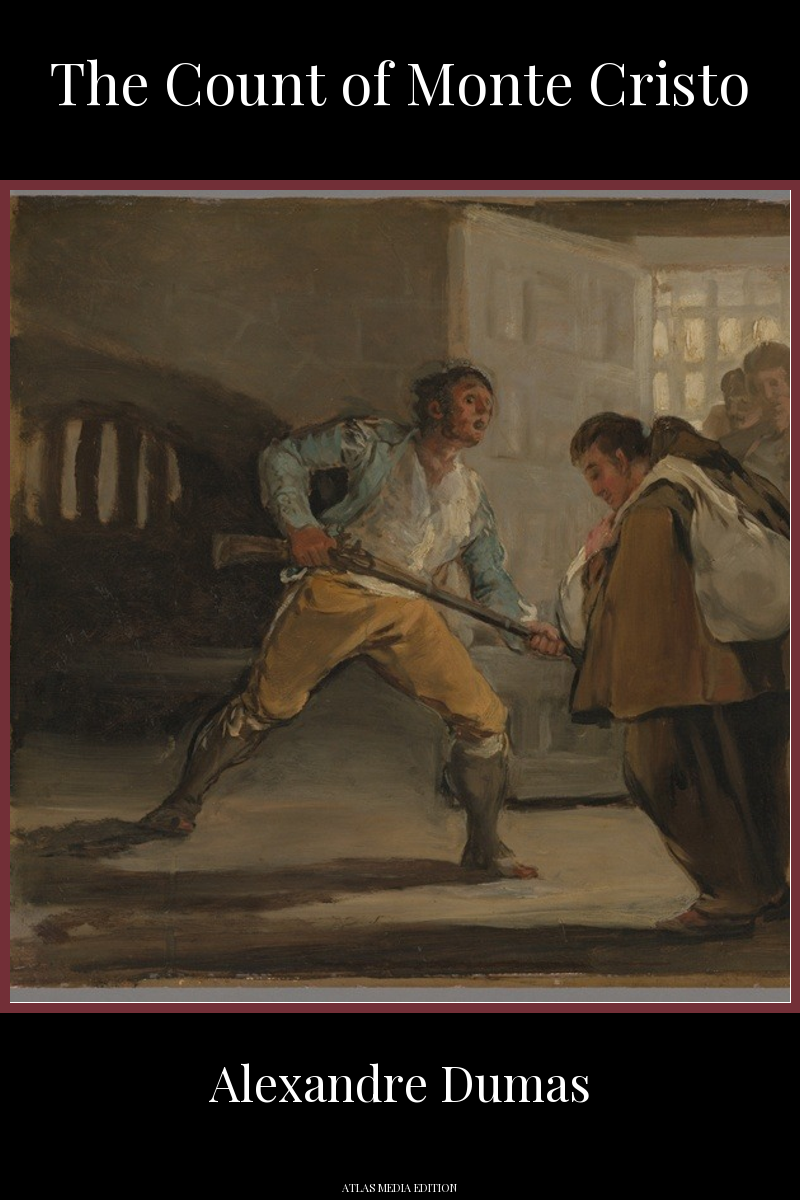
- Novel
The Count of Monte Cristo
- Published: 1844
- Atlas edition: V1.3 ·
- Language: French
ABOUT THE AUTHOR
Alexandre Dumas
1802–1870Alexandre Dumas (1802 to 1870) was a French writer, best known for historical adventure fiction. The Count of Monte Cristo is among his most celebrated works. This edition presents an English translation credited to Chapman and Hall, with annotation credited to Thomas Y. Crowell (1836 to 1915).
ABOUT THE WORK
The Count of Monte Cristo
The Count of Monte Cristo is a novel by Alexandre Dumas, a long adventure story of betrayal and revenge set in France and the Mediterranean from 1815 onward. It opens at Marseilles, where the young sailor Edmond Dantès returns on the Pharaon, newly promoted and about to marry.
A rival, Danglars, resents him, and a visit to Elba on a dying captain’s orders becomes the pretext for his ruin. What follows is a classic story of imprisonment, escape, hidden treasure and a carefully planned reckoning with the men who wronged him.
WHY IT MATTERS
Why read it
This is the case for reading a book that still grips.
Few novels give a reader such pure narrative appetite. It begins in a bustling harbour and within pages has turned a happy man into a prisoner, and the question it plants, what would you do with absolute power to repay a wrong, does not let go. It offers speed, scheming, disguise, secrets and long-delayed payoffs, all handled with a showman’s confidence.
It also asks something harder than a thriller usually does. Revenge feels righteous at the start. By the end the reader is weighing what such certainty costs the person who holds it.
Reading it closely
The opening shows how Dumas builds his effects.
The first chapter spends its energy on the ship, the pilot, the crowd and the ramparts. The crowd senses misfortune with “that instinct which is the forerunner of evil”, and the narrator lets dread gather before anything happens. Dantès is shown through competence: he gives the orders, watches the crew obey, and keeps working while the owner questions him. Danglars is drawn in one stroke as “obsequious to his superiors, insolent to his subordinates”.
The structure is a great reversal. A man at the height of his prospects, young, loved by the crew and nearly captain, falls through small acts of envy and political accident. The chance meeting with the emperor at Elba and the packet for Marshal Bertrand seem harmless to Dantès, who says he “did not even know of what I was the bearer”. Innocence is his flaw as well as his virtue.
The prose is plot driven, built on dialogue, with abrupt exchanges that reveal motive. Dumas also uses real history and places as a frame, so that the fiction sits inside a believable world. The result is melodrama with unusual patience.
Then and now
The book arrived as popular entertainment and became a world classic.
It was serialised from 1844 to 1846, then published in book form in 1846. Serial readers waited for each instalment, and that rhythm shaped its cliffhangers. Its reputation as a pillar of adventure fiction has endured, and it is read in many languages and often adapted. Critics have sometimes ranked it below more literary novels of its century, yet its sheer vitality and its place in the popular imagination have kept it in print and in classrooms.
A way in
Start at the harbour and read the first chapters slowly, because the betrayal is planted there. Watch who speaks, who listens, and who knows more than he should. The older English translation in this edition carries its period flavour, so allow a few chapters to settle. Then let the plot carry you.
Edition Record
- First publication
- 1844
- Textual basis
- Source text: Standard Ebooks, https://standardebooks.org/ebooks/alexandre-dumas/the-count-of-monte-cristo/chapman-and-hall
- Atlas edition
- V1.3 ·
- Language
- French
Prepared from the recorded source and the reviewed Atlas working edition.
Accessibility: EPUB and PDF are offered where approved; accessibility features have not been independently certified.
Source & Rights
- Text source
- Standard Ebooks
The Count of Monte Cristo by Alexandre Dumas; translated by Chapman and Hall. Source text prepared from the Standard Ebooks edition (https://standardebooks.org/ebooks/alexandre-dumas/the-count-of-monte-cristo/chapman-and-hall).