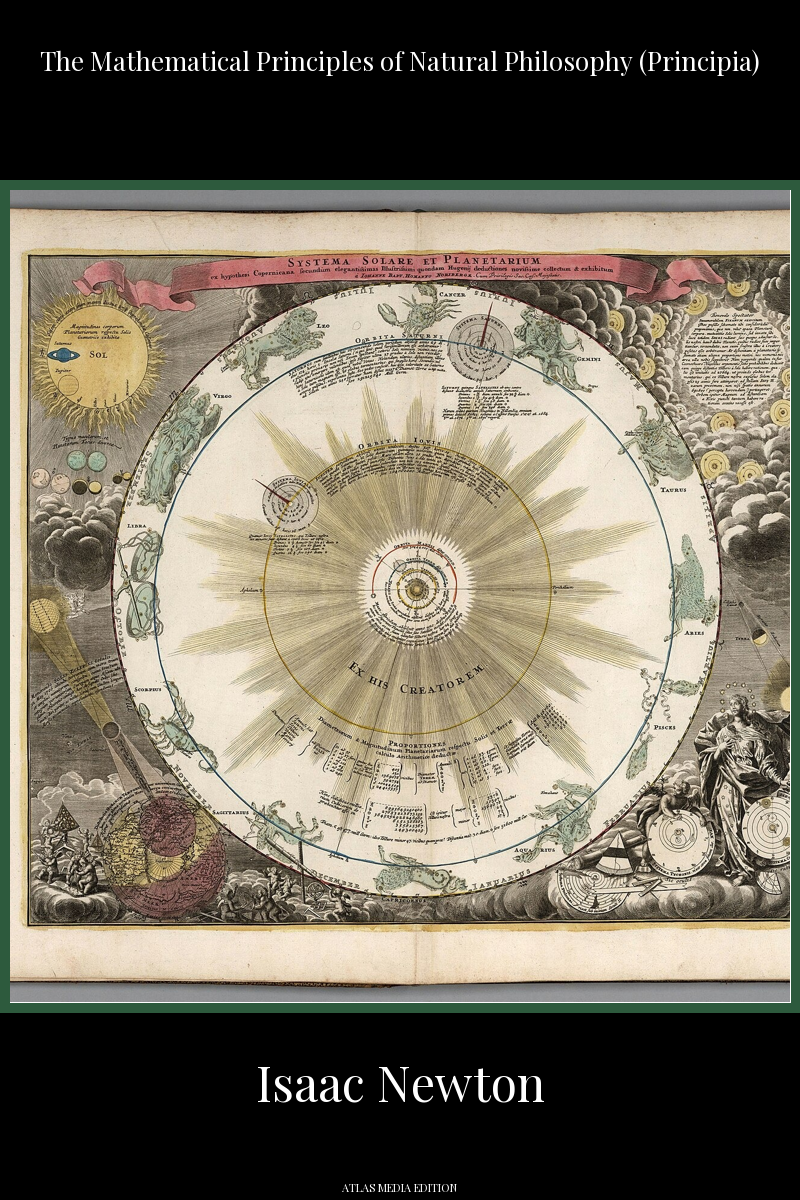
- Novel
The Mathematical Principles of Natural Philosophy (Principia)
- Published: 1687
- Atlas edition: V1.4 ·
- Language: Latin
ABOUT THE AUTHOR
Isaac Newton
1642–1727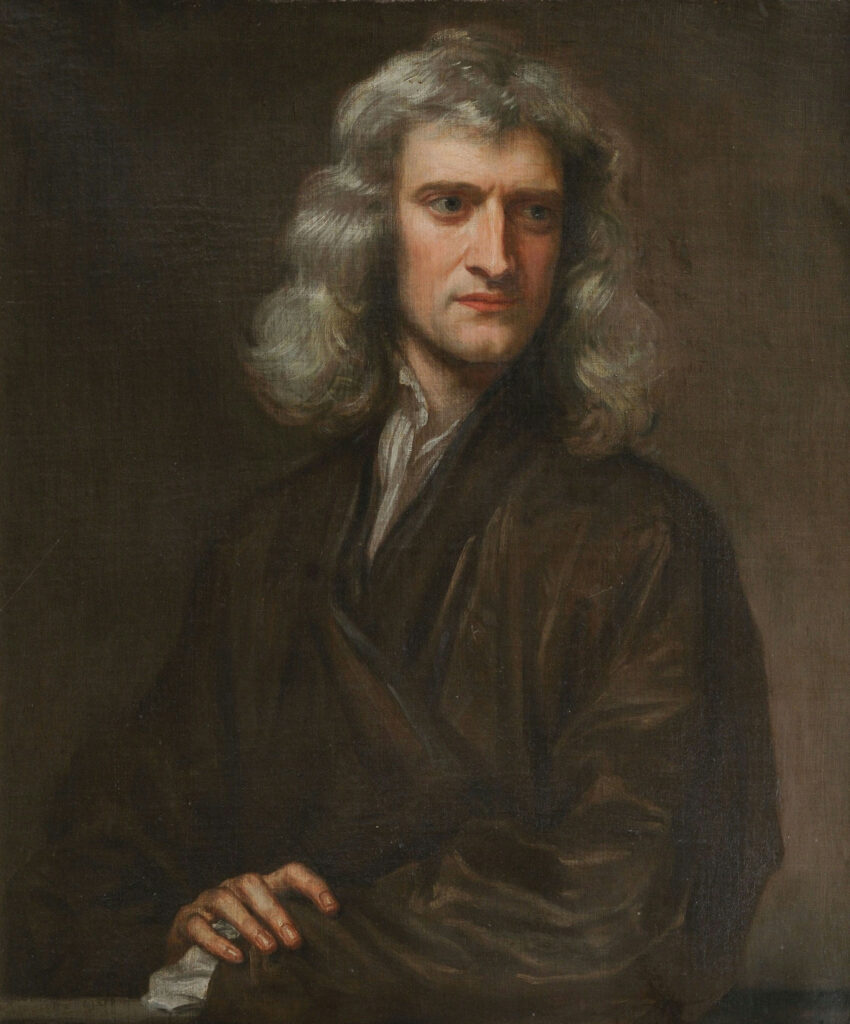
Isaac Newton (1642 to 1727) is the author of the Principia. The supplied record identifies him as the creator of the work, and the edition styles him Sir Isaac Newton. Andrew Motte (1696 to 1734) is credited as the English translator. N. W. Chittenden, M. A., is named as contributor, supplying the life of the author and the dedication. The edition was published in New York by Daniel Adee in 1846 as the First American Edition.
ABOUT THE WORK
The Mathematical Principles of Natural Philosophy (Principia)
The Mathematical Principles of Natural Philosophy, known as the Principia, is Isaac Newton’s founding work of mathematical physics. The edition described here is the First American Edition, published in New York by Daniel Adee in 1846. It presents Andrew Motte’s English translation, revised and corrected, together with Newton’s System of the World, a portrait taken from the bust in the Royal Observatory at Greenwich, and a life of the author by N. W. Chittenden.
The edition opens with a dedication by Chittenden to the teachers of the Normal School of the State of New York. He calls teaching the highest and most responsible office a person can fill, and he offers the Principia to educators as the greatest work of the greatest Teacher. An introduction to the American edition follows. It remarks that the book had remained little known in the country, because Latin copies were few and English copies were very expensive. The editor says that this edition places the work within the reach of all, and that great care was taken, by collation and revision, to make it accurate.
The introduction also argues for the educational value of geometrical synthesis. Chittenden notes that Newton, though the inventor of fluxions, criticised the treatment of geometrical subjects by algebraic calculation and preferred the geometrical method in his maturer opinions. He suggests that students who have worked through Euclid or Legendre might proceed to the Principia, where geometry is used from the familiar to the sublime.
The contents show the shape of the treatise itself. After the author’s preface come the Definitions and the Axioms, or Laws of Motion, which set out the basic terms and principles. Book I, on the motion of bodies, is divided into fourteen sections. It begins with the method of first and last ratios, which Newton uses to demonstrate the propositions that follow. It then treats the invention of centripetal forces and the motion of bodies in conic sections. Later sections cover finding orbits from a given focus or without one, motion in given orbits, rectilinear ascent and descent, movable orbits and the motion of the apsides, and motion on given surfaces, including pendulums. Further sections examine bodies attracting one another, the attractive forces of spherical and non-spherical bodies, and the motion of very small bodies acted on by forces directed to the parts of a large body.
Book II, also titled on the motion of bodies, turns to resisting mediums. Its sections consider resistance proportional to velocity, to the square of velocity, and to a mixture of both. They also treat circular motion in resisting media, the density and compression of fluids and hydrostatics, the motion and resistance of pendulums, and the motion of fluids and the resistance met by projected bodies. The listed contents continue with the propagation of motion.
The original Latin work was first published in 1687. This 1846 volume is therefore a later English-language presentation of it, framed for American readers and teachers, and it adds biographical and explanatory matter around Newton’s text.
WHY IT MATTERS
Why The Mathematical Principles of Natural Philosophy (Principia) matters
The Principia matters because it shows a way of reasoning in which natural phenomena are explained by mathematical demonstration from stated definitions and laws. The table of contents makes this visible. Newton begins with definitions and the laws of motion, then builds outward through ratios, forces, orbits and attraction before turning to the motion of bodies in fluids and resisting media. The structure itself teaches that a large body of knowledge can rest on a small set of principles.
The 1846 American edition adds a second story, about access. Its editor complains that the work was locked behind a dead language and a high price, and he presents his edition as a remedy. Whatever one thinks of his rhetoric, the point is real: a scientific classic only shapes a culture when readers can obtain it. The inclusion of a life of the author, a portrait and the System of the World shows an effort to make Newton approachable as well as authoritative.
The introduction also records a debate that still has echoes. Chittenden defends geometrical synthesis against the spread of analytical and algebraic methods, and he cites Newton’s own preference for geometry. Readers today may find the claim debatable, but it raises a lasting question about whether the way we teach mathematics shapes the way we think. The editor believes that working through geometric proofs develops the faculties more fully than memorising formulas.
The dedication to teachers shows how the book was understood in its American moment: as an instrument of public education and civic character, not only of physics. That reading is partly the editor’s own, and it should be treated as an interpretation of the work, not a description of Newton’s aims.
For a modern reader, this edition is useful for two reasons. It gives an English route into one of the central texts of the scientific revolution, and it documents how nineteenth century readers valued, framed and promoted that text. Both aspects are worth keeping in view when approaching the book today.
Edition Record
- First publication
- 1687
- Textual basis
- Source text: Project Gutenberg, https://www.gutenberg.org/ebooks/76404
- Atlas edition
- V1.4 ·
- Language
- Latin
Prepared from the recorded source and the reviewed Atlas working edition.
Accessibility: EPUB and PDF are offered where approved; accessibility features have not been independently certified.
Source & Rights
- Text source
- Project Gutenberg

The Mathematical Principles of Natural Philosophy (Principia) by Newton, Isaac; translated by Motte, Andrew. Source text prepared from Project Gutenberg ebook 76404.