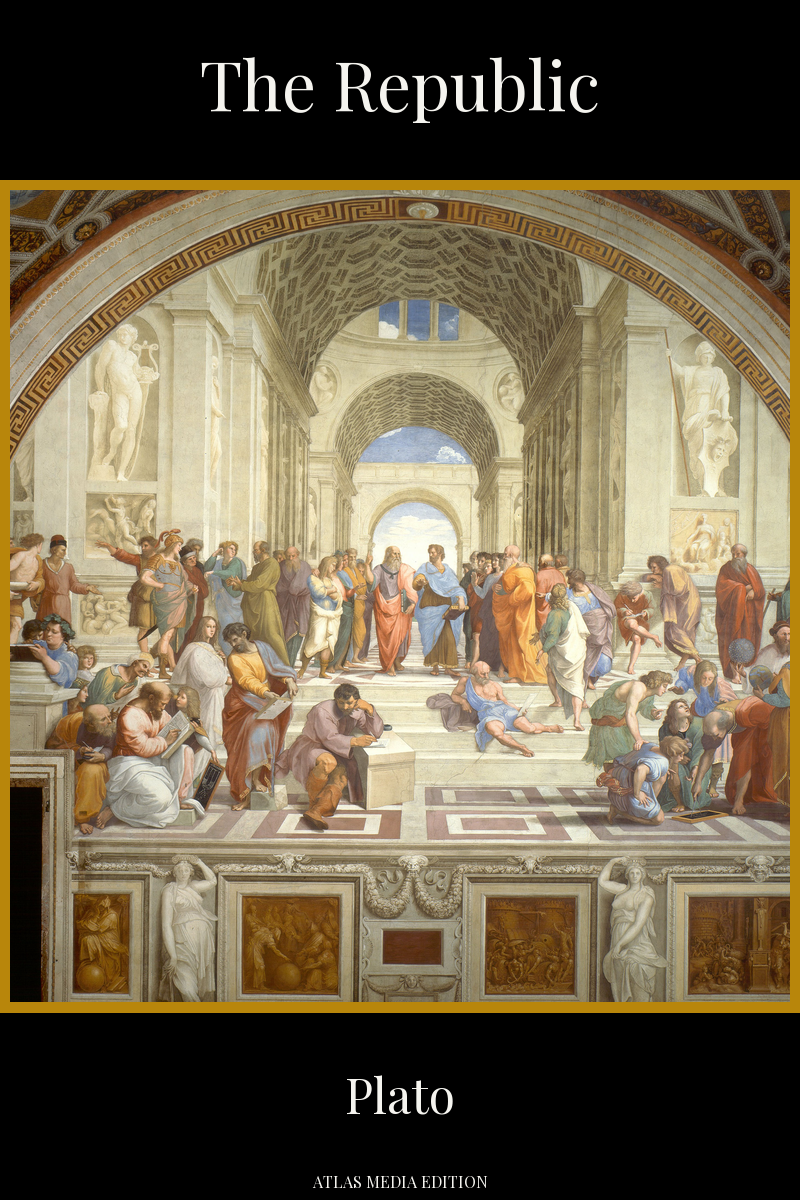
- Novel
The Republic
- Published: c. 375 BC
- Atlas edition: V1.3 ·
- Language: Ancient Greek
ABOUT THE AUTHOR
Plato
-428–-348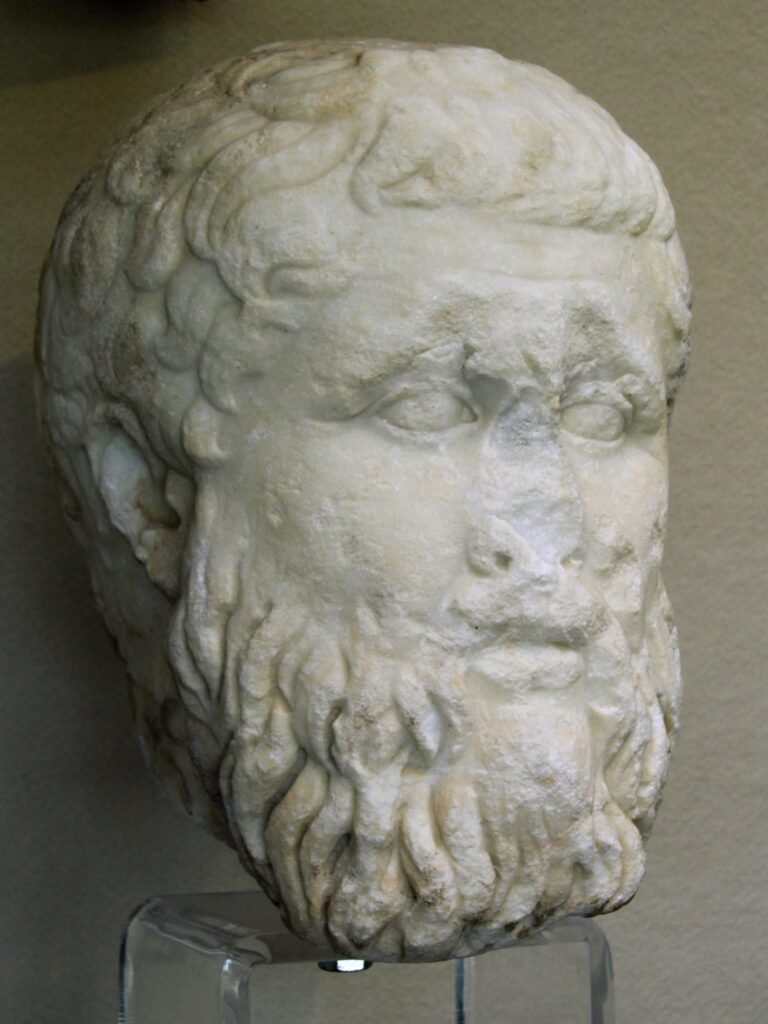
Plato (c. 428 to 347 BC) was an ancient Greek philosopher of Classical Athens and one of the central figures of Western philosophy. He was a student of Socrates and the teacher of Aristotle.
Plato wrote dialogues rather than treatises, and Socrates speaks in nearly all of them. He founded the Academy, a philosophical school in Athens. His complete works are believed to have survived, unlike those of nearly all his contemporaries.
ABOUT THE WORK
The Republic
The Republic is Plato’s dialogue on justice, written around 375 BC. It asks what justice is, and whether a just person is happier than an unjust one. To answer, its speakers imagine an entire city, because justice may be easier to see written large in a state than in a single soul. This Atlas Media edition uses Benjamin Jowett’s English translation, based largely on his revised third edition of 1888.
The dialogue begins at the port of Piraeus, where Socrates is persuaded to join a gathering at the house of Cephalus. The old man suggests that justice means telling the truth and paying what one owes. Socrates finds exceptions at once. His son Polemarchus proposes helping friends and harming enemies, and the sophist Thrasymachus argues that justice is simply the advantage of the stronger.
In Book II, Plato’s brothers Glaucon and Adeimantus press the challenge harder. Glaucon tells the story of the ring of Gyges, which makes its wearer invisible, and asks whether anyone with such power would stay just. If justice is good only for its rewards, why not merely seem just? Socrates sets out to show that justice is good in itself.
To do so he builds a city in words. It begins with simple needs and grows into a state with three classes: producers, auxiliaries who defend the city, and guardians who rule. The guardians’ education in music, poetry and physical training is examined in detail, including which stories should be told to the young. A founding myth, the “noble lie” of gold, silver and bronze souls, is proposed to persuade citizens to accept their places.
In Book IV the city’s justice is found to be each class doing its own work. The same pattern is traced in the individual soul, which has reason, spirit and appetite. A just person is one whose reason, supported by spirit, governs desire.
Books V to VII contain the work’s most famous and controversial proposals. The guardians are to hold property in common, and women of suitable nature may serve as guardians alongside men. Socrates then argues that cities will know no rest from trouble until philosophers rule or rulers become philosophers. To explain what the philosopher knows, he offers the images of the sun, the divided line and the cave, in which prisoners mistake shadows on a wall for reality until one is freed and climbs toward the light.
Books VIII and IX describe how a good city decays, through timocracy, oligarchy and democracy into tyranny, with a matching type of person at each stage. The tyrant, apparently the freest of men, is shown to be the most enslaved to his desires.
Book X returns to poetry, criticising imitation, and closes with the Myth of Er, the story of a soldier who returns from death to describe how souls choose their next lives.
WHY IT MATTERS
Why The Republic matters
The Republic matters because so many later debates begin with it. Its questions about justice, education, power and knowledge shaped Greek, Roman, Islamic and European philosophy, and its images still appear in everyday speech. The allegory of the cave, in particular, has become a shorthand for the difference between appearance and understanding.
Reading The Republic as a dialogue
The work is a conversation rather than a treatise. Plato never speaks in his own voice; Socrates questions others, tests their answers and changes direction. Readers have to decide how far each proposal is meant literally, how far it is a thought experiment, and where irony may be at work. Reading the full text, rather than a summary of its conclusions, makes those judgments possible.
Debating the city in The Republic
Plato’s ideal city has always divided readers. Some admire its demand that rulers be wise and free from private gain, and its argument that women could share in rule. Others have found it troubling. In The Open Society and Its Enemies (1945), Karl Popper criticised Plato’s state as authoritarian, pointing to its fixed classes, censorship of poetry and the noble lie. Both readings draw on the same passages, and the book invites readers to weigh them.
The dialogue also began a long tradition of imagined commonwealths. Later writers, including Thomas More in Utopia (1516), set their ideal societies in conversation with Plato’s city, sometimes borrowing from it and sometimes answering it. Reading The Republic alongside those later works shows how an argument about one city became a way of questioning every real one.
The Republic also remains a practical guide to thinking. Its method of defining terms, testing examples and following an argument where it leads is still used in classrooms today. Students of philosophy, politics, education and literature continue to return to it, often finding that its questions outlast its answers.
Edition Record
- First publication
- c. 375 BC
- Textual basis
- Source text: Project Gutenberg, https://www.gutenberg.org/ebooks/55201
- Atlas edition
- V1.3 ·
- Language
- Ancient Greek
Prepared from the recorded source and the reviewed Atlas working edition.
Accessibility: EPUB and PDF are offered where approved; accessibility features have not been independently certified.
Source & Rights
- Text source
- Project Gutenberg

The Republic by Plato; translated by Jowett, Benjamin. Source text prepared from Project Gutenberg ebook 55201.