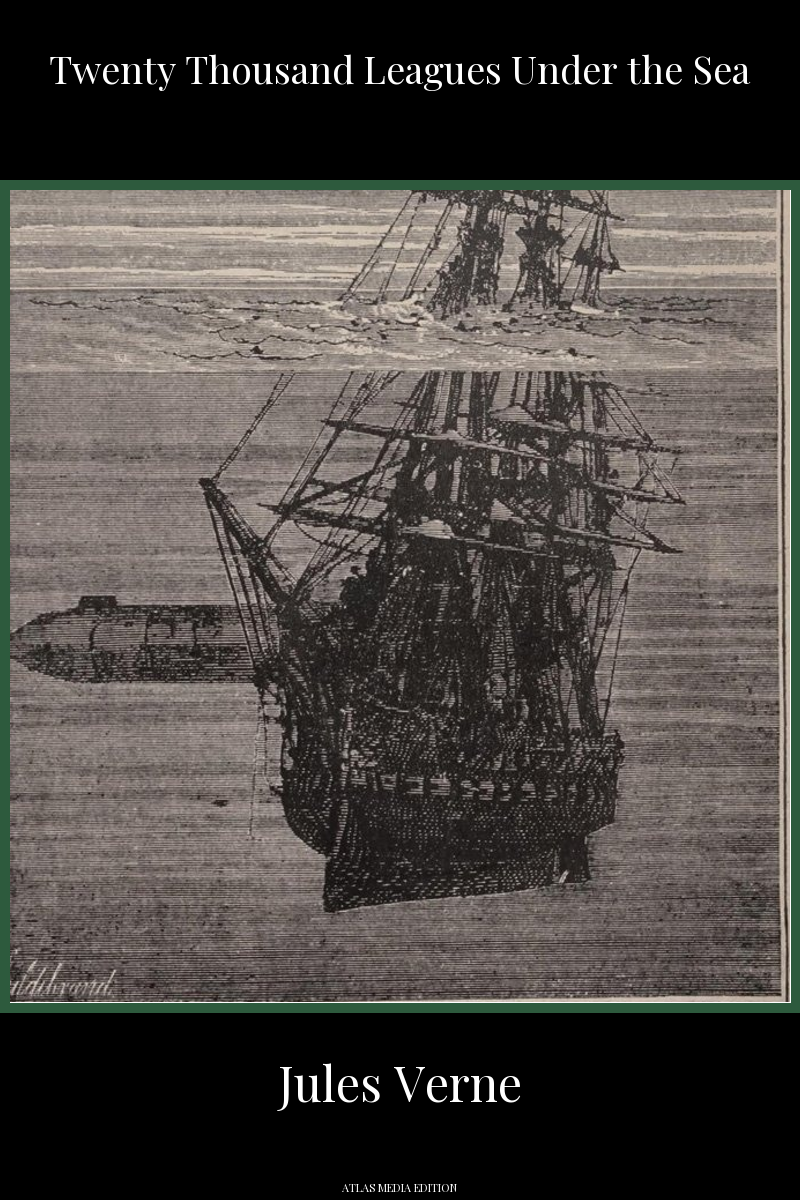
- Novel
Twenty Thousand Leagues Under the Sea
- Published: 1869
- Atlas edition: V1.3 ·
- Language: French
ABOUT THE AUTHOR
Jules Verne
1828–1905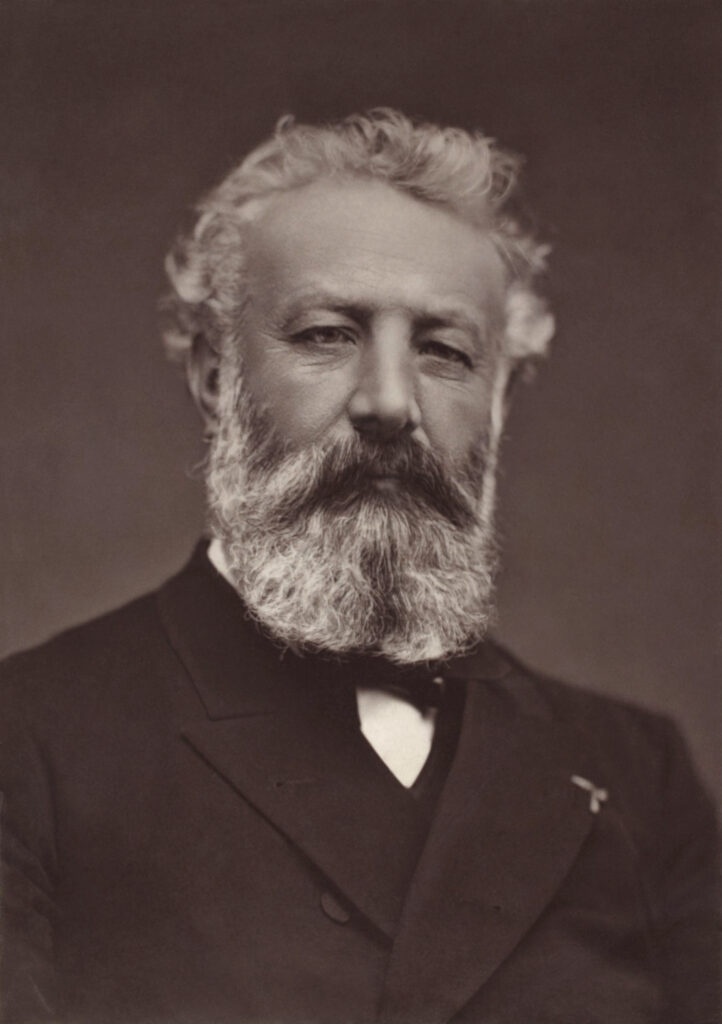
Jules Verne (1828 to 1905) was a French author. The supplied evidence records his birth year as 1828 and his death year as 1905. He wrote Twenty Thousand Leagues Under the Sea, which was serialised in Pierre-Jules Hetzel’s French fortnightly periodical, the Magasin d’éducation et de récréation, from March 1869 to June 1870. The English text supplied here is a Project Gutenberg edition, released as eBook #164 on September 1, 1994, and prepared by anonymous volunteers.
ABOUT THE WORK
Twenty Thousand Leagues Under the Sea
Twenty Thousand Leagues Under the Sea, by Jules Verne, opens in the year 1866, when a mysterious phenomenon unsettles the maritime world. Ships of several nations report an enormous, spindle-shaped object, sometimes phosphorescent, moving faster than any whale and larger than any cetacean known to science. The sightings are entered in log-books, and the first chapter lists vessels such as the Governor Higginson, the Columbus, the Helvetia and the Shannon that meet it in different oceans within days of one another.
Public opinion divides. Newspapers joke about the creature, cafés sing about it, and learned societies argue over whether it is a giant narwhal, a kraken or a sea-serpent. The debate seems to end in ridicule, until early 1867 when ships begin to strike something in the dark. The Moravian breaks part of her keel on an unmarked rock, and the Scotia of the Cunard line suffers a similar shock. The monster is no longer a curiosity but a danger to shipping.
The United States prepares a fast frigate to hunt the creature and clear the seas. The narrator is Professor Pierre Aronnax, a French naturalist who happens to be in New York and is invited to join the expedition. He accepts, and brings his devoted servant Conseil, who classifies everything calmly. On board they meet Ned Land, a Canadian harpooner of great skill and a stubborn, practical temper, who doubts the monster is a living animal at all.
The hunt crosses the Atlantic and rounds South America into the Pacific. When the frigate finally engages its quarry, the encounter goes badly. Aronnax, Conseil and Ned Land are thrown into the sea and find themselves on the back of the supposed beast. It proves to be a metal vessel, a submarine called the Nautilus.
The three men are taken prisoner by its commander, Captain Nemo, a learned and secretive figure who has cut all ties with life on land. He tells them they may live aboard, but they may never leave. The Nautilus runs entirely on electricity drawn from the sea, and Nemo uses it to roam the oceans of the world, free of any government.
The rest of the book is a voyage of observation and adventure. The captives walk on the sea floor in diving gear, visit a submarine forest, pass among coral reefs, and view the wreck sites and islands of the Pacific. They cross the Indian Ocean, pass through the Red Sea by an underwater tunnel, and reach the Mediterranean. Later chapters take them to the legendary ruins of a vanished continent, an undersea coal mine, the Sargasso Sea, the ice of the South Pole, and a battle with giant squid.
Throughout, Aronnax is fascinated by Nemo and by the science he displays, while Ned Land grows increasingly desperate to escape. Tension between wonder and captivity drives the story toward its last chapters, in which a violent episode and a final flight bring the voyage to its conclusion.
WHY IT MATTERS
Why Twenty Thousand Leagues Under the Sea matters
The novel matters first as a landmark of popular science fiction. Verne builds his story on the science and engineering of his day, and he fills it with measured depths, latitudes, species names and technical detail. That habit of grounding invention in plausible fact became a model for later writers of adventure and speculative fiction.
It also shows a nineteenth century fascination with the ocean as the last great unknown. The book turns the sea into a space of discovery, where classification, collection and description are forms of pleasure. Conseil’s endless taxonomy and Aronnax’s lectures make knowledge itself part of the adventure, and the reader is invited to share the thrill of seeing the world in a new way.
Captain Nemo is the work’s enduring creation. He is a brilliant engineer, a lover of art and books, and a man who has rejected the society of his time. The novel never reduces him to a simple hero or villain. His power and his isolation raise questions about freedom, technology and the right of one person to stand outside the law. Aronnax’s divided feelings, admiring and uneasy at once, keep those questions open for the reader.
The imprisonment of the three visitors adds a moral edge. Ned Land’s longing for land and liberty counters the beauty of the voyage, and the story keeps asking what knowledge is worth when it is bought at the cost of freedom.
Finally, the Nautilus has become a cultural symbol. Its image shaped how generations pictured submarines and undersea exploration, and the title remains a byword for ocean adventure. The book was first serialised in French in a magazine for education and recreation, which suits its mixture of instruction and entertainment, and it still rewards readers who enjoy both.
Edition Record
- First publication
- 1869
- Textual basis
- Source text: Project Gutenberg, https://www.gutenberg.org/ebooks/164
- Atlas edition
- V1.3 ·
- Language
- French
Prepared from the recorded source and the reviewed Atlas working edition.
Accessibility: EPUB and PDF are offered where approved; accessibility features have not been independently certified.
Source & Rights
- Text source
- Project Gutenberg
- Cover image
- Cover: Illustration from the source edition (Illustrator of the source edition), public domain. Cover design: Atlas Media.
Twenty Thousand Leagues Under the Sea by Verne, Jules. Source text prepared from Project Gutenberg ebook 164.