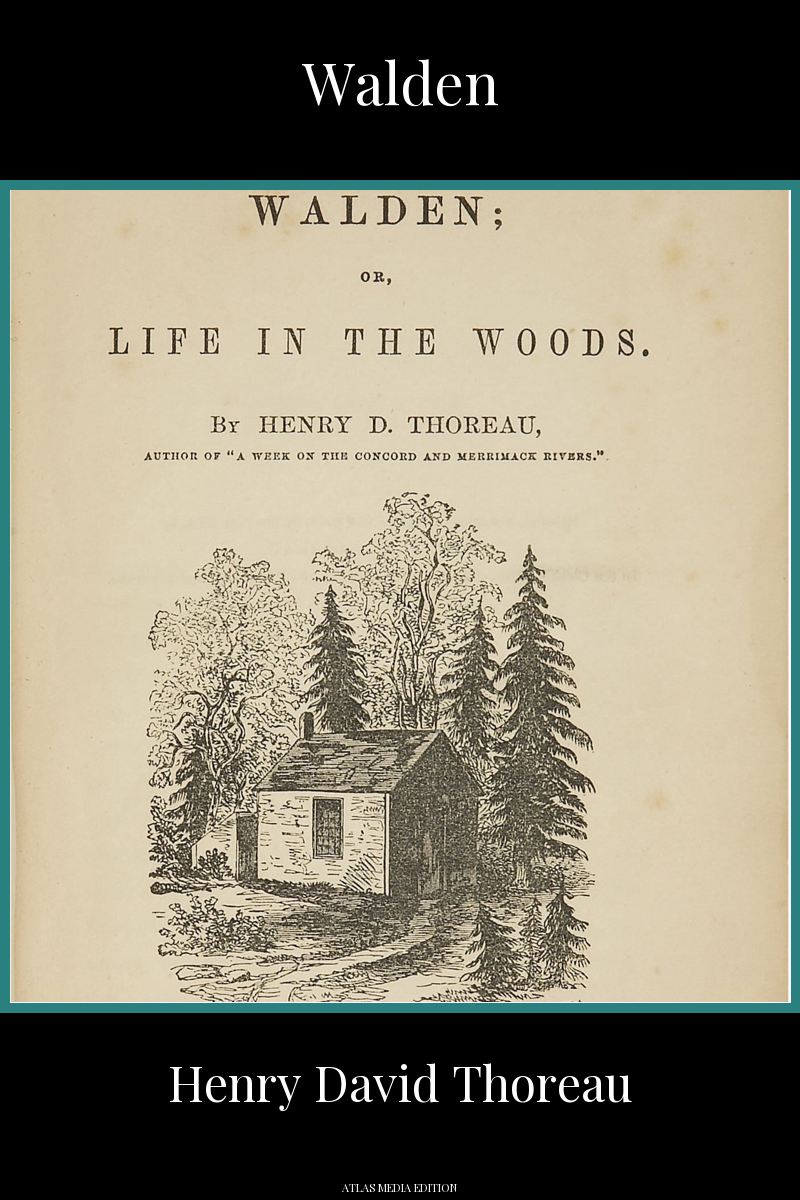
- Novel
Walden
- Published: 1854
- Atlas edition: V1.3 ·
- Language: English
ABOUT THE AUTHOR
Henry David Thoreau
1817–1862Henry David Thoreau (1817 to 1862) was an American naturalist, essayist, poet and philosopher, and a leading transcendentalist.
He is best known for Walden, a reflection on simple living in natural surroundings, and for his essay Civil Disobedience, an argument for refusing to obey an unjust state. His writings on natural history anticipated the methods of ecology and environmental history.
ABOUT THE WORK
Walden
Walden is Henry David Thoreau’s account of the two years he spent living in a small cabin he built himself beside Walden Pond, near Concord, Massachusetts. Published in 1854, it is a reflection on simple living, nature and independence, and one of the classics of American writing. This Atlas Media edition also includes Thoreau’s essay On the Duty of Civil Disobedience.
Thoreau moved into the cabin on 4 July 1845. The land belonged to his friend and mentor Ralph Waldo Emerson. He stayed two years, two months and two days, though the book compresses that time into a single year, following the seasons from summer to spring.
The long opening chapter, Economy, sets out his purpose. Most people, he argues, spend their lives working to pay for things they do not need, and so lead lives of quiet desperation. He lists the exact cost of building his cabin, down to the nails, to show how little a person truly requires.
In the chapter Where I Lived, and What I Lived For, Thoreau explains that he went to the woods because he wished to live deliberately, to face only the essential facts of life and learn what it had to teach. He wants to strip life back to see what is left.
Much of the book is close observation of nature. Thoreau describes the pond in every season, its colour and clarity, the sounds of birds and animals, a battle between red and black ants, and the loon that dives and calls across the water. He measures the depth of the supposedly bottomless pond and records exactly when its ice forms and breaks.
He also writes about reading, solitude and visitors. He reads the classics, tends a field of beans, talks with a woodcutter and passing travellers, and walks to the village for news. He argues that solitude need not be lonely, and that the company of nature can be enough.
In winter he describes ice cutters harvesting the pond and the cracking and booming of the ice. In the chapter Spring, the thaw and the flowing sand and clay of a railway bank become an image of renewal.
In the conclusion Thoreau explains why he left: he had several more lives to live. He urges readers to explore their own inner world and to follow their own path.
WHY IT MATTERS
Why Walden matters
Walden matters because it asked, earlier and more memorably than most books, what a good life really needs. Its questions about work, possessions and time have found new readers in every generation, and they feel especially pressing in an age of constant consumption.
Simple living and Walden
Thoreau’s experiment was not a retreat from the world so much as a test of it. By keeping careful accounts and living cheaply, he tried to show that people could free themselves from much of the labour they accepted as necessary. Readers interested in sustainability, minimalism and self-sufficiency still return to his arguments.
Walden and the natural world
The book’s detailed observations of the pond and its creatures anticipate later ecology and environmental history. Thoreau is often cited as a forerunner of modern environmentalism, and his writing about nature combines scientific precision with poetic attention.
The essay Civil Disobedience, included in this edition, argues that individuals should not let governments override their conscience. Thoreau wrote it after spending a night in jail for refusing to pay a tax that would support slavery and war. It later influenced movements of non-violent resistance.
Thoreau is also funny. He mocks fashion, the newspaper habit, and the railway that everyone rushes to catch without asking where it goes. His humour keeps the book from becoming a sermon and invites readers to laugh at their own habits.
Walden can be read slowly, a chapter at a time. Its mix of practical detail, humour and lyric description rewards readers who share Thoreau’s wish to look closely and live deliberately.
Edition Record
- First publication
- 1854
- Textual basis
- Source text: Project Gutenberg, https://www.gutenberg.org/ebooks/205
- Atlas edition
- V1.3 ·
- Language
- English
Prepared from the recorded source and the reviewed Atlas working edition.
Accessibility: EPUB and PDF are offered where approved; accessibility features have not been independently certified.
Source & Rights
- Text source
- Project Gutenberg

Walden by Thoreau, Henry David. Source text prepared from Project Gutenberg ebook 205.